The Viennese Secession

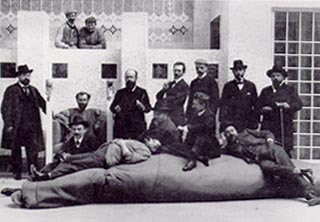
The Vienna Secession was founded on 3rd  April 1897 by several young artists in Vienna frustrated by the increasing conservatism of the Austrian Artists’ Society (Gesellschaft bildender Künstler Österreichs) housed in the Vienna Künstlerhaus. The founders were  Koloman Moser, Gustav Klimt, Max Kurzweil Josef Hoffmann, Joseph Maria Olbrich and Wilhelm Bernatzik.

kuenstler_history

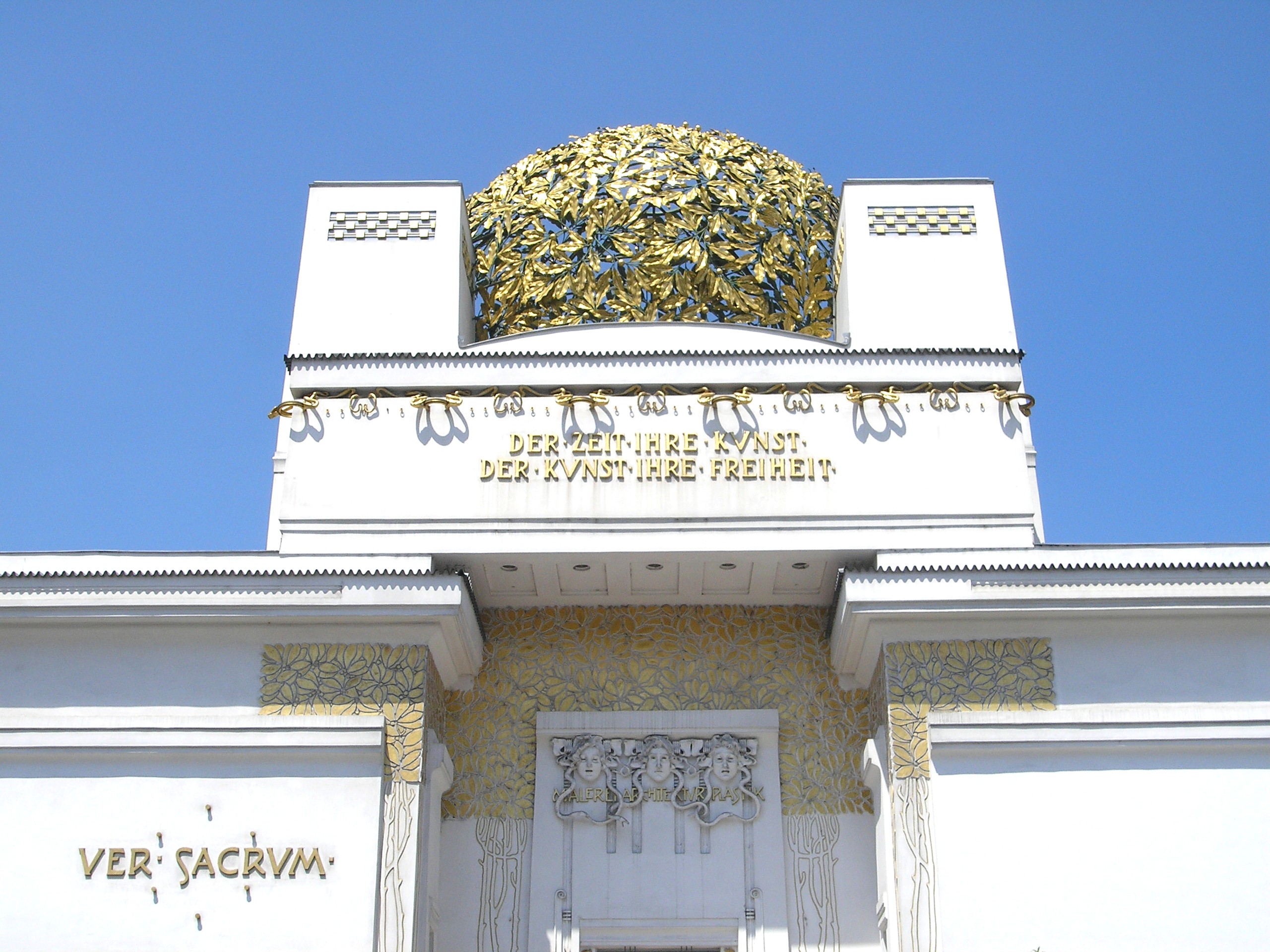
The Gesellschaft bildender Künstler Österreichs controlled the direction of art within Austria; and those forms were firmly rooted within Historicism. Innovation was not encouraged and young artists were expected to show deference to the hierarchy of the Gesellschaft bildender Künstler Österreichs. Moreover they controlled many of the grants and forms of support available to young artists. Many in Vienna looked to their fellow artists in the Berlin and Munich Secession movements and building on their successes created the Vienna Secession. However, unlike Berlin and Munich the Vienna Secession had no single defining art style. The aim of the Viennese Secession was to explore and embrace all forms of art outwith the narrow academic tradition. Their motto was ‘Der Zeit ihre Kunst. Der Kunst ihre Freiheit.’ (To every age its art. To every art its freedom.) This motto was placed above the entrance of their exhibition building.

OLYMPUS DIGITAL CAMERA

Although the Secessionists were free spirited and forward thinking they were not entirely out of keeping with the spirt of the age. Fin de siecle Vienna saw a multitude of new ideas and movements across the arts and sciences, philosophy and politics. While many proved ephemeral some, such as the work of Sigmund freud, would be extremely long-lasting and influential. The traditional rigidity of middle and upper class Viennese society made the establishment of the Secession all the more remarkable and their first exhibition in 1898 both shocked that traditional society and delighted the avant-garde.

Within the ethos of the Secession was a desire to bring all kinds and forms of art to the public and they developed a dedicated exhibition policy, which countered the establishment art exhibited by the Gesellschaft bildender Künstler Österreichs. One of their earliest triumphs was the exhibition which familiarised the Viennese to the work of the French impressionists. The work of the impressionists had been dismissed by the Gesellschaft bildender Künstler Österreichs as primitive daubs unworthy of the name art. But the Secession went beyond mere pictorial art; they blended and found complementarity in all art forms. Their fourteenth exhibition, designed by Josef Hoffmann, was dedicated to Ludwig van Beethoven. The exhibition had a statue of Beethoven by Max Klinger in the centre with a frieze of Beethoven’s life and music by Gustav Klimt mounted on the walls around the statue. The Viennese public were amazed by this approach and flocked to the exhibition.

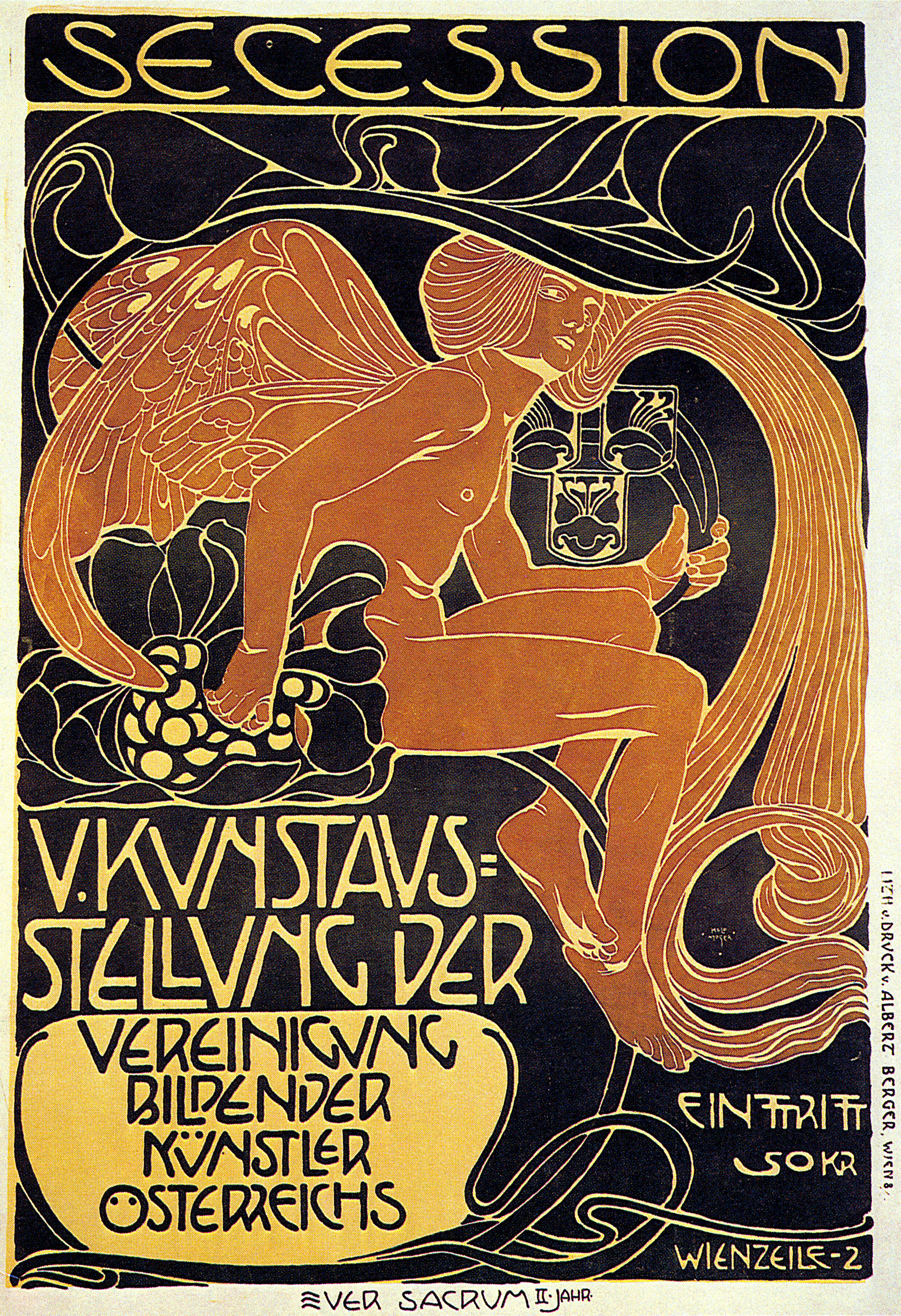
In 1898, the Secession built their exhibition house. Designed by Joseph Maria Olbrich, the  building became a visible icon of the movement and was known as die Sezession. Within die Sezession art was displayed from across Europe including the works of Charles Rennie Mackintosh, Max Klinger, Arnold Bocklin and Eugène Grasset. The group also produced a magazine, Ver Sacrum, which contained articles and debates about art and artistic concepts and was illustrated in a highly decorative manner.

vienna_secession_fifth_exhibition_poster

The Secession was not a static organisation but was ever evolving. Discussions about art, its form and application, and the place of art in society motivated many in the movement. In 1903, Josef Hoffmann and Koloman Moser founded the Wiener Werkstätte as a fine-arts society with the goal of reforming the applied arts. By 1905 differences in artistic concepts reached a head and Gustav Klimt seceded from the Vienna Secession taking several other artists with him.

With the loss of Klimt the Secession lost some of its drive and over the following years many of its original members drifted away to form other loose groupings or to work on their own. However, the influence of the Secession on the Viennese public was such that the dominant influence of the Gesellschaft bildender Künstler Österreichs on Viennese art had been forever broken and the art world revitalised.

——-oOo——-

Posted in Uncategorized | Leave a comment

Anita Berber: dancing on the edge of a volcano

Posted in Uncategorized | Leave a comment

The Premonstratensians in Bohemia

strahov-budova

The Premonstratensians, also known as the Order of Canons Regular of Prémontré, or the Norbertines, were founded by Norbert of Xanten in 1120 at Prémontré and received papal approbation in 1126. The Order quickly spread across Europe during the twelfth century. The Premonstratensians followed the Rule of St Augustine but Hugh de Fosse, who took over leadership of the Order from Norbert, introduced many elements from the Cistercian Order. Norbert had originally been ordained a subdeacon and had served at the court of Frederick of Cologne and later that of Henry V, Holy Roman Emperor.  He had avoided ordination as a priest until after a riding accident in 1115 when he underwent a conversion. After several years of itinerant preaching he arrived at Prémontré where he established the first Premonstratensian House in 1120. Norbert quickly left Prémontré under the control of de Fosse and continued his preaching finishing up as Archbishop of Magdeburg in 1126.

The establishment of the Premonstratensian Order came about against the backdrop of the Canonical Reform of the eleventh and twelfth centuries.  The Lateran Synod of April 1059 had promulgated an Easter message of new awakening life for the Church. The canons of cathedrals and other chapters were to be called to live a true ‘apostolic way of life’. After his conversion Norbert had resolved to live the ‘Vita apostolica’ by preaching and gathering like-minded followers about him which then developed into the Premonstratensian Order.

The order developed somewhat differently in Western and Eastern Europe. It should be noted that at that time Eastern Europe meant the German states. Lands further east of German states were perceived as ‘other’ and ‘foreign’, at best Orthodox and at worst pagan. The western houses saw Prémontré as their mother house while the houses in Eastern Europe especially those around the eastern German states recognised Magdeburg as their spiritual head. This division was exacerbated by the papal-imperial conflict and resulting schism of 1160-1177. Prémontré and the western houses faithfully followed Pope Alexander III however the houses of the Empire recognised the antipope Hadrian IV.  During this period efforts to centralise the Order were initiated with individual houses being assigned to groups known as circaries with a subsequent reduction in the importance of visitations by the father Abbot to daughter houses. Alexander III decreed that the abbot of Prémontré was the father abbot of all Premonstratensian Houses.  This decree was ignored by the eastern houses and after the schism divisions remained with the eastern houses no longer sending their prelates to attend general chapters. The eastern houses also continued to resist attempts at centralisation of the order with missives from Prémontré quietly ignored. This lack of unity even extended to titles as western houses adopted the French tradition of calling their superior ‘abbot’ while eastern houses called their superior ‘provost’. The religious focus of the houses also differed. The western houses tended to be more contemplative in their focus. The eastern houses, while providing a contemplative communal way of life for the Canons, focussed more on the active preaching activities of the Order. However, despite these differences both east and west appear to have thought of themselves as one international Order.

As they followed the Augustinian rule the Order had relatively modest requirements which, in Western Europe, allowed benefactors of modest means to establish Premonstratensian Houses. Houses could be established relatively quickly and Western Europe saw a rapid spread of the Premonstratensians in the middle of the twelfth centuries, e.g. the first house was established in England in 1143. By the end of the twelfth century Premonstratensian Houses were found in England, Scotland, Wales, Ireland, France, the Low Countries and Italy. Most houses in Western Europe were sited in relatively remote rural locations and once established were relatively self-contained.

Eastern Europe also saw a rapid spread of Premonstratensian Houses, albeit along somewhat different lines from those in the west. Houses were established by the lower nobility but also by bishops and princes. Rural houses were matched by those in urban locations and by the end of the twelfth century there were Premonstratensian Houses in Saxony, Westphalia, Thuringia, Bavaria, Rhineland Palatinate and Austria.

In Bohemia the Premonstratensian Houses appear to have been founded by a combination of the ruling Dukes and Bishops as well as more minor nobility. In addition the Houses appear to been generally found beside urban developments although there were some in rural locations. The diocese of Bohemia was under the Archbishopric of Mainz and many of the clergy in Bohemia were German or of German origin. As a result there was a relatively strong German influence in ecclesiastical matters in Bohemia. It is unclear, however, whether that influence extended to the founding of Premonstratensian Houses in the Eastern   European model or if the houses in Bohemia developed a third different Slavic model and what implication this may have had for the political development of the Bohemian state vis-a-vis the Holy Roman Empire.

The Holy Empire Empire of the twelfth century dominated central Europe. Emperor Frederick I, Barbarossa, (regnal dates 1155-1190) was keen to restore the Empire to its previous prestige and power under Charlemagne. Barbarossa’s Italian campaigns and Crusades had implication across vassal states of the Empire not least in the matter of raising money to pay for such activities. Barbarossa also had to contend with unrest inside the empire mainly caused by the activities of Henry the Lion of Saxony. Bohemia was at that time an independent state, albeit one that recognised the overlordship of the Emperor. Located in the centre of Europe beside the Empire and at the axis of trading routes such as the Amber Road, Jantarová stezka, from the Baltic to the Mediterranean and routes from the Rhine eastwards to Silesia and beyond gave Bohemia a somewhat significant status in twelfth century Europe. Rich from its silver mines in Kutná Hora and trading centres such as Prague and protected by its mountains and forests from easy domination by the Empire Bohemia was both an attractive target for and a source of independent irritation to the Emperor. It is possible that the arrival of the Premonstratensians in Bohemia from Germany could have afforded an opportunity for greater German, i.e. Imperial influence in the Czech lands without the need for aggressive and expensive military action. German Premonstratensians could, for example, have facilitated the movement of money into the Empire. On the other hand the subversion of the Germanic Premonstratensian model into a more Slavic type could have allowed Czech resistance to and rejection of Imperial influence in a relatively non-confrontational manner and the development of a degree of religious autonomy with regards to the Empire without the apparent challenge of more overtly political elements.

From the current evidence it seems that both interpretations may  be correct; although the balance between German influence and Czech resistance appears to have changed over the years. The initial impetus does seem to be that of Imperial control with senior members of the Bohemian Houses coming from other German Houses and new recruits being supplied by Magdeburg. Once established, however,  the Bohemian Houses developed outwith Germanic control albeit slowly and with varying degrees of success. By the 14th century several of the Bohemian Houses were actively working in and integrating with their local communities despite the continued efforts of Magdeburg to influence their develoment.

The model of development chosen for the Premonstratensian Houses in Bohemia had political implications and the use of monastic houses as a powerbase for political leaders and as a powerful propaganda tool is well understood within medieval Europe. The politically and militarily strategic position of Bohemia meant that the development of holy orders was never solely a religious act. Within Bohemia  religion and politics were intertwined and as the middle ages moved into the Renaissance religious dissatisfaction with the Catholic church and the dominating influence of the Imperial Germanic states grew. By the 15th century Jan Hus and his followers were challenging both church and state and by the 16th century the reformation was firmly entrenched in Bohemia. Religious upheavals continued in the 17th century as Bohemia along with many German states bore the brunt of the thirty years war. During these troubled years the Premonstratensians  went into decline and were forgotten by many. In the 21st century the Premonstratensians remain active in Bohemia with several houses such as Strahovský klášter in Prague where their members continue to preach the Vita apostolica.

——-oOo——-

Posted in Uncategorized | Leave a comment

Medieval History on Film

Silver_mine,_Kutna_Hora

The portrayal of history on film has frequently raised tensions between academic rigour and cinematic vision. This tension is possibly best articulated by historians  who have spoken of films portraying how they imagined the past was lived rather than the reality.  However, whilst this tension remains film can give a ‘way in’ to history that can lead on a deeper understanding of a period. This is especially true of the Middle Ages, a society that was extremely visual and performative. Symbolic displays of wealth and power were ubiquitous from the gold plate and wall tapestries of the Dukes of Burgundy, to the public coronations of kings and popes across Europe. Stories were told visually in expensive illuminated manuscripts and simple painted church walls. What better medium therefore than film to shine a light on the medieval past? The tension between cinematic vision and historical rigour should not be ignored, however it could be argued this tension is less problematic that at first sight and that with the use of visual imagery and story telling the positive understandings of medieval history that can be gleaned from films outweighs the concerns of some academic historians.

Two films about the medieval world, Becket, a British/American film from 1964 and Údoli vcel (The Valley of the Bees) a Czech film from 1968, are examples of the potential of understanding. The film Becket is loosely based on the actual story around the friendship of Thomas Becket and Henry II in 12th century England while Údoli vcel is a fictional tale of a man who as a young boy is forced into a religious order and his relationship with an older Teutonic Knight set in the Czech lands of the 12th century. Both films explore the relationship between the men and their interaction with the church. The films both end with the rupturing of the protagonists’ friendship and murder.

Looking at visual imagery it is interesting to note that the ‘division’ between film and academic textbook is not necessarily as clear cut as first imagined. Both Becket and  Údoli vcel build their stories using the visual imagery of film however,  books such as Geoffrey Barraclough’s The Medieval Papacy, published in 1968, is awash with images while there are countless papers published on the displays of wealth in the medieval courts and the use of visual images to portray status across medieval society. Images were an integral part of medieval life and the written history of that period reflects this and does not merely relegate discussions about objects and images to the confines of art history or other specialist and obscure disciplines. Imagery pervades the written history of the Middle Ages and it is these very images that lend themselves so well to film.

In one scene in Becket Louis VII of France has an audience with two English ambassadors while he is being seen by his tailor. As Louis says to one of his own courtiers before the entrance of the ambassadors, ‘it will demonstrate to the English their exact social status in our court’. There is no evidence that this scene ever actually took place. However, what it shows is the medieval use of expensive clothing to display wealth, power and status. But the scene has a double meaning. As Louis displays his status to the English within the scene so the film shows Louis’ status and his display of that status to the audience. The scene in the film is a perfect modern mirror of its medieval counterpart that can occur only using a visual medium.

This mirroring is also seen in Údoli vcel in a scene where one of the Teutonic Knights, who had broken the rule of the Order, is executed in a brutal manner. The scene shows the knight stripped of his robes faced with several members of the order who symbolically snuff out the candles they are carrying and turn their backs on their former brother.  They do not see his actual death. The former knight steps backwards through a trap door and falls several feet into an enclosure where he is mauled by dogs. However, the camera stays at a distance and the audience, like the knights, do not actually witness the death. Similarly, both the audience and the brothers hear the sounds of the dogs, the tolling of the death bell and the Latin chanting but are both one step removed from the action but fully aware of the significance of these sounds. The fact that the medieval church forbade the spilling of Christian blood by its own members and thus would use secular authorities or other means, in this case dogs, to carry our execution is vividly and memorably illustrated in this scene.

Using pictures to tell a story has a long history within human society. The cave paintings in the Dordogne are estimated to be about 17,000 years old. And this story telling is seen very clearly in the case of the medieval church. Church walls were painted with scenes from the bible which were thought to be historically true. (It can be argued whether this was actually believed by everyone but that is a matter for another discussion.) So telling historical stories with pictures is not a new phenomenon. It could possibly be argued that the only thing that is new is that the images are moving. Yes, in the 21st century, there are huge technological advances but the basic story telling is the same now as it was in the 12th century.

Becket shows the enthronement of the Archbishop of Canterbury. The audience sees the cathedral, the procession, the robes, the laying on of hands, hears the music, the Latin prayers and ‘Becket’ prostate on the ground. This is not a short scene but lasts for just under five minutes but still manages to hold the audience’s attention. Without a thorough knowledge of Medieval Catholic Church ritual in what other medium could such a sense of what that ceremony would have been like be gained? The detail may not be exact but the overall effect is to inform the audience of the magnitude and importance of the ceremony and in that, it could be argued, the film Becket succeeds where many a textbook does not.

In Údoli vcel an early scene shows a fight between the knights and some colliers over a sword. While the scene itself is imaginary the portrayal of the poor colliers with wooden staves fighting two heavily armed and militarily trained knights evokes clearly the overwhelming difference in their status and the desperate poverty of the colliers that drives them to commit such a risky act. As in the Becket scene although some of the exact detail may be incorrect the audience gains a clear understanding of the perilous nature of existence for the peasantry in the Czech Lands of the 12th century where an opportunity for gain however slight, and however dangerous, has to be seized.

These two scenes, these visual displays, evoke an understanding of the medieval world that a dry recitation of facts or the reading of some academic papers can seldom generate.

While it would seem that medieval history is a perfect match for film the tension between academic rigour and cinematic vision remains. Historians are in the business of ‘demystifying’ history while film uses a ‘linear narrative’. But are these different approaches necessarily in conflict? While present day historians may see the ‘new’ construction of history on the screen as artificial so the ‘old’ construction of history on the written page could be equally seen as artificial to previous generations for whom history was based in the oral tradition. Does this then mean that the tension between academia and film is redundant? Perhaps that is a step too far? It is doubtful if anyone in the 21st century would argue that history is the sole preserve of the academic historian. And equally there are probably very few academic historians who would wish to set themselves up as the history police. However, as facts without imagination can produce history of the dullest variety so imagination without facts does not produce history at all. The tension between academic rigour and cinematic vision is not a negative check on new innovations within history but a positive spur to the production of better history: the maintenance of intellectual rigour acts as ballast to cinematic and imaginative vision. The ‘linear narrative’ when derived from the historians’ rigour allows the audience an understanding of the historical event or era that can be complementary to the written text rather than undermining it. The tension that exists can be a positive driving force if only academic historians would embrace it. Allowing for some of the wilder imaginings found in the likes of Braveheart most audiences watching historical films recognise the difference between what they see on the screen and academic history. There is no need therefore to take that positive tension and inflate it into an unbreachable divide.

Criticism of historical film is all too easy for academic historians, and in many cases it is all too deserved. There are historical films that not only promote the story over the facts but actively distort the facts for the sake of the story. But other than a desire that films ‘adhere to the facts’ few other constructive ideas are ever forthcoming from academic history. In the case of medieval history films, while adherence to the facts is to be strongly promoted, perhaps historians should learn to occasionally put away their beloved textbooks and manuscripts and re-engage with the visual images and story-telling that would have been familiar to their 12th century forbears. The manipulation of imagery has come a long way since the 12th century. As have audiences. The credulous belief in the stories painted upon a church wall has evolved into a sophisticated ability to tell reality from fiction. Medieval history films, when produced with a sense of respect for that sophisticated audience, can surely take their place with others as a valid form of history telling. The relationship between film and the historical period they depict and the times that produce them is complex and that complexity should not be denied. However, if we can retain our critical senses and remain aware of the tension between cinematic vision and historical rigour then the historical truths contained in medieval history films such as Becket and Údoli vcel can in their own way contribute to historical discourse.

——-oOo——-

Posted in Uncategorized | Leave a comment

Wroclaw: Politics, religion and economics

Bresslau-Wroclaw.Nuremburg1-e1321478861776

The development of the town of Wroclaw in Poland from the eleventh to the fourteenth centuries was the result of the combination of a particular set of political, religious and economic elements. These elements were, individually, not unique to Wroclaw but the particulars of their combination and interaction uncovers the complexities of Wroclaw’s development and its influence across Silesia.

In 1096 Zbigniew, the natural son of Duke Władysław, became involved in a plot against Sieciech, the Voivode of Cracow. A group of discontents captured Zbigniew, took him to Wroclaw and promised that he would inherit the lands of a Baron Magnus if he joined with them. The plotters pleaded with the chief citizens of Wroclaw for support. Władysław on hearing of the situation sent several envoys to negotiate, unsuccessfully, with the citizens of Wroclaw. Władysław then marched on Wroclaw and was met with a delegation led by the bishop and finally negotiations ensued. Zbigniew fled from Wroclaw to the town of Kruszwica. The importance of the town and respect for the local elite had led to Wroclaw being chosen as the town from which to launch the revolt in the first place and had been the reason for Władysław negotiating rather than simply attacking the town leaders. The elite of Wroclaw were men to be dealt with on relatively equal terms not merely small towns men to be bullied or attacked. In contrast there was no negotiation at  Kruszwica where Władysław attacked his son even though Zbigniew had, by that time, Pomeranian and Prussian forces at his disposal.

In 1244 Wroclaw was involved in yet another dynastic feud. Bolesław and Henry, two of the sons of Henry II the Pious, received Wroclaw and Legnica respectively as part of their inheritance when their father died. Bolesław disputed the settlement and swapped his land with Henry giving up Wroclaw for Legnica which he, Bolesław, believed to be superior. However, Bolesław then regretted the swap and wanted Wroclaw back. This dispute quickly became part of the overall dynastic feuds being played out at the time. While it could be argued that this dispute was merely the usual arguments over the acquisition of land by medieval rulers keen to promote their own status and prestige, it is noticeable that both Bolesław and Henry appear prepared to spend considerable time and resources in securing Wroclaw for themselves over a period of some eight years.

But why was Wroclaw so desirable? Wroclaw had became a Bishopric as early as 1000 and soon became firmly established as the alternative power player to the Ducal court. By the twelfth century the bishopric was strong enough to see the building of several new churches under the Patronage of Peter Wlast and in 1149 Walter de Malonne was appointed bishop. During de Malonne’s tenure the territorial possession of the Bishopric were confirmed by Pope Adrian IV.  In the matter of the confirmation of the territorial claims of the bishop the claims of other landowners would have had to have been rejected no doubt raising tensions between those whose land was given back to the church and the bishop.
de Malonne was ambitious and campaigned on the issue of lapses in conduct by his fellow clergy. The campaign against the lapses of the clergy was part of the Canonical Reform of the eleventh and twelfth centuries. The Lateran Synod of April 1059 had promulgated an Easter message of new awakening life for the Church. The canons of cathedrals and other chapters were to be called to live a true apostolic way of life. de Malonne’s territorial authority and clerical campaigns were, by their very nature, not universally popular amongst the clergy or landowning families and in both cases de Malonne faced opposition. However, known for his force of personality he ignored the challenges from the local elites and remained as bishop for some twenty two years.

Bishop Thomas II was  a similarly strong bishop. In 1284, Duke Henryk IV Probus required money for his political campaigning and sought to raise funds by making ‘unlawful demands on Bishop Thomas and the clergy of Wroclaw’ for money. The bishop refused and Duke Henryk seized his property, ejected ecclesiastical officials and demanded all tithes to be paid to him. Bishop Thomas stood firm and after some fruitless personal negotiations applied to the Archbishop of Gniezno who placed Wroclaw under interdict in 1285. The Duke ignored this and expelled the bishop. The bishop left Wroclaw to live in exile in the town of Racibórz under the protection of Duke Casimir. Henry demanded that Casimir expel the bishop and laid siege to Racibórz in 1287. Thomas then dressed in his finest ecclesiastical robes and led a procession out of the town and down to Henry’s camp when Henry was suddenly ‘seized with fear’ and prostrated himself on the ground in front of Thomas.
It is curious that Henry appeared unwilling to allow Thomas to live quietly in Racibórz; perhaps he did not want to lose face in front of other dukes. But the  fact that he was willing to continue this dispute over three years and to the extent of bringing siege warfare against his own bishop demonstrates the position and authority of Thomas. One does not expend time and money on someone of no consequence. However, Henry appears to have been equally matched by Thomas’ willingness to defend the dignity of the church rather than quietly acquiesce with the Duke. The final event in the dispute is a quintessential piece of medieval performative politics. When Thomas in his full ecclesiastical regalia and vestments processed out of Racibórz into the camp of his enemy he was undertaking a very public display of the authority of the church. Thomas could regain his position either as the living bishop or as a dead martyr for Wroclaw. In either event the authority of the church would be enhanced at the expense of the Ducal power.

In addition to the court and the church the third element in Wroclaw’s development was trade. Initially trade was probably restricted to the movement of goods and raw materials from its own hinterland however this soon expanded due in no small part to Wroclaw’s geographical location. In the twelfth century Wroclaw was a conveniently situated transit point for merchants from Prague travelling east and for Baltic traders travelling south. Wroclaw gained from the provision of hospitality, taverns and stabling and the like, but also in the trade of some local goods to merchants travelling further afield. Trade developed as the many religious orders moved into the area and engaged in agriculture and mining and as artisans and merchants engaged in secondary trades also migrated attracted by the economic opportunities.

By the thirteenth century Wroclaw’s economic opportunities included international trade. Traders from Wroclaw were noted in towns and areas such as Kiev, Regensburg, Munich, the Netherlands, Northern Italy and Venice. Wroclaw merchants traded fur pelts for luxury items such as spices and silks.  Records from Florence in 1299 and 1300 show credit notes from the Frescobaldi bank to a Wroclaw trader, David, for the transportation of furs and reimbursements of expenses. Trade continued to develop and by the fourteenth century Wroclaw was importing luxury items such as silk, taffeta, pepper, ginger, saffron, figs and raisins. Myśliwski’s investigations outline not only the extent of Wroclaw’s foreign trade connections but also the sophistication of that trade. The reimbursement of expenses to the Wroclaw trader indicates the involvement, at least at some level, with the complexities of the Italians banking system. In addition the volume, type and number of goods traded suggests a home market that must have been used to and was able to afford such luxury items; in other words an advanced economy.

One of the major changes that helped that advanced economic to develop was the adoption of Magdeburg Law by Wroclaw in 1261. Magdeburg Law, which had originated as a set of German town laws, was implemented slightly differently in Poland from the original German format incorporating local civil and criminal law codes. Interestingly Davis and Moorhouse raise the possibility that Wroclaw was incorporated before 1261. Documents from the Abbey of Trzebnica in 1242 describe Wroclaw as an ‘incorporated city’ and the planning for the Market Square could possibly push incorporation back as far as the 1230s. Nevertheless, Magdeburg Law was adopted in 1261. German became the official language of administration and many German and Jewish merchants were encouraged to settle in Wroclaw. Trade was regulated within Wroclaw to favour local traders with restrictions placed on foreign merchants. Trade guilds were established under a grant from Duke Henryk Probus and by 1272 membership of a guild became mandatory for every ‘Christian merchant and craftsman’. Experienced artisans and merchants became elders within the guilds loyal to the City Council. However, over time these elders started to form a ‘patrician elite’ that held considerable influence on the City Council. The increased wealth generated by Wroclaw’s traders and artisans allowed the elders to acquire a certain level of political power within the council; a political power that presumably allowed them a degree of independence from complete domination by court or church.

The interaction between court, church and trade drove Wroclaw’s development and influenced other Silesian towns. The political machinations of the Piast dynasty frequently saw disputes over the right to rule Wroclaw; a right which was presumably worth fighting over due to the role as the seat of power of the Silesian dukes, the prestige of its existence as a Bishopric and the wealth generated by its trade. Within medieval Silesian many of the clergy were related to the leading families as the church offered a career for those younger brothers unable to inherit and build up a retinue in the secular world. The church was also an extremely important element in the trade of Wroclaw. Several monastic orders arrived in Wroclaw in the early to mid-twelfth century including the Benedictines and the Premonstratensians who became wealthy landowners indulging in agriculture and related trades, the Augustinians, who started breweries and the Cistercians who mined gold and silver at Lubiąż. This list indicates not only a lively religious milieu but one in which the monastic orders were actively involved in economic development. These economic developments attracted migrants, who settled and expanded local small communities which soon became incorporated into the city itself. For example the Augustinians, who had arrived at the request of Bishop Walther, brought Walloon artisans with them when they first moved to Wroclaw.

Politics also played its part in economics. For example, in 1355 Wroclaw was under the rule of Charles IV of Bohemian who pursued an actively pro-Italian policy. This resulted in favourable terms being extended by the Doge of Venice to all of Charles’ subjects including traders from Wroclaw. However, this positive influence was counterbalanced by the opposition from Austrians to allow Wroclaw merchants to travel through their lands to Venice. This opposition could have been due to the economics trade which the Austrians were losing or could have been a political challenge to the Bohemians by the Hapsburgs. It is, however, most likely to have been a combination of the two.

One component of Wroclaw’s development that runs through the political, religious and economic elements is the changing ethnic mix within the city. The earliest religious orders brought Germans and Walloons into Wroclaw and this influx was further expanded by the arrival of Jews attracted by the mercantile opportunities offered by Wroclaw. As early as the eleventh century Jews were involved in land transactions around Wroclaw. The church in Wroclaw seems to have been reasonably relaxed with regards to the Jewish population in its community with little evidence of the implementation of the restrictions on Jews laid down at the fourth Lateran Council of 1215. These restrictions only appear to have come into play after the Synod held in Wroclaw itself in 1267. While it is not known why the church in Silesia was so slow to implement these restrictions the economic benefits derived from Jewish trading may have played its part.

Several Polish towns, such as Kraków, Minsk, Poznań, Łódź, adopted Magdeburg Law using the ‘settlement with German law’ as seen in Wroclaw. While many towns implemented the law using local derivations Wroclaw was an important influencing element on towns in Silesia and further afield with regards to the incorporation and implementation of the law. A further feature where Wroclaw led and Silesia then followed is in the forging of trade routes. Wroclaw’s merchants required furs to trade; furs which were supplied from across Silesia. In time these commodities were followed by traders from Silesian towns such as Strzegom.

Between the eleventh and fourteenth centuries politics, religion and economics drove the development of Wroclaw aided by an ethnically mixed population.It was the interactions between the political, religious and economic elements that were important in Wroclaw’s development and gave it its pre-eminent place in Silesia which could not help but affect the development of other towns in the region. Where Wroclaw led Silesia followed.

——-oOo——-
Posted in Uncategorized | Leave a comment

The rule of the Přemyslovci: revolt and unrest in medieval Bohemia

220px-Dux_Fridrich


Between the 9th and 12th centuries the Czech Lands were ruled by a series of dukes from a single family the Přemyslovci.

The first member of the Přemyslovci to rule Bohemia was Bořivoj I  in  870.
Between 870 and 1198 the chronicles list 52 adult male members of the Přemyslovci family of which 26 held positions of duke, 12 were vice-dukes and three held religious positions. Two of the dukes were promoted to king by the Emperor, three individuals held the ducal position twice, three dukes also held positions as vice-dukes and one individual, Jindřich Břetislav, simultaneously held the position of Bishop of Prague and Duke.
Initially succession was by primogeniture with the eldest son of a Duke succeeding his father and this position being confirmed by public acclamation by the leading Czech families usually at the castle in Prague. However, in 1055 Břestislav I called on the Czech nobility to recognise the eldest member of the dynasty as Duke. Břestislav himself was succeeded by his son, having no living brother, but thereafter succession by seniority was firmly recognised.

The form of landownership practised by the Přemyslovci had two interlinked elements to it. Firstly the duke as ruler of the Czech lands owned all the land. No other member of the family owned lands or estates although land could be gifted to them by the Duke. And secondly as the senior member of the Přemyslovci the Duke was responsible for everyone else in the family. Consequently all other members of the family were dependent on the duke for everything; from food and shelter to arranging marriages and providing dowries. However, this combination of the concentration of landownership and responsibility in the hands of a single member of the family gave rise to young men within the Přemyslovci frequently having fewer responsibilities than members of the leading families who ran estates. Young men, in other words, who were members of the ruling dynastic family but had a liminal status within the hierarchy of medieval Bohemia; and a liminal status that was public.
Within Bohemian society status and notions of manhood was gained and recognised by levels of wealth or landholdings or military prowess. However, the wealth of a junior member of the Přemyslovci was publicly known to be in the gift of the duke as was the holding of any estates. And although there were occasional skirmishes with the German marcher lords and the Poles opportunities for military activity were not guaranteed. So the status of young male Přemyslovci was not only liminal but could be thought of as emasculating.
By 1111 even the Duke had realised this and created the vice-dukedom of Moravia to assuage male pride amongst his male relatives. However the vice-dukedom remained in the gift of the duke and was not allowed to become hereditary as the Dukes feared it would become a powerbase around which rivals could gather.  In fact this proved all too correct an assumption as revolts were frequently launched from Moravia encouraged by resentment over the duke’s interference in the vice-dukedom. Resentment about the ducal control of Moravia stoked revolts; revolts proved the need for the dukes control.

The adoption of the rule of seniority by the Přemyslovci although removing the problems of rule by a minor or the lack of a male heir did produce problems.
There were obvious tensions which arose when for example the adult son of a dying duke could be passed over in favour of the younger brother of a duke. But the main issue was who was perceived as senior within the family by the leading nobility. Seniority was not necessarily granted by age or relation to the duke. Other members of the family who had built up a strong retinue and who were perceived to be a stronger individual could claim seniority. And as the ducal throne could only be claimed after a public acknowledgement by the leading Czech families. Then those with a strong retinue could and did challenge for seniority.

Within this seniority system of succession if a duke were to prove weak or unpopular he could be challenged by another senior member of the Přemyslovci dynasty aided by disgruntled members of the leading Czech families. Even were a duke to be strong and relatively popular the succession by seniority could gave rise to disputes when sons of dukes were passed over in the succession by their uncles who claimed the ducal position as younger brothers of a previous duke. As a result of this many Přemyslovcis used violent means against other family members either in an attempt to gain the ducal position or to prevent others from doing so.

Members of the Přemyslovci exiled, imprisoned, forced into the church, maimed and killed their male and sometimes female relatives. They did so to gain or retain the position of duke. This intra-dynastic violence appears, paradoxically, to have given rise to two different scenarios with regards to the Czech peasantry. Where two equally matched ducal contenders or an existing duke and challenger opposed each other extreme violence was employed on both sides. Family members attacked each other and their followers and laid waste to supporter’s lands. However, the violence usually arose after a new duke was proclaimed, was sporadic in nature and tended on the whole to be in response to perceived threats or actual violence from a challenger. In this situation dukes rarely held power for long, on average only 5 years and peasant life was subsequently disrupted by changes in political leadership, changes in taxation, disruption to trade, crop burnings, and battles.

In the case where one powerful individual arose violence was employed somewhat differently. Action was taken early in the ducal reign, usually within weeks of election, against potential challengers usually in order to pre-empt revolts and was carried out on a more continuous basis; but usually only against the individual family member and his closest supporters. In this case the duke eliminated rivals before they could raise support. As a result the duke held power for a considerable time. As violence was, generally, contained within the dynasty the Czech peasantry enjoyed a period of relative calm during these times.

Struggles for supremacy within ruling families were not unknown in medieval Europe. However, the combination of succession by seniority which also required the support of the leading Czech families and the lack of land holding by non-ducal members of the Přemyslovci gave those struggles a particular flavour in the Czech lands. Lisa Wolverton has stated in Hastening Toward Prague, ‘from the mid-eleventh to the turn of the thirteenth century, the men of the ruling dynasty were in almost constant conflict with one another’. (1) But while this constant conflict over the ducal throne engulfed the Přemyslovci men and women in sometimes extremely violent and bloody family battles there is one final particular point to note. The Přemyslovci ruled the Czech lands for some 328 years with only one break when the ducal throne passed to the Polish count Bolesław I Chrobry, who nevertheless was a Přemyslovci albeit by maternal descent and from a cadet branch. In those 328 years of public acclamation with the leading families never looked outside the Přemyslovci for their rulers. Where the leading nobility agitated politically or in open rebellion against the duke the rival contender supported by those leading families was still always a member of the Přemyslovci family.

(1) Wolverton Lisa., Hastening towards Prague; power and society in the medieval Czech lands, pp 100.


——-oOo——-

Posted in Uncategorized | Leave a comment

Anita Berber: dancing on the edge of a volcano

Anita


Weimar Berlin, 1919 until 1933, was an extraordinary era; a time when sexual, political and artistic freedom came together like never before or, arguably, since. Art forms that had been growing and developing in Germany, and Europe, from the end of the 19th century exploded as revolutionary ideas from Russia and ‘Americanism’ from the United States penetrated German culture. Dancers, artists, playwrights and poets struggled to understand and express through their art the horrors of the Great War and the chaos of the Weimar Republic. The Wilhelmian morality of the day, instituted by the kaiser, came up against the modern world and a Verwilderung der Sitten (degeneration of morals) swept across Weimar Germany, most notably in Berlin.

Anita Berber, who died on the 10th November 1928 aged only twenty nine, was the epitome of Weimar Berlin. Painted by Charlotte Berend and Otto Dix, she was an actress, a dancer and a poet who ended her life in a pauper’s grave in Berlin. She scandalised and challenged middle class German morality in equal measure. An Expressionist artist who frequently danced naked Anita interpreted music with every atom of her being. She inhabited her body in a way that was sensual and erotic. She moved in a way that disturbed the audience. Even those who flocked to see her and who spoke approvingly of her dancing still found themselves somewhat disconcerted by the emotions and sensations she awoke in them. This was the effect that Anita intended but that intention was completely natural and without artifice. However much Anita used her body as a work of art and carefully cultivated her image it was completely truthful. This was not an artist who put away the costume at the end of the performance; Anita’s whole life was a performance.

This was a woman who seduced married women away from their husbands; punched a German boxing champion in the face and almost got punched back; insulted the king of Yugoslavia and got called a ‘Serbian Pompadour’ and got banned by the International Artists Union but kept on dancing anyway. She was the great Berlin wild child who was called ‘totally perverted’ and who managed to be arrested or deported from practically every country in central Europe. Anita danced naked, gambled wildly and partied like no-one before, or arguably, since with a concoction of drugs that defies belief.

But Anita was also a vulnerable woman. She personified the German obsession with death. Abandoned by first her father and then, temporarily, by her mother in early childhood Anita grew up psychologically damaged. She searched all her life for her father’s approval and never received it. Like a child desperate for attention she threw tantrums and made bad choices. She was a flawed genius with a self-destructive nature who expressed that vulnerability and pain publicly. Her vulnerability and pain was there for all to see in her slim waif-like naked body. This was a woman who was unafraid to express her sexuality, unafraid to say she took drugs, unafraid to say she drank to excess. But this open expression of her life was a mask that hid the deep wounds. She lived life to excess as many did in Weimar Berlin. But with Anita it was more than that, it was always more. Her sexuality was frequently of a masochistic nature; her drug taking was equally to escape reality as to enjoy life. Her behaviour was destructive and nihilistic. But underneath that there was a vulnerability that touched the audiences – even if they were unable to say so consciously unable to consciously articulate why she had that vulnerability. And that gave her that spark of sympathy that gave even her wildest behaviour and performances the mark of human tragedy that followed her all her life.

Anita lived her life in raw emotion. There was no artifice with her and that gave her the strange mixture of strength and vulnerability and allowed the audience to engage with her and find her, for all she was a terrifying presence, a fragile, vulnerable beauty. The intense emotion that came from her was the truth. This was not a mere naked kabarett dancer; Anita Berber was an Expressionist artist who has never been equalled.

Anita’s dances included
Absinthe
Arabesque Duet
Astarte
Brahms Waltz
Candle
Caprice Espagnol
Cocaine
Czardas
Dance in White
Diana, the Huntress
La Masque
Legend of Dagobah
Lotus Land
Man and Woman
Morphine
Murder, Woman and hanged one
Narcissus
Pierretto
Pritzel-Figurines
Profane
Shipwrecked
Salomé Princess of Judah
Suicide
Telephone call 19-20
The Burr
The corpse on the dissecting table
The night of the Borgias
The Rose
The somnambulist and the convict
The woman with the seven masks
Three small dream marches
Vision

Anita’s appeared in twenty eight films
Das Dreimäderlhaus (1918) (The House of the Three Girls)
Dida Ibsens Geschichte: Eine finale zum Tagebuch einer Verlorenen von Margaret Böhme  (1918) (Dida Ibsen’s story: A finale to the diary of the lost girl by Margaret Böhme)
Die Nixen Königin (1919 ) (The Nixen Queen)
Die Reise um die Erde in 80 Tagen (1919) (Around the World in Eighty Days)
Anders als die Andern (1919) (Different from the others)
Die Prostitution/ Das Gelbe Haus (1919) (The Madam/The yellow House)
Peer Gynt (1919) Peer Gynt
Peer Gynt 2. Teil: Peer Gynts Wanderjahre und Tod (1919) (Peer Gynt – Part 2: Peer Gynt’s years of travel and death)
Unheimliche Geschichten (1919) (Tales of Mystery)
Nachtgestalten (1920) (Creatures of the Night)
Yoshiwara, die Liebesstadt der Japaner (1920) (Yoshiwara, the Japanese city of love)
Falschspieler (1920) (The Deceiver)
Der Schädel der Pharaonentochter (1920) (The skull of Pharaoh’s Daughter)
Der Graf von Cagliostro (1920) (The Count of Cagliostro)
Verfehltes Leben (1921) (Destroyed life)
Die goldene Pest (1921) (The Golden Pest)
Die Nacht der Mary Murton (1921) (The night of Mary Murton)
Lucifer (1921) (Lucifer)
Dr Mabuse, der Spielmann (1921) (Dr Mabuse, the Gambler)
Die von Zirkus (1922) (She from the Circus)
Schminke (1922) (Makeup)
Lucrezia Borgia (1922) (Lucrezia Borgia)
Die drei Marien und der Herr von Manana (1922) (The three Maries and the Lord of Manana)
Im Kampf mit dem unsichtbaren Feind (1922) (Fighting the invisible enemy)
Wien, du Stadt der Lieder (1923) (Vienna, City of Song)
Moderne Tänze (1923) Modern dance)
Irrlichter der Tiefe (1923) (Light from the Depths)
Ein Walzer von Strauß (1924) (A Waltz by Strauss)

She wrote three hauntingly beautiful poems
Orchids
Dreams
Longing

——-oOo——

kindlecover(1)

Available on Amazon – http://tinyurl.com/q8ox8nt

——-oOo——-

Posted in Uncategorized | Leave a comment

Max Reinhardt: the father of theatre direction

max-reinhardt-03

Max Reinhardt was the man who transformed the role of theatre director into what it is today and in so doing changed theatre for both performers and audience. Without Max Reinhardt the theatre of today would be unrecognisable.

Max Reinhardt, Maximilian Goldmann to a Jewish family, was born in Baden bei Wien, Austria-Hungary on September 9, 1873. His first love was acting in 1890 he started his studies at the Sulkowsky Theater in Matzleinsdorf. He started acting in Vienna and later at the Stadtheater in Salzburg with duties as an assistant director where he quickly made a name for himself. In 1894, he was invited to join the Otto Brahm’s company at the Deutsches Theater in Berlin. Although initially pleased at the recognition of his talent that this offer implied, Max was surprised and disappointed at the tone of Brahm’s productions. The naturalism that Brahm adopted was de rigeur across the theatrical world. However, Max felt that this naturalism had become stale and predictable. He continued working for the next few years chafing under the constant repetitious format on the stage.

In 1901 he co-founded Schall und Rauch (Sound and Smoke) a cabaret for experimental theater, renamed the Kleines Theater (Small Theater) in 1902. This was followed up with the establishment of the Neues Theater, which ran from 1902 until 1905. These two projects allowed him to continue working through his evolving philosophy of integrating stage design, costumes, language, music, and choreography into a complete piece of artwork, Gesamtkunstwerk. At that time the role of a director in the theatre was largely administrative. The director was responsible for ensuring that the actors knew their lines and followed the stage directions of the play. There was little opportunity or any expectation for the director to show any artistic interpretation of the work being performed. Max would explode this role giving directors in particular and the theatre in general a completely new artistic philosophy.

In 1902 Max seized the opportunity to implement his new philosophical approach into mainstream theatre. Working at the Kleines Theater, he directed a production of Oscar Wilde’s Salomé. Before production began Max read several translations of the Sophocles’ play before choosing the version by Hugo von Hofmannsthal as his guide. Using the von Hofmannsthal translation alongside Wilde’s play Max transformed the rehearsal room into a hotbed of discussion. He worked intently on the script and stage directions with his actors, most notable Gertrud Eysoldt who played the lead role. Rehearsals became more than just reading lines as Max and Gertrud discussed the characters and motivations. The performance stunned audiences and critics alike.

Max followed this success in 1903 with another Sopochels play where he furthered developed his style. In Elektra Max again worked with Gertrud Eysoldt in the title role. Again he looked at several translation of the original play for inspiration further developing the techniques he had pioneered in Salomé. He started to integrate the different elements within theatrical production; stage design, lighting, music and choreography, costumes. These elements, which had previously been seen as merely incidental and secondary to the actors, became important elements within the production complementing the action upon the stage.

The 1902 production of Salomé had been seen by Richard Strauss who had been struck by the use of von Hofmannsthal translation. In fact he was so impressed that Strauss approached von Hofmannsthal with the idea of a collaborative venture. In 1910 Strauss and von Hofmannsthal came together to produce Der Rosenkavalier. Working at the Dresden Opera House Strauss and von Hofmannsthal had intended to use Max as their director. Unfortunately the management of the Opera House refused and demanded the use of their in-house director. The first dress rehearsal was a disaster; Der Rosenkavalier was wooden and stilted, the script was in place, the actors knew their lines but something was lacking. Eventually the management agreed with Strauss and von Hofmannsthal and Max took over as director. He immediately started working with the actors developing their characters and drawing deeper meanings from the script. Der Rosenkavalier premiered on January 26 1911 to critical acclaim.

In 1905 Max started the Hochschule für Schauspielkunst ‘Ernst Busch’ drama school in Berlin, teaching his new techniques to up and coming actors and directors. In 1919 he opened the Grosses Schauspielhaus, (Great Playhouse), known as the ‘Theatre of the Five Thousand’, which included a large revolving stage. And in the early 1920s he built the two Boulevard Theaters on the Kurfürstendamm in Berlin. These theatres allowed him to stage several productions with the total theatre experience without any interference from theatre owners.

In 1920, working with Strauss and von Hofmannsthal, Max established the Salzburg Festival directing an annual production of the morality play Everyman. The festival showcased Max’ new approach in theatrical production. In 1929 the opportunity arose to increase his teaching but in a more formal setting than his Hochschule für Schauspielkunst ‘Ernst Busch’. The university of music and Performing Arts in Vienna approached Max in 1929 to develop a drama course.

Such was Max’ influence in transforming theatre that he was sought after by many companies to work with them. Between 1905 and 1930 he worked as director at the Deutsches Theater in Berlin, and between 1924 and 1933 he was director of the Theater in der Josefstadt in Vienna. At the Deutsches Theater Max brought another new innovative approach to the stage with the experiment in big theatre. The entire theatre space was utilised with scenes even invading the seating space of the audience. Actors and audience were integrated to create a total theatre experience.

When Hitler came to power in 1933 Max Reinhardt came under the spotlight of Joseph Goebbels and his propaganda ministry. He, therefore, took the opportunity when it arose in 1934 to visit Holywood. In 1938, he moved first to Britain and then permanently to the United States of America. His influence in European theatre was widespread and long lasting. He gave new impetus to actors and directors and challenged mainstream stage productions. He introduced new elements into theatre and performance and even today in the most unadventurous theatre productions the notion of motivation and character development are standard. He left a legacy that has enriched all within the theatrical world and entranced audiences to this day.

—oOo—

Posted in Uncategorized | Leave a comment

Esterháza-kastély: the Hungarian Versailles

Esterházy-kastély2

Esterháza palace in Fertőd, Hungary, is a large Rococo building built by Prince Nikolaus Esterházy.

In 1762 Nikolaus Esterházy succeeded to the family title after the death of his older brother Prince Pál Antal. Before his brother’s death, Nikolaus had generally lived apart from the court preferring to stay at his hunting lodge near the Neusiedlersee in Hungary.

In 1766, Nikolaus began the construction of a magnificent new palace on the site of his old hunting lodge.
The architects Johann Ferdinand Mödlhammer and Melchior Hefele both worked on the palace. The design of the palace was complex, incorporating elements from the palace at Versailles which the Prince had visited in 1764, and took several years to complete. The palace’s opera house was completed in 1768 (the first performance was of Joseph Haydn’s opera Lo speziale) followed shortly afterwards by the marionette theatre in 1773, and the fountain in front of the palace was finally completed in 1784. It is estimated that the construction costs topped 13 million Austro-Hungarian gulden.

Nikolaus Esterházy died in 1790 and was succeeded by his son Anton. Despite the obvious magnificence of the palace neither Anton nor any of his later successors had any interest in living in the palace. This may well have been due to the palace’s location. The palace was built near the south shore of the Neusiedler See, on swampy land, in a somewhat isolated location. The political advantage to the Esterházy’s of the existence of such a magnificent palace was lost as its isolated location rendered it almost invisible to the ruling families of the other European powers. The display of wealth and power involved in the construction and maintenance of large palaces remained an important element in European realpolitik. However, unlike in the medieval period when courts were mobile, the modern era had seen the great buildings of European power and wealth increasingly built in or near capital cities; Versailles, after all was situated within a day’s ride from Paris. Esterháza palace was just too far from Budapest and the centre of the court’s activities. In addition Esterháza was not the primary or ancestral home of the Esterházy family; that was Schloss Esterházy, a palace nearby, in Eisenstadt.

Despite its limited appeal to the Esterházy family the palace for several years had a leading role in European music as the home of Joseph Hadyn. In 1761, Prince Pál Antal offered Haydn the job of Vice-Kapellmeister, but he was quickly promoted to be in charge of the Esterházy musical establishment. In 1766, Haydn was elevated to full Kapellmeister.
Hadyn’s role was that of a ‘house officer’ within the Esterházy establishment and followed the family as they moved among their various palaces. Hayden lived on the palace estate at Eszterháza between 1766 to 1790 and wrote the majority of his symphonies for Prince Nikolaus’ orchestra.

Due to the isolated nature of Eszterháza many of the palace musicians, who were separated from family during their time there, suffered from loneliness and boredom. Hadyn had to contend with the prince’s demands for new and diverting music while attempting to support his increasingly frustrated musicians. Matters came to a head in 1772 when Prince Nikolaus, decided to remain at Eszterháza for the season. Not only did he intend to prolong his stay at Eszterháza by several weeks but Nikolaus’ announcement had come when the musicians had expected to hear that they would shortly be leaving.

Angry and upset by the news, the musicians approached Haydn. They were desperate to return to their wives in Kismarton but as servants of the prince could not leave without his permission. Haydn, recognised the delicacy of the situation and decided to appeal to the prince’s intelligence through a musical demonstration of the situation. Hadyn wrote a symphony during which each instrument stopped playing in turn. Each musician was ordered to snuff out the candle on his musical stand, pick up his sheet music and leave with his instrument in his hands after finishing with his phrase. Nikolaus understood the meaning behind the ‘farewell symphony’ and the day after the performance left Eszterháza much to the relief of the musicians.

Posted in Uncategorized | Leave a comment

The king in the mountain

Friedrich_I._Barbarossa_(Christian_Siedentopf,_1847)

Frederick I, who was born in 1122, was the Holy Roman Emperor from 1155 until his death in 1190. He was elected King of the Germans at Frankfurt in 1152, King of Italy in 1155, was crowned Roman Emperor by Pope Adrian IV in 1155 and was crowned King of Burgundy in 1178. An imposing figure with a full red beard, from which he gained the name Barbarossa, he was a skilled politician and superb military tactician. His life was one of military conquest and political success such that his death was not the end but the beginning of a legend.

Barbarossa first came to prominence when he took part in the Second Crusade in 1147 with his uncle, the German king Conrad III. Although the crusade was a failure Barbarossa distinguished himself in battle and won the confidence of the king. When Conrad died in February 1152, he named Barbarossa as his heir, instead of his own son the future Frederick IV Duke of Swabia. Only Frederick and the prince-bishop of Bamberg had been present at Conrad’s death. Conrad’s son was only six-year-old son and at Frankfurt on 4 March 1152 the German electors designated Barbarossa as the next king of the Germans. He was crowned King of the Romans at Aachen several days later, on 9 March 1152.
When Barbarossa became king he inherited a largely nominal title with little real power. The previous years of internal disputes, the passing of the royal title from one dynastic family to another and the power of the Papal states had rendered the German King relatively weak. The only potential benefit the king held was the wealth of the rich cities of northern Italy, which were still nominally within his power.o

Barbarossa wished to restore the status of the Empire and started by reinstating his authority over the 1000 individuals German states. He did so with a combination of flattery, concessions and threats. The smaller states quickly swore fealty to the Emperor and this soon developed into the majority of the German princes recognising Barbarossa’s authority. Once the German states were subdued Barbarossa turned his attention to the northern Italian states. Although nominally part of his lands these city states had enjoyed a degree of independence for several years; an independence they had no intention of giving up.

In October 1154 Barbarossa marched down towards the northern Italian cities. Milan, Tortona and Pavia were subdued by 1155. Barbarossa then approached Rome. The Pope, Adrian IV, was struggling with the forces of the republican city commune. Frederick joined forces with the Pope to allow Adrian to regain control of the city. On 18th June 1155, Adrian IV crowned Frederick I Holy Roman Emperor at St Peter’s Basilica, amidst the acclamations of the German army. The Romans, angered at the German king’s involvement in their city politics,  began to riot. Barbarossa used his troops to put down the revolt, resulting in the deaths of over 1,000 Romans. He then returned home to Germany.

On his return to Germany Barbarossa found several small rebellions in progress which he swiftly put down. Key amongst the squabbling German princes was Frederick’s cousin Henry the Lion. Although ostensibly loyal, Barbarossa recognised that Henry the Lion could be a powerful enemy.

When Barbarossa left Rome Pope Adrian IV felt threatened by King William I of Sicily. As a result Adrian granted William several territories that Barbarossa viewed as his. The relationship between Barbarossa and Adrian was further strained when a letter sent by Adrian suggested that the Imperial crown was a gift from the Papacy and that the Empire itself was a fief of the Papacy.  In June 1158, Barbarossa set out upon his second Italian expedition, accompanied by Henry the Lion and his Saxon troops. After the capture of Milan Barbarossa intended to deal with Adrian but before he could begin the pope died and two rival popes were elected, Alexander III and Victor IV; both of whom sought Barbarossa’s support. Barbarossa demanded that Alexander appear before him and recognise that the imperial crown and the Empire were not in the gift of the pope. Alexander refused and in 1160 Barbarossa Frederick recognised Victor IV as the legitimate pope.

In response, Alexander III excommunicated both Barbarossa and Victor IV and joined in an alliance with the Norman state of Sicily against the Emperor. Barbarossa ignored the alliance and moved to the northern Italian states to suppress the rebellion which was brewing at Milan. Once the northern cities were once more subdued he returned to Germany at the end of 1162.

On his return to Germany he had to deal with the growing conflict between Henry the Lion and a number of neighbouring princes. In addition Barbarossa sought to restore peace to the troubled states of the Rhineland, where he organised a magnificent celebration of the canonisation of Charles the Great (Charlemagne) at Aachen, under the authority of the Paschal III who had succeeded Victor IV.

In 1166, rumours reached Barbarossa that Alexander III was about to enter into an alliance with the Byzantine Emperor Manuel I. Barbarossa prepared to leave for Rome but his cousin Henry the Lion refused to assist his Emperor. In 1167 Barbarossa besieged the city of Ancona, which had acknowledged the authority of Manuel I and was also victorious over the Romans at the Battle of Monte Porzio. He then lifted the siege of Ancona and moved to Rome, where his wife was crowned empress and he received a second coronation from Paschal III. At this point a sudden outbreak of an epidemic threatened to destroy the Imperial army and Barbarossa withdrew to Germany.

While Barbarossa was in Germany the northern Italian cities started to rebel again and  in 1169. Barbarossa made his fifth expedition to Italy. Yet again Henry the Lion refused to help. Barbarossa was opposed by the pro-papal Lombard League which was joined by Venice, Sicily, and Constantinople. Barbarossa was defeated by the Lombard League Alessandria in 1175. This was followed by another heavy defeat at the Battle of Legnano near Milan, on 29 May 1176, where he was badly wounded. Ever the pragmatist, Barbarossa begin negotiations for peace with Alexander III and the Lombard League. In the Peace of Anagni in 1176, Frederick recognised Alexander III as pope, and in the Peace of Venice in 1177, Frederick and Alexander III were formally reconciled. Barbarossa acknowledged the Pope’s sovereignty over the Papal States; Alexander acknowledged the Emperor’s overlordship of the Imperial Church.

Frederick had not forgiven Henry the Lion for failing to come to his aid in 1174. Using the open hostility of several of the other German princes to Henry’s power and territorial gains, Barbarossa had Henry tried in absentia by a court of bishops and princes in 1180. Barbarossa declared that imperial law overruled traditional German law and Henry was stripped of most of his lands and declared an outlaw. The Lion was sent into exile for three years but after his return was no longer a threat to Barbarossa.

In 1188 Barbarossa embarked on the Third Crusade. Barbarossa led his army through Hungary, Serbia, and Bulgaria before entering Byzantine territory and arrived at Constantinople in the autumn of 1189. After some time spent in Constantinople the Crusaders pushed on through Turkey. On June 10th 1190 Barbarossa and his men reached the Saleph river. The bridge across the river was crowded with troops and camp followers so Barbarossa decided to walk his horse through the water instead. The Saleph river has a strong current which overpowered his horse; Barbarossa was in full heavy armour and was unable to swim to safety; he may even have had a heart attack. Whatever the full reason, he died in the river despite the best efforts of his men to save him.

Barbarossa body was preserved in vinegar but this was largely unsuccessful. His body was buried in the church of St Peter in Antioch, his bones were interred in the cathedral at Tyre and his heart was buried in Tarsus.

For such a man to die in such a way ran counter to his life. Barbarossa was the sort of man that should have died in the midst of battle, sword in hand. Or perhaps stabbed through the heart by an assassin’s blade. But certainly not drowned in a simple river crossing. And because of the ignoble nature of his death the legend soon arose that he did not die. Barbarossa, is the king in the mountain. He is not dead, but asleep with his knights in a cave in the Kyffhäuser mountain in Thuringia or Mount Untersberg in Bavaria. Great black ravens fly round the mountain top guarding the king and keeping a watch out for danger. Barbarossa sits at his great table with his knights and his red beard has grown through the table at which he sits. His eyes are half closed in sleep, but now and then he raises his hand and sends a boy out to see if the ravens have stopped flying. For legend says that when the great black ravens cease to fly around the mountain Barbarossa will awake and rise with his knights and ride out to restore Germany to its ancient greatness

—oOo—

Posted in Uncategorized | Leave a comment