Count Karl von Stürgkh: Friedrich Wolfgang Adler

On the 21st October 1916 Count Karl von Stürgkh was murdered by Friedrich Wolfgang Adler.

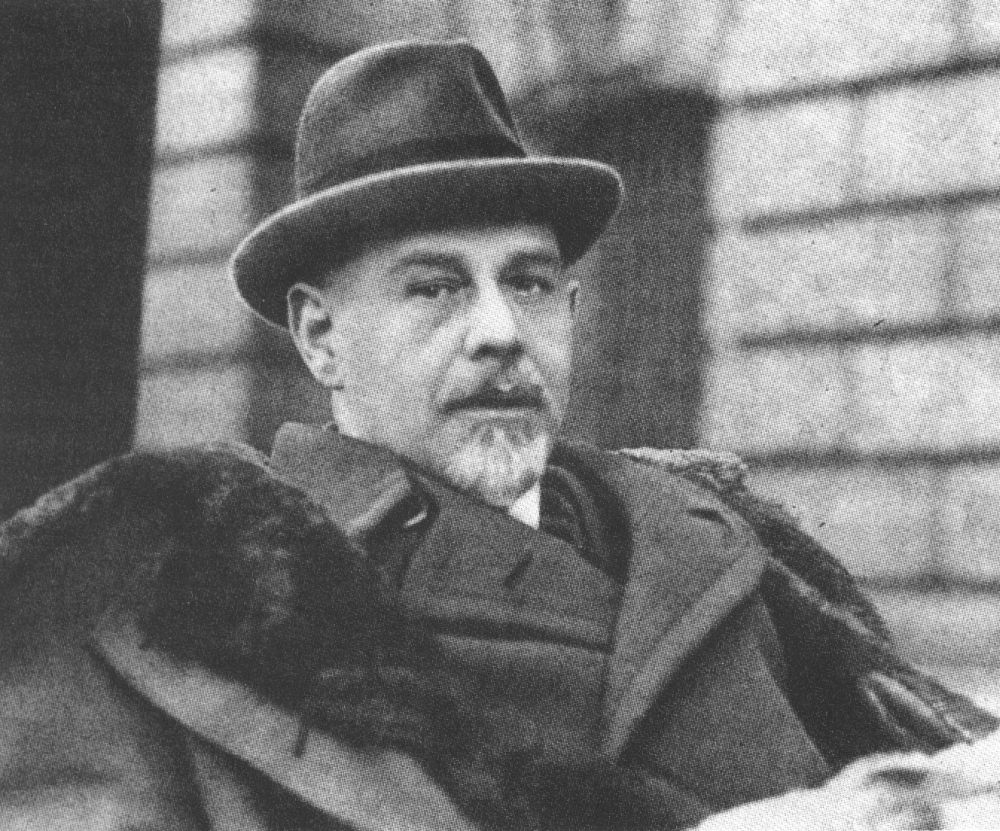
Stürgkh, whose family originated from the Upper Palatinate, had been born on 30th October 1859. The family owned vast estates in the Halbenrain region of Südoststeiermark in the Austrian state of Styria. The family had longed served the Habsburgs and Stürgkh was elected a member of the Austrian Imperial Council in 1891.
sturgkh

Count Karl von Stürgkh

A well respected politician in Imperial circles, Stürgkh served as minister for education in the cabinets of Count Richard von Bienerth-Schmerling and Paul Gautsch von Frankenthurn between 1909 and 1911. Internal problems in the Dual Monarchy caused increasing unrest and by 1911 rising food prices had resulted in several demonstrations which grew increasingly violent. Socialists called for radical change and eventually several riots broke out in Vienna. Revolutionaries burst into the parliamentary debating chamber and started shooting at conservative members. Stürgkh was unhurt although he had narrowly missed being injured. Gautsch resigned and Emperor Franz Joseph appointed Stürgkh Austrian Minister-President on 3rd November 1911.

Stürgkh had been outraged by the civil unrest and gave little credence to the claims of socialists. He ruled the lands of Cisleithenia autocratically taking as his guiding principal the paternalistic but supreme power of the Habsburgs. Between 1912 and1914, when the situation in the Balkans continued to deteriorate, Stürgkh became closer to the ‘war party’ in Vienna. Opposed by the socialists, and others in the ‘peace party’, Stürgkh became frustrated by their attempts to raise their concerns in the imperial council. On 16 March 1914 Stürgkh adjourned the meetings of the Imperial Council and allowed laws to be passed by emergency decree.

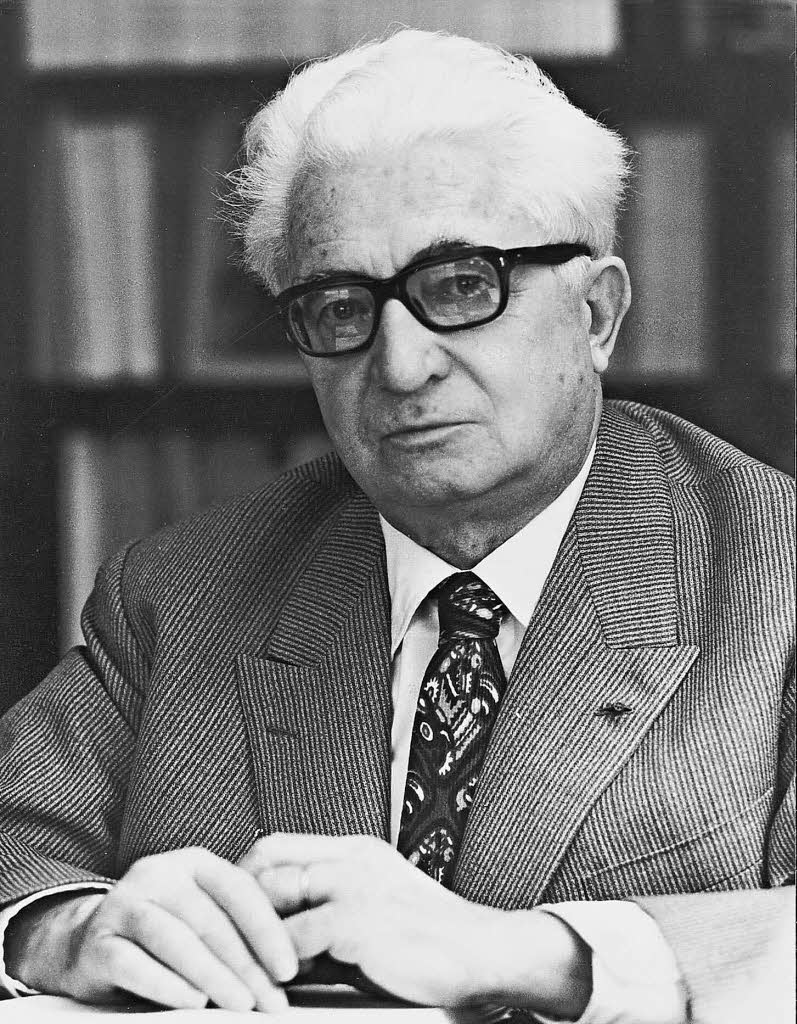
Friedrich Wolfgang Adler was born in Vienna on 9th July 1879. His mother was the writer Emma Adler and his father was Victor Adler a prominent member of the social democratic party. Adler moved to Zurich in 1897 to read physics, mathematics and chemistry at the University of Zurich. This was also the year he joined the Social Democratic Party of Austria (SPÖ). Adler continued to work at the university but remained active in politics. In 1907 he became editor of the magazine Der Kampf he then became editor of the Volksrecht newspaper in 1910. Adler became involved in the international trade union movement. In 1911 he abandoned his university work all together and became secretary-general of the SPÖ in Vienna. He became the spokesperson for the left wing of the SPÖ and found himself increasingly at odds with the gradualist and moderate views of the majority of the party.

a089743a

Friedrich Wolfgang Adler

The problems in the Balkans were of grave concern to the SPÖ. The actions of Stürgkh and his increasingly autocratic rule set both men on a collision course.
Stürgkh, Foreign Minister Count Leopold Berchtold and Chief-of-Staff Franz Conrad von Hötzendorf had long advocated a preventive strike against Serbia. Deeply concerned about the spread of Pan-Slavism in the Bohemian, Carniolan and Croatian crown lands, and irridentist feeling elsewhere in Cisleithenia Stürgkh felt that a show of force in Serbia was the best option to stem the tide of what he saw as socialist anti-Imperialism. This policy was blocked by the ‘peace party’ led by Archduke Franz Ferdinand and the Emperor himself who wished to avoid conflict. The assassination in Sarajevo changed everything.

Once war was declared on 28th July, Stürgkh refused to convoke the parliament while the SPÖ, after a very heated internal debate, decided to support the war. Adler was devastated by the party’s decision. Vehemently opposed to the government’s war policy Adler continued to oppose all measures but was stymied by the lack of democratic means by which to campaign. Parliament was in abeyance and all policy, military and civilian was decided by decree.

Unsupported by his party and with all avenues for legitimate debate blocked Adler was becoming increasingly frustrated. By October 1916 this frustration had reached breaking point. The battles of the Somme and Verdun had killed hundreds of thousands for little or no gain, civilians on the home front were suffering severe malnutrition and the end of the war seemed a distance prospect. Adler identified Stürgkh as the main stumbling block to bringing the war to an end. Stürgkh as an individual supported the war and indeed was an advocate of total war no mater what the costs. In addition, Stürgkh represented the worst of aristocratic Austrian rule willing to sacrifice the lives of working class men and women for the greater glory of the Habsburgs.

On the morning of the 21st October Friedrich Adler armed himself with a pistol and entered the dining room of the Meißl und Schadn hotel in Vienna where Stürgkh was having lunch. Adler entered the dining room and after approaching Stürgkh’s table calmly drew his pistol and shot Count Karl von Stürgkh three times killing him. Adler was instantly apprehended and taken into police custody. The assassination sent shock waves through the Austrian establishment and fears were raised that socialist and communists would use the assassination to foment revolution in Vienna and Budapest. An immediate police crack down on socialist and communist gatherings was ordered and a successor to Stürgkh was quickly found. Emperor Franz Joseph appointed Ernest von Koerber as Austrian Minister-President. This was one of the emperor’s last official acts; he died four weeks later.

The horror of the assassination followed by the death of the emperor shook Austria and fears of revolution were rife. The establishment were keen to play down Adler’s anti-war politics and rumours were spread as to his stated of mind. Court doctors were appointed to have Adler declared insane. This would have avoided the publicity generated by a trial and also give a clear message that anti-war feeling was not a strong political movement but the delusion of fools and lunatics. Unfortunately Adler was quite clearly not insane and no doctor could be found who would declare him so.

In May 1917 Adler’s trial went ahead. The case against him was clear and uncontested he had deliberately shot Stürgkh with the intention of killing him. When Adler stood up to defend himself the worst fear of the establishment we realised. Adler freely admitted his guilt but placed his actions squarely in the context of his anti wars policies. Who was really guilty? Adler who had shot one man or politicians like Stürgkh who sent millions to their deaths? Unfortunately for the authorities, despite the press censorship in place Adlere’s impassioned speech was widely circulated in left wing pamphlets. Frustratingly for Adler, the divisions between the various socialist and communists groups prevented his works from generating any cohesive action.

Adler was found guilty and sentenced to death. His sentence was commuted to eighteen years in prison. When the revolution broke out in 1918 he was amnestied and released from prison. He threw himself into the revolution and became leader of the Arbeiterräte (workers’ councils) and a member of the National Council of Austria. By 1921 Adler was secretary of the International Working Union of Socialist Parties and was subsequently active in the formation of the Labour and Socialist International. He served as joint secretary-general of the International with Tom Shaw and then on his own until 1940.

When the Anschluss of 1938 took place Adler intended to stay in Austria to fight fascism. By the outbreak of war however, it was clear that he was in danger of sent to a concentration camp and possibly being shot. Adler fled to the United States.

Friedrich Wolfgang died on 2nd January  1960 in Zurich.

—oOo—

Posted in Uncategorized | Leave a comment

Margarete Schütte-Lihotzky

     On 23 January 1897 Margarete Lihotozky known as Grete, was born into a comfortable bourgeois family in Vienna. Her father Erwin Lihotozky, was a manager for the municipal expansion fund for the Vienna City Council. Grete was a very bright child and her parents, who was extremely liberal minded, encouraged both their daughters, Grete had an older sister Adele, in their studies. In her final year at school, in 1915, Grete expressed her desire to continue studying and decided to apply to the Kunstgewerbeschule (today the University of Applied arts, Vienna). Although Grete’s school certificate and portfolio were excellent and she was likely to pass the entrance examination the Kunstgewerbeschule had never admitted a female student. Her mother, Julie, who was herself very artistic, had a friend who knew the artist Gustav Klimt. On being asked, Klimt wrote a letter of recommendation for Grete. Two hundred and forty prospective students sat the entrance exam for the 1915/16 term. Less than forty passed, Grete was one of them and she was duly enrolled at the Kunstgewerbeschule for the term beginning September 1915.

schuette-760-500x500

Grete flourished at the Kunstgewerbeschule. She studied under Anton Hanak and Oskar Strnad and won prizes for several of her designs in her first and final year.  Strnad was one of the leading pioneers of sozialer Wohnbau in Vienna at the turn of the century. Sozialer Wohnbau designed stylish but affordable social housing for the working class. The connection between design and functionality that was first made in Vienna would spread across Europe spawning movements such as the Bauhaus in Weimar. Grete instinctively understood the concept of design and functionality and this concept formed the basis of all of her later work. After graduating, Grete was involved in several projects that incorporated sozialer Wohnbau. By 1920 she was working with Adolf Loos designing housing for those injured in the Great War. She then started work on the Österreichische Siedlung und Kleingartenverband (Austrian Settlement and Allotment Garden Association). The Österreichische Siedlung und Kleingartenverband was created to help war veterans and displaced persons find affordable housing in which to live and land on which to grow their own food. The work with the Österreichische Siedlung und Kleingartenverband saw Grete working alongside the philosopher Otto Neurath and Josef Frank the architect.

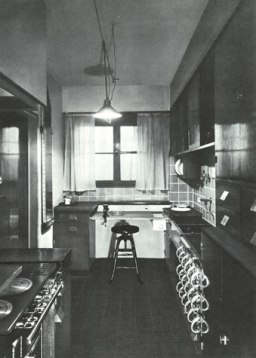
In 1926 Grete was approached by Ernst May the architect. May was working as the city planner for the council of Frankfurt am Main. After the devastation of the Great War the council has decided on a city wide regeneration called the New Frankfurt project to address their various housing issues. The New Frankfurt project created several housing developments across the city all of which incorporated sozialer Wohnbau principles. It was while working on this project that Grete developed the Frankfurt Kitchen. Although not noted as a cook herself Grete recognised the amount of time that working women spent in their kitchens. She also recognised that kitchens were often the least designed aspects of working class homes. Looking at the work of Frederick Winslow Taylor and her own research Grete worked to design the ‘housewife’s laboratory’. Her idea was to maximise comfort and working area but in a minimum of space. Grete looked at various examples of cooking spaces and finally used a dining car kitchen from a train as a basic model. By the time she had finished Grete had designed a well designed, comfortable, kitchen that was the prototype of the modern built-in kitchen. Ten thousand of these kitchens were installed into the social housing developments in Frankfurt before the design spread across other German and central European cities.

01_FK-Archival-Photo

‘FRANKFURT KITCHEN’


While in Frankfurt Grete met and married the fellow architect Wilhelm Schütte. Despite this happiness there were tensions as the political situation in the Weimar Republic deteriorated. By the late 1920s Grete and Wilhelm joined the ‘May brigade’. This was a group of seventeen architects including Ernst May and Erich Mauther all of whom were either communists or socialists. In 1930 the May Brigade moved to Moscow to work on the first of Stalin’s five year plans. One of the group’s first commissions was the creation of the city of Magnitogorsk in the Urals. The existing settlement was a small village of nomadic pastoralists but Stalin had identified the settlement for a steel works and a modern city capable of housing 20,000 workers was required. After this initial project Grete and Wilhelm continued to work on several other schemes in the Soviet Union but became increasingly disillusioned with Stalin’s regime. Life in the Soviet Union became dangerous as both Grete and Wilhelm were vocal in their disapproval of the political regime and in 1937 they left and were spared imprisonment under Stalin’s Great Purge.
In 1838 Grete and Wilhelm moved to Istanbul to take up teaching posts at the Academy of Fine Arts. While in Istanbul Grete met Herbert Eichholzer the Austrian architect who was a leading activist in the Kommunistische Partei Österreichs (KPÖ) (Austrian Communist Party). Eichhholzer was a leader organiser of the Communist resistance to the Nazis. In 1939 Grete joined the KPO and in late 1940 she travelled to Vienna via Greece and Yugoslavia to meet with members of the communist resistance. She took copies of correspondence between Johann Koplenig, chair of the KPÖ, and Josef Dobretsberger, a former member of the Schuschnigg government and Professor of National Economy in Graz.

A meeting was set up for the 22 January of 1941 where Grete was due to meet a man named ‘Gerber’, to discuss establishing a communications network between Turkey, France, Czechoslovakia and the Society Union. ‘Gerber’ was in reality Erwin Puschmann a senior member of the KPÖ and leader of the Austrian Communist resistance movement. Grete and ‘Gerber’ met at the Café Viktoria. The two spoke briefly and quietly. Just as they started to exchange papers two Gestapo men appeared and attacked Gerber grabbing him round the neck. Grete tried to hide her papers but was also held and the papers retrieved. Grete and ‘Gerber’ were then taken out the back entrance of the café and bundled into a waiting car. They were driven to the infamous Hotel Metropole, on Morzin square. When Grete arrived at the Hotel Metropole she discovered that Eichholzer and several other comrades had also been arrested. They were all were charged with treason.
Grete  was sent to Schiffamtsgasse district gaol in Vienna to await trial. The trial in the Volksgerichtshof (people’s court) began on 22 September 1942. All of the prisoners showed signed of malnutrition and Eichholzer and Puschmann had also been tortured while waiting trial. All were found guilty and sentenced to death. On 7 January Puschmann and Eichholzer were executed by firing squad in Vienna. Grete’s sentence was commuted to fifteen years in prison. She was sent to Aichach gaol in Bavaria. She was freed by a group of American soldiers on 29 April 1945.

By 1947 Grete had returned to Vienna however as she remained a communist this tainted her professional reputation in the eyes of many in Austria due to the post war political settlement in Europe. Austria had been badly damaged during the war and there was a dire need for decent affordable housing; architects were much sought after. However, the fear of the power of the Soviet bloc rendered Grete persona non grata with many city authorities. Grete found work as a consultant in China, Cuba and the German Democratic Republic. Her continued communist stance also caused something of a strain within her marriage and in 1951 she separated from Wilhelm.
During the 1960s Grete continued to work on workers’ housing projects but also increasingly spoke out on the need for peace between nations. Whilst remaining a communist, Grete nevertheless campaigned for a need for understanding between states despite differences in political ideology. She recognised the devastation wrought by the second world war and placed the blame squarely on the shoulders of politicians of all brands. By the late 1970s the Austrian authorities had relaxed many of their attitudes and Grete’s work became increasingly recognised.

In 1977, Grete received a medal for her peace work, in 1978, she was awarded an honour badge for her work in the Resistance and then in 1980 she was awarded the Architecture Award from the City of Vienna. In 1988, when she was to be awarded the Austrian Decoration for Science and Art, Grete refused to accept the award on the grounds that the then Austrian Federal President Kurt Waldheim had a somewhat unsavoury wartime record. Outraged Waldheim withdrew the honour which Grete only received in 1992. In 1995, when she was ninety eight years old, Grete, with a group of other ex-Nazi prisoners, successfully sued Jörg Haider a member of the National Council. During a debate in the National Council Haider had described Nazi concentration camps as ‘prison camps’. Grete was awarded the Grand Decoration of Honour in Gold with Star for Services to the Republic of Austria in 1997.

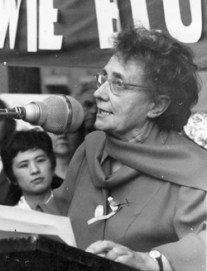
schuette_250px

Margarete Schütte-Lihotzky died in Vienna on 18 January 2000. She was interred in an Ehrengrab (memorial grave) at the Zentralfriedhof, Wien-Simmering.

Posted in Uncategorized | Leave a comment

Das Kabinet des Dr. Caligari

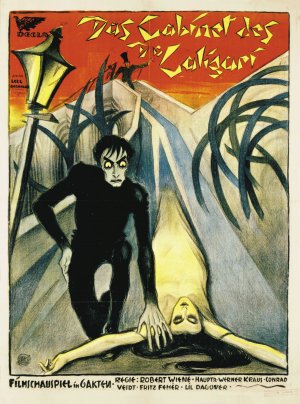
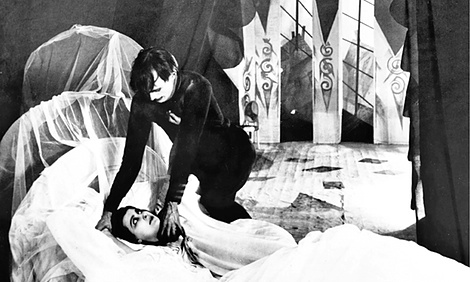
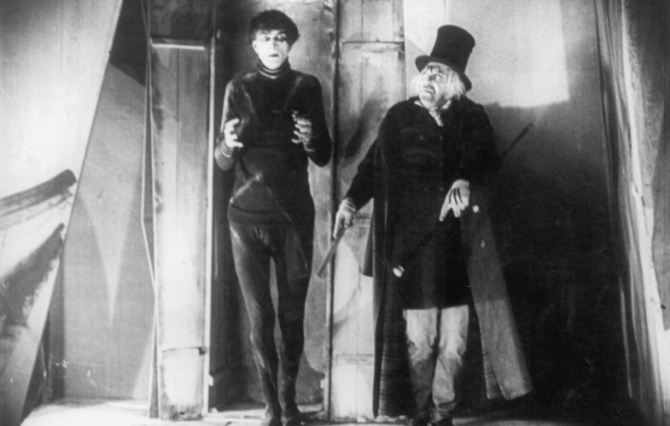
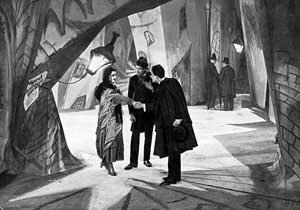
On the 27th February 1920 the Expressionist film Das Kabinet des Dr. Caligari premiered in Berlin. Directed by Robert Wiene and starring Werner Krauss and Conrad Veidt, Das Cabinet was a horror film that became one of the most influential films of German Expressionism. The film used highly stylised sets, with abstract, jagged buildings painted on flat canvas backdrops. The actors used unrealistic acting technique that exhibited spasmodic and dance-like movements.


Das-Cabinet-des-Dr-Caligari-poster
The film follows a tale of murder involving a doctor, Caligari, who controlled a somnambulist. The film opens with a young man called Francis sitting talking to an older man telling his story to the older man in flashback. Francis had lived in the town of Holstenwall. With his friend Alan he decided to visit the fair.  A stranger, Dr. Caligari , asked the town clerk for a permit to perform at the fair. The clerk was rude to Caligari, but gave the permit. That night, the clerk was found stabbed to death in his bed.
The next morning, Francis and Alan visited Caligari’s booth at the fair, where he opened a coffin-like box to reveal a sleeping figure, Cesare. Caligari woke Cesare who answered questions from the audience. Alan asked ‘How long will I live?’. Cesare answered, ‘Until dawn.’ Later that night, Alan was murdered. Francis investigated Alan’s murder with help from his sweetheart Jane and her father, Dr. Olsen.
At night, Francis spied on Dr. Caligari, and saw what he thought was  Cesare sleeping in his box. However, the real Cesare crept into Jane’s home and abducted her. Chased by a mob, Cesare eventually dropped Jane and fled, but collapsed and died. Francis and the police investigated and realised that the Cesare in the box was only a dummy. Dr. Caligari escaped in the confusion, but Francis followed him to an insane asylum. Francis then discovered that Dr. Caligari was the asylum’s director. Francis studied the director’s diary which revealed his obsession with the story of an 11th-century mystic named Caligari, who used a somnambulist, named Cesare, to commit murders. When a somnambulist, Cesare, was admitted to the asylum the director decided to experiment on the new patient in order to understand the earlier Caligari. Francis and the asylum doctors call the police to the asylum. Cesare’s corpse was found and Dr. Caligari attacked one of the staff. He was restrained and became an inmate in  the asylum.
The film then returned to the initial scene of Francis and the old man. It was then revealed that Francis, Jane and Cesare were all patients in the asylum. The man that Francis believed was Dr. Caligari was actually the asylum director. Francis attacked him, but was restrained and was placed in the same cell Dr. Caligari was confined to in his story. The director announced that, now that he fully understood Francis’ delusion, he could cure him.

Conrad-Veidt-and-Lil-Dago-014
The story of Dr Caligari had arisen out of the experiences of the writers, Hans Janowitz and Carl Mayer. These two, despite being pacifists, had both seen the horrors the Great War at first hand. Dr. Caligari represents the Kaiser and Cesare is the German soldier trained and expected to kill. The Great War had torn Germany apart and its aftermath, the Weimar Republic, was ill prepared to heal the wounds of war. Politics quickly descended into extremism on both the left and right as blame for the defeat was thrown about; the economy was weak, agriculture and industry had been devastated by the war,  and the people were angry, bewildered and shell-shocked. The situation os a madman that had led the country into a war, a people that had killed without waking to the horror and a final realisation that the mad were interchangeable with and undistinguishable from  the sane was mirrored in Dr Caligari.

One of the key moments in the film is when Alan asks, ‘How long have I to live?’ . By the second year of the Great War this was a question that many Germans asked themselves. The war not only slaughtered men but by its very nature left dead bodies lying next to the living. Death was random, ugly and ever present. Francis’ depair over Alan’s death ad his need to understand why also reflected those who had survived the war. Why had they survived but their brother had not? What had their brother died for? Why had they survived a war that had been lost?


bfi-00o-0jb-the-cabinet-of-dr-caligari
The parallels between Caligari, the Kaiser, who controls a somnambulist, the German people, to commit murder, start a war, are somewhat obvious. However, the happy ending ‘it was all a dream’ gave a childlike resolution to the horrors of the war. In fact in the original story there is no happy ending. The narrator is not mad. Caligari is indeed the head of the lunatic asylum but he is mad and the murders did actually take place by the somnambulist under the doctor’s control. The original story ended with Caligari as an inmate in his own asylum. The introduction of the happy ending had been at the insistence of the producers, a move that was initially resisted by the director Robert Wiene but to no avail. It may be that the imposition of this ending onto the film saved it from the censors but certainly made the film more commercially successful. The film could be viewed as a simple horror movie with a happy ending or it could, as many on the left saw it, be an indictment of the past four years and in fact the happy ending ‘proved’ the gullibility of the German people. Those naïve enough to believe that ending were foolishly trusting enough to become the somnambulist, as they had for the previous four years, and would again, in the opinion of the left. The fact that Caligari had mesmerised the somnambulist so successfully undercut the ‘it was all a dream’ ending for those with a discerning eye.

——-oOo——-

Posted in Uncategorized | Leave a comment

Expressionism

The start of the twentieth century saw great changes within art. The Great War had broken apart countries, communities and human bodies. For the artistic community wholeness could only come about through modernity. Expressionism was the first major artistic movement after the war which gave artists the means by which to explore and interpret that modernity. Expressionism, by its very nature, did not create or follow a single message other than a desire to seek the wholeness of the German soul. Expressionism explored the emotional experience of life and death.
Expressionism was a modernist movement that started initially in poetry and painting. The Expressionists artists sought to to present the world from a subjective perspective but a perspective that was distorted and twisted to heighten the emotional response. Meaning was to be found through the emotional experience rather than the physical reality of seeing or hearing a piece of art.
Expressionism had started to develop before the Great War but it was the horrors of that war which saw the art form flourish as many artists across Europe, but predominantly in Germany and Austria, sought to make sense of what had just happened.
The German Expressionist art movement started around 1905 when a group of four German artists, led by Ernst Ludwig Kirchner, formed Die Brücke in Dresden. This was followed in 1911 by a group that formed Der Blaue Reiter in Munich. The name was inspired by Wassily Kandinsky’s painting Der Blaue Reiter.  Artists such as Kandinsky, Paul Klee, Auguste Macke and Franz Marc gravitated together as they moved, artistically away from impressionism. Feeling constrained by the dehumanising effects of industrialisation and the growth of cities, these artists rejected realism and sough an emotional response to the machine age.

card-4859729-front
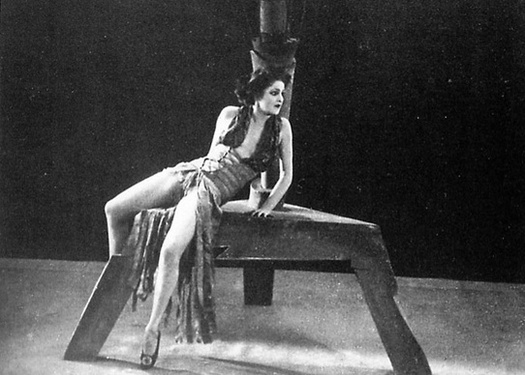
Expressionist painters sought the subjective interpretations and emotions of their artistic subjects. Emotional reaction was as important as the aesthetic image produced. Kandinsky, one of the major Expressionists artists, worked with simple shapes and colours to allow the viewer to experience the emotions of paintings. The movement also shaped dance with proponents such as Anita Berber, Rudolf von Laban, and Pina Bausch.Emotion was key and dancers would use dramatic poses and deliberately wild movements to generate the response of the audience. Dances would subvert traditional such that a ballet piece would be danced in a bizarre costume with deliberately non graceful movements.

anita-berber10
German cinema was hugely influenced by Expressionism. Robert Wiene’s The Cabinet of Dr. Caligari (1920), Fritz Lang’s Metropolis (1927) and F. W. Murnau’s Nosferatu, a Symphony of Horror (1922) all used the new techniques with lighting and props. Shadow and light were used to convey heightened mood and props that were ‘obvious’ used perspectives that jarred causing the viewer to questions what they saw. Filming used camera shots at different angles removing any sense of normality leaving viewers no alternative but to immerse themselves in the unreal world presented to them on the screen. This use of lighting and props carried over into the theatre where it was accompanied by bare stage sets and dialogue that was sparse in content and declaimed in heightened tones. Characters were mythic and action was symbolic. Theatre audiences could not relax the only response available was emotional not cerebral.

20071110170917!CABINET_DES_DR_CALIGARI_01
Expressionism also influenced architecture. Erich Mendelsohn’s Einstein Tower in Potsdam, Germany and Bruno Taut’s Glass Pavilion of the Cologne Werkbund Exhibition being two of the greatest examples. Architecture was an interesting medium in which to find Expressionism as the fleeting emotional nature of the art was difficult to render into the permanence of a built structure. Equally it could be argued that the prime function of a building is emotional as it is  what houses human life.

4677
Expressionism like all artistic movement was not static and soon evolved into many forms. By the late 1920’s in Germany Dadaism and Neue Sachlichkeit were challenging Expressionism in the artistic world. Expressionism and the art forms that followed it were hated and labelled degenerate by the Nazis and many artists fled then Hitler came to power. However, the art of the Expressionists inspired others around the world and continue to do so to this day.

——-oOo——-

Posted in Uncategorized | Leave a comment

The scandal of William Tell: Berlin 1919

tell_wilhelm

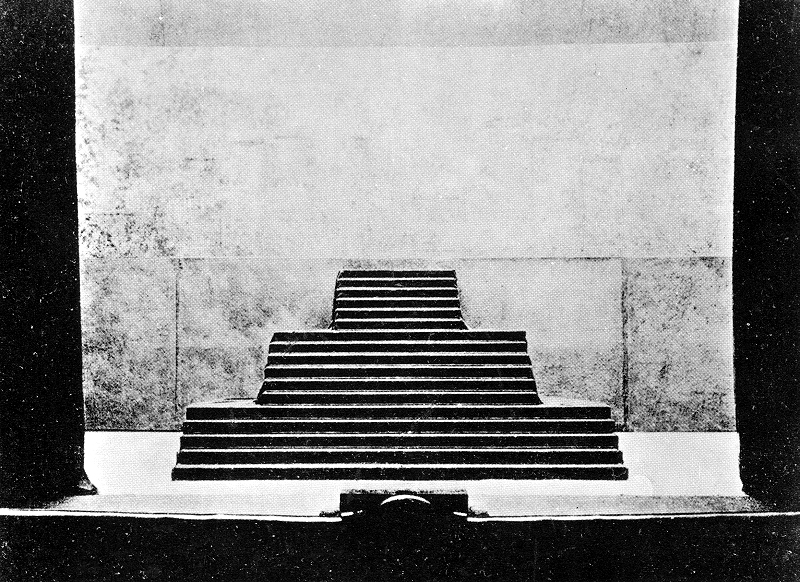
In December 1919 Leopold Jessner staged the play William Tell.  A native of Königsberg Leopold was born in 1878 and had started out as an actor before becoming a stage director in 1911. He was a member, albeit a somewhat passive one, of the SDP  which controlled the Prussian cultural ministry. He was initially appointed director of the Prussian State Theatre as a political appointee; the expectation being that he would be supportive of and abide by the regulations laid down by the SDP. However, Jessner had other ideas and intended to be as independent as possible. His ambition for the State Theatre was to transform it into a ‘showplace of the people.’ Jessner was extremely influential in theatrical circles in Berlin and as such helped to transform the theatre. He was a true Expressionist. He developed the use of abstract stage sets and discordant speech. One of his initiatives was the Jessnertreppe. This was a large set of plain irregular steps with no adornment which was placed centre stage and dominated the space which was usually bare of any other props. These steps were used variously by actors within the action of the play. This stage setting focused the action of the play on the actors upon the bare steps and thus reduced the audiences’ stimuli to a single point concentrating the mind upon the stream of consciousness behind the words. Jessner’s radical and challenging style of production gained him detractors on the right and advocates on the left both inside and outside artistic circles. In 1921 he directed Hintertreppe a hugely influential Expressionist film which laid much of the ground work the later films of F.W. Murnau, Fritz Lang, and G.W. Pabst. His challenges to the establishment saw him dismissed from his post at the state theatre and by 1933 he was forced into exile.

kekesi_9

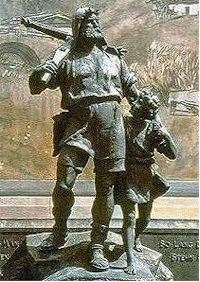
On the evening of December 12th 1919 Leopold Jessner staged his production of William Tell. The play by Schiller was a favourite of right wing conservatives. As such the production at the Berlin State Theatre was unlikely to go ahead without comment. Despite, or indeed because, of the apparent conservative themes within the play, Jessner decided on a complete Expressionist recasting of the tale. This was William Tell as revolutionary son challenging his reactionary father. Rehearsals started with the stage brightly lit and the bare Jessnertreppe  placed predominantly in the centre. The text was cut to its bare bones with all references to the fatherland and patriotism removed. Fritz Kortner played the tyrant Gessler with a chest full of medals and cheeks full of bright red make up. The symbolism was anything but subtle. The music was strident; trumpets were used extensively which mimicked the car horn of the old Kaiser’s limousine. With this level of emphasis, it was unlikely that in the gossipy world of Berlin theatre rumours about the Jessner’s approach would fail to circulate. By the evening of the opening performance the political right and left and the theatrical establishment and critics were all in a heightened state of excitement.
When the doors opened there was a rush to the seats and battle lines were quickly drawn. Different groups sat in, and in some cases on, their seats yelling insults at each other, whistling and stamping their feet. The noise could be heard in the dressing rooms backstage. The situation became so heated that Jessner lost his nerve and called for the curtain to be brought down. Kortner and Albert Bassermann, who played Tell, along with the rest of the cast reassured Jessner and persuaded him to go ahead with the performance and the curtain was duly raised. The opening blasts of the trumpets could barely be heard over the audience who hooted and roared back in response. Kortner strode onto the stage and yelled down the audience who subsided and the action continued to the end of the first act and the curtain was brought down. The audience promptly broke into further roaring; the left wing were delighted by the evening so far and taunted the right wing as to the real story of William Tell. The right wing screamed obscenities at the left wing accusing them of disgracing the fatherland. The situation threatened to get completely out of control. The noise was such that the second act could not go ahead. Bassermann suddenly thrust himself through the curtains and his appearance startled the audience into silence when he shouted, ‘Schneisst doch die bezahlten Lümmel hinaus’, (Throw the bums out, they’ve been bought). A final roar went up from the right wing as they were ejected from the theatre and the play continued to an overwhelmingly positive acclaim.

3c7cd46d9f

The reaction to the evening’s performance was predictably polarised. The Spartacists and their fellow travellers were ecstatic at finding new revolutionary fire in what had previously been a traditionally conservative tale. For the conservatives the night had been a disaster. The left wing had been comforted and given new life by the wrecking of a classic Germanic tale. In addition Jessner had shown himself to be a reprehensible Expressionist artist. This double blow was not one that they intended to accept without retribution. Jessner did not have to wait long for that retribution to come. During the early 1920s he came increasing under pressure from the national socialists. He was attacked for his ‘un-German’ productions, his Bolshevik aesthetics and of course for being Jewish. Delegates to the Prussian state government made numerous attempts to remove him. These attempts failed, not because he had any great supporters amongst the other delegates but simply that the other parties saw, in blocking calls for his dismissal, a way of opposing the national socialists. Jessner remained at the Berlin State Theatre until 1930 and thereafter continued to work in several other theatres in the capital before finally emigrating in 1933. One of the major consequences of the William Tell night was the realisation by the right that the lack of legal framework on morality in the arts could lead to a lack of action on the part of the Sittenpolizei (morals police). They were determined that such an event should never occur again and that action should be taken in advance of performances and not afterwards. Censorship had to be applied across the board. If the left could ‘ruin’ a national classic such as William Tell there was obviously no limits to their debauchery and they had to be stopped by whatever means possible. Jessner’s William Tell gave the right all the ‘proof’ they required for the need for stronger censorship laws. Such was the artistic world of Berlin in 1919.

——-oOo——-

Posted in Uncategorized | Leave a comment

Sachsenspiegel (German Law)

German Law was a system of civic government that allowed the merchants and artisans of towns a degree of control in trade and town governance. There were three main types:  Lübeck Law, Nüremberg-Vienna Law and Magdeburg Law or Magdeburg Rights.

17-Magdeburg

Magdeburg Rights were a set of town privileges established by the Holy Roman Emperor, Otto I in the tenth century. The Rights were based on a combinations of various Germanic laws (Sachsenspiegel) with little input from Roman law. The Rights regulated the trade of local merchants and artisans. The geographic situation of Magdeburg made it a prime trading location especially in grain. Recognising this and the wealth that flowed from such trade Otto I supported the development of the city. This was welcomed by the Magdeburg Merchants Guild who worked with the emperor’s advisors to establish the code of Rights.

Once established in Magdeburg these rights were exported across the empire giving a degree of early standardisation of trading rights within town charters. Adoption of Magdeburg Rights allowed merchants and artisans to control both the trade in their towns and eased trade between towns. Some towns and cities outwith the empire  started to adopt the Rights as they eased trade with German towns. The stability in trade and subsequent wealth generated by the Rights then helped further town development across central Europe.

Merchants and artisans comprised one of the most important sectors within towns and villages. Separate from but trading with and supporting the nobility and the church these merchants and artisans needed to be given a degree of autonomy by means of privileges in order to function well. However, these privileges needed to be regulated. Previously, privileges had developed in a haphazard manner dependent on the whim of the ruler. This dependency on the ruler’s personal character and interests meant that privileges could be altered at any time. While this seldom happened frequently it could, and the uncertainty created had a detrimental effect on long term trade. The development of Magdeburg Rights stabilised the situation for all concerned.

The Rights regulated trade in towns: how trade was conducted and who could and could not trade. Foreign merchants entering a town were not allowed to ply their own trade, but were forced to sell the goods they had brought to local traders. Jewish traders, even those who lived within a town, were controlled as to what they goods they could trade. While most Jewish merchants had poorer trade conditions than non Jews those condition were at least consistent. Many towns within the empire actively sought out Jewish traders for the wealth they created. The adoption of Magdeburg Rights allowed the town leaders to offer the Jewish traders consistent trading conditions which they supplemented with improved protection from persecution.

The Rights also regulated internal aspects of trade. The length and content of apprenticeships; the  criteria for becoming a journeyman and the relationship between and apprentice or journeyman and his master. Permission for a journeyman to move to another master and even to marry were also regulated by the Guild. By regulating apprenticeships the Rights guaranteed that artisans were trained to the same level and thus producing goods of an equal standard. They also strengthened, relatively, the rights of apprentices to be taught their trade properly, to be treated fairly by their masters and to gain a degree of protection from abuse. The Rights strengthened the Guilds which oversaw their trade protecting guild members from competition from non guild members and gave some assistance in the event of ill health and accident.

The success of the Magdeburg Rights, the financial and social stability they created and wealth they generated, saw the Rights granted to over one hundred towns across Central Europe. By the 13th century Magdeburg Rights were incorporated across the German states, Schleswig, Bohemia, Pomerania, Lithuania, Ukraine, Moldovia, Belarus and Poland.

This spread was greatly aided by the eastern migration of German traders across Europe.
As German merchants and traders started migrated to the Slavic lands of the east in the early 13th century. The Teutonic Knights, who controlled the lands along the banks of the Vistula River, introduced German Law to the towns under their control.
In addition to this spread German Law was incorporated into many towns in the upper Oder River valley. The Piast Dynasty allowed the development of German Law partly under pressure from the empire to allow the adoption of the law and partly in order to develop their economies. As part of these economic policies the Piasts also invited  Jewish and German merchants to settle in several towns. As the development of towns in Poland improved trade and generated wealth rulers in Bohemia, Moravia and Hungary also seized the initiative and approached merchants and traders to migrate eastwards.

The Law of Magdeburg implemented in Poland differed from the original German form. It combined the existing Polish civil laws with planning based, to a degree, on the ancient Roman model. Some and owners started to use the location privilege known as ‘settlement with German law’ across their estates even when German settlers were not present. The economic benefits of German Law were such that the use of ‘settlement with German law’ when German settlers were not present became prevalent. At the same time most of the rural peasantry continued to live in accordance with common law.

The spread of German Law enabled the physical eastwards migration of settlers but also the eastward movement of trade on terms favourable to German merchants. Economic development increased across central and eastern Europe but at a greater rate in the central Germanic states. Even where large scale eastward migration did not take place lawyers, clerks and administrators versed in German Law were frequently requested by eastern areas to enable the implementation and subsequent administration of the Law. While this eased the implementation of the law it raised tensions with existing town elites who resented the imposition of foreign laws an customs. Even when the Laws created wealth and stability the status afforded to the foreign clerks and lawyers continued to cause tension as did the perceived wealth flowing out of eastern towns into the empire.

——-oOo——-

Posted in Uncategorized | Leave a comment

Franz Joseph I, Emperor of Austria and Apostolic King of Hungary

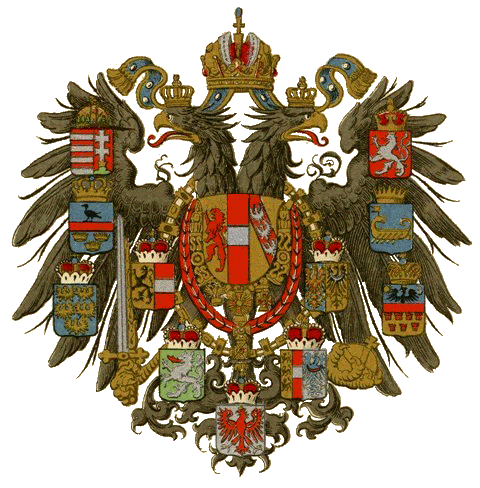
austria-hungary-coa

In the year 1900 Count Ferdinand von Zeppelin invented the great flying wonder that was the Zeppelin. The Seeberger-Otis wooden escalator won first prize at the Paris Exposition Universelle. Europe was a new and exciting place. Except for the medieval fantasy that was the Empire of Austria and Hungary.

There were several monarchies in Europe such as; the Romanovs in Russia; the Hohenzollerns in Germany; the House of Saxe-Coburg and Gotha in Britain; the Hernadottes in Sweden and the House of Schleswig-Holstein-Sonderburg-Glücksburg in Norway. But none reached the legendary fairy tale heights of the Habsburgs of the Empire of Austria and Hungary. The House of Habsburg had arisen in the 10th century from the ruling family of the castle of Habsburg in Switzerland. From there the family had spread across Europe acquiring lands by a mixture of marriage, conquest and treaty. By the 16th century the family ruled vast lands across Europe and separated into the senior Habsburg branch in Spain and the junior Habsburg branches. One of these was the Austrian branch that became the House of Habsburg-Lorraine. Despite being one of the most junior branches of the original Habsburgs the House of Habsburg-Lorraine continued the family tradition of marriage, conquest and treaty and by 1900 ruled over a vast empire that covered most of central and south-eastern Europe.

austria_hungary_1911

In 1867, the ‘Compromise’ had created a constitutional union of the Empire of Austria and the Kingdom of Hungary. This union consisted of the two monarchies, Austria and Hungary, and the autonomous region of Croatia–Slavonia under the Hungarian crown. The  two regions of the Empire were Cisleithanian, the lands and provinces of the Imperial Council, which included Austrian, and Transleithanian, Hungary. The newly created empire was geographically the second largest country in Europe and the third most populous. The peoples of the Habsburg Empire included, Germans, Czechs, Slovaks, Slovenes, Ruthenians (Ukrainians), Hungarians (Magyars), Rumanians, Serbs, Croats, Poles, Silesians and Italians.

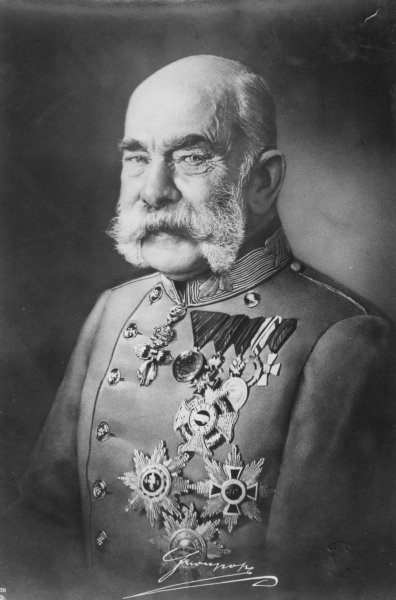
And over it all reigned His Imperial and Royal Apostolic Majesty, Franz Joseph I, by the Grace of God Emperor of Austria, Apostolic King of Hungary, Bohemia, Dalmatia, Croatio, Slavonia, Galicia, Lodomeria, Illyria; King of Jerusalem; Archduke of Austria; Grand Duke of Tuscany and Cracow; Duke of Lorraine, Salzburg, Styria, Carinthia, Carniola and of Bukovina; Grand Prince of Transylvania; Margrave of Moravia; Duke of Upper and Lower Silesia, Modena, Parma, Piacenza and Guastalla, Oswiecin, Zator, Friuli, Ragusa and Zara; Princely Count of Habsburg, Tyrol, Kyburg, Gorizia and Gradisca; Prince of Trent and Brixen; Margrave of Upper and Lower Lusatia and Istria; Count of Hohenems, Feldkirch, Bregenz, Sonnenberg; Lord of Trieste, Kotor and the Wendish March; Grand Voivode of the Voivodship of Serbia.

xjf377251
The Empire Franz Josef ruled over was a mixture of lands and peoples and had been acquired over many years in a variety of ways. As a result, by the time the Empire of Austria and Hungary had come into existence the rule of the land had developed into a three-headed dog.

The Imperial Council, and the fifteen individual crown lands of Cisleithania with their own diets; the Cisleithanian government and the Hungarian government.
The parliament of the kingdom of Hungary convened in Budapest. Vienna had both the Imperial Council and the Cisleithanian government. The Hungarian parliament dealt with the governance of Hungarian. The Cisleithanian government dealt with governance of the lands and provinces in Cisleithania. The Imperial Council dealt with the Austro-Hungarian Army, the Austro-Hungarian Navy and the Foreign Ministry, the maintenance of the Imperial Court in Austria and Royal Court in Hungary and any governance matters that impinged on Imperial matters.

Both Cisleithania and Hungary had Prime Ministers and full cabinets. However, there was only one Foreign Minister who was a direct link between Franz Josef and the two cabinets. The Foreign Minister was also responsible for ‘family celebrations of his Majesty’. The two Prime Ministers shared one Minister of Finance and one Minister of War. These men rules in Austria as ‘Imperial Excellencies’ and in Hungary as ‘Royal Excellencies’.
The government in Budapest was responsible to the King (His Royal Apostolic Majesty Franz Josef) although controlled by the  Hungarian nobility. The Hungarian parliament was elected on a limited franchise. The government in Vienna was responsible to the Emperor (His Imperial Majesty Franz Josef) while the parliament was elected on a limited franchise. The Council in Vienna was responsible to the Emperor. Its members were elected from the two governments.

These elected members discussed matters with the Ministers of the Imperial Council which acted as the legislature of Cisleithania and the Empire, except where matters was purely Hungarian; although His  Royal Apostolic Majesty, Franz Josef, could, as King of Hungary pass legislation for the Hungarians. Even if the matter in hand concerned both Cisleithania and Hungary the respective delegates conducted their initial discussions separately from each other as a matter of protocol. His  Royal Apostolic Majesty, Franz Josef, in the guise of his Ministers, could not be privy to the discussions of his Imperial Majesty, Franz Josef, in the guise of his Ministers, and vice versa. After initial discussions, the matters were then presented to the Imperial Council where the Ministers of his Royal Apostolic Majesty, Franz Josef, could notify the Ministers of his Imperial Majesty, Franz Josef, or vice versa, about the pertinent matter.

In addition to the royal and parliamentary protocols that were in place each parliament had its own civil service. These produced materials in either German and Hungarian for internal matters or in German for matters that needed to be discussed with the other parliament or the Council. The Imperial Council also had its civil service which produced material in German. The official language in the Cisleithanian parliament was German. However, the vast majority of the population of Cisleithania and a large minority of deputies in the parliament did not use German as their first language. Nationalist politics used the question of language as a means by which to voice political discontent. In 1897, the minister-president Count Kasimir Felix Badeni failed to introduce a language ordinance, requiring the use of German in speeches. Many of the Czech delegates used this lapse to demand greater freedoms for the use of the Czech language. They were supported by other Slavic groups calling for greater freedoms in language and political autonomy. These calls were opposed by the German Radicals and the Pan-Germanists. Other delegates joined the debate deliberately speaking in their own languages. These debates descended into shouting and occasionally fighting. While this appalled most members of the nobility and the Imperial Council it made the public gallery of the parliament house hugely popular as an afternoon’s entertainment for many ordinary Viennese.

And above it all reigned the ever benevolent Imperial and Royal Apostolic Majesty, Franz Joseph I, by the Grace of God Emperor of Austria and Apostolic King of Hungary.

——-oOo——-

Posted in Uncategorized | Leave a comment

The murder of Walter Rathenau

Walther+Rathenau+the+famous+politician+of+the+German

Walter Rathenau was an industrialist and founder of the Allgemeine Elektrizitäts-Gesellschaft (AEG)  (electrical engineering company). He was murdered in June 1922, a prominent victim of the Organisation Consul one of the many right-wing paramilitary groups.

At the outbreak of the Great War Rathenau approached the War Ministry and suggested that a Kriegsrohstoffabteilung (KRA) Raw Materials Department be established. The Ministry agreed and Rathenau was appointed to establish the KRA. After the Great War Rathenau entered politics helping to found the German Democratic Party (DDP). Despite being more liberal than many in government he retained a high degree of influence due in part to the work he had undertaken and contact he had made during the war.

In 1921, he was appointed Minister of Reconstruction, and, in 1922 became Foreign Minister. Rathenau was convinced that Germany had to fulfil its obligations under the Treaty of Versailles. At the same time he worked tirelessly for a revision of the terms. Fulfilling the obligations, in Rathenau’s opinion, strengthened their bargaining position for a lessening of the terms. Most German nationalists disagreed fundamentally with this position feeling that any fulfilment of the treaty implied acceptance of the war guilt clause.

Attempting to balance the intricate and interlinked domestic and foreign policies of the Weimar Republic Rathenau further angered the nationalists when, in 1922, he negotiated the Treaty of Rapello. This treaty saw Germany and the Soviet Union renounced all territorial and financial claims against the other following the Treaty of Brest-Litovsk. It also ‘recognised’ the secret German-Soviet collaboration, begun in 1921, which provided for the rearmament of Germany, including German aircraft manufacturing in Russian territory. This rearmament work was of great importance to German industry and appeased many in the German military who were still angered by the end of the war.

However, despite the obvious benefits many nationalists saw the treaty as part of the “Jewish-Communist conspiracy” which threatened Germany; Rathenau was Jewish. Combined with Rathenau’s acceptance of the Treaty of Versailles this ‘proved’ to the nationalists that Rathenau was a traitor to the fatherland. The nationalist paramilitary group the Organisation Consul determined to assassinate him.

On the 24th June 1922, despite having been told of threats against him and rumours of an intended attack, Walter Rathenau’s chauffeur drove him from his home in Grunewald to the Foreign Office in Wilhelmstraße by his normal route. As he was driven along a Mercedes-Touring car passed him. The car was driven by Ernst Werner Techow and also contained Erwin Kern and Hermann Fischer. Kern opened fire at Rathenau with a MP 18-submachine gun at close range,, while Fischer threw a hand grenade into the car before Techow drove off.

The leader of the Organisation Consul was Hermann Ehrhardt who had devised the plot to kill Rathenau. Ehrhardt believed that Rathenau’s death would cause the government to fall and provoke the left into violence thus precipitating civil war. The right would then ‘defend’ Germany and emerge victorious to institute a right wing authoritarian regime.

The structure of the Organisational Consul was such that small cells such as that containing Techow, Kern and Fischerthree had minimal contact with the hierarchy of the group. Thus Ehrhardt and other senior members were protected from the negative consequences of any actions.  However, Techow, Kern and Fischerthree had not acted alone and one of their fellow conspirators was Willi Günther who, ecstatic about their success, had been less than discrete in who he told abut the affair.

When the news about Rathenau’s death became known right-wing demonstrators gathered on the Berlin streets chanting ’Auch Rathenaur, Der Walther/ Erreicht kein hones Alter!/ Knallt ab den Walther Rathenau/ Die gottverdammte Judensau’ (Now Walter, too, will never see old age! Down goes Rathenau the Goddammned Jewish swine.) However, an equally large number of liberals and socialsit gathered on the streets to demonstrate about the murder.

The following day President Ebert announced an emergency decree for ‘the defense of the Republic’. Local officials were given powers to ban threats of violence towards the Republic or members of the government. This was despite the fact the those powers were already available to the police under the laws around threats to public safety. This minor point was glossed over as the Berlin police sprang into action.

Willi Günther was arrested and confessed all  and several arrests warrants were issued for the other members of the Organisational Consul. Rathenau’s funeral on the 27th saw thousands on the streets of Berlin and workers staged a citywide strike to show ’proletariate support for the Republic’.

Techow was quickly arrested but Fischer and Kern remained at large for some two weeks. Eventually they were tracked down to on the castle of Saaleck in Thuringia and were confronted by the police. Kern was shot dead and Fischer committed suicide.

In October 1922 Ernst Werner Techow was charged with murder. Twelve other  defendants appeared charged with various offences concerning aiding and abetting an assassination.

The prosecution case focused on the antisemitism of the accused. The defendants, the prosecution argued, believed Rathenau to have intimate relations with Bolshevik Russia and was one of the three hundred ‘Elders of Zion’ from the antisemitic forgery The Protocols of the Elders of Zion.

The defendants, in turn, denied that they had killed Rathenau because he was Jewish and stressed their loyalty to Germany. They stated that they had undertaken to eliminate Rathenau as he was a danger to the fatherland. However, they also stated that they ad acted alone. The prosecution was unable to prove the actual involvement of the Organisation Consul.

Two of the defendants, Tillessen and Plaas were convicted of non-notification of a crime and sentenced to three and two years in prison, respectively. Another, Salomon received five years imprisonment for accessory to murder.

Techow was fund guilty of accessory to murder. He stated he had been coerced into the act by threat of death by Kern and received to fifteen years in prison for accessory to murder. Techow’s sentence was reduced by an amnesty in 1928 and he was released from prison  on the 7th January 1930.

——-oOo——-

Posted in Uncategorized | Leave a comment

Empress Elisabeth of Austria: The tragedy of Sisi

Erzsebet_kiralyne_photo_1867


Elisabeth of Austria, born on the 24th December 1837 was the wife of Emperor Franz Joseph I, and Empress of Austria and Queen of Hungary.

Born into Bavarian royalty, Elisabeth, known as Sisi,  married Emperor Franz Joseph of Austria in 1854 when she was only sixteen years old. The marriage was arranged by Franz Josef’s mother, Princess Sophie, although it had originally been intended that Franz Josef would wed Sisi’s elder sister Helena. Franz Josef defied his mother’s wishes and the initial relationship between Sophie and Sisi was somewhat stained. Within weeks of her marriage it became apparent that Sisi was deeply unhappy at the Austrian court; she was nervous and depressed and found her court duties extremely stressful.

In 1855 Sisi gave birth to a daughter whom the Princess Sophie took into her own care. She named the child after herself and refused to allow Sisi to have any part n the child’s  upbringing. In 1856 Sisi gave birth to a second daughter whom Princess Sophie also removed from her mother’s care. Even though she had only been married for three years the lack of a male heir was considered a great shame for the royal family for which Sisi was blamed. Rumours started to spread and in 1857 a vicious pamphlet was printed a copy of which was left on Sisi’s desk.

‘…The natural destiny of a Queen is to give an heir to the throne. If the Queen is so fortunate as to provide the State with a Crown-Prince this should be the end of her ambition – she should by no means meddle with the government of an Empire, the care of which is not a task for women… If the Queen bears no sons, she is merely a foreigner in the State, and a very dangerous foreigner, too. For as she can never hope to be looked on kindly here, and must always expect to be sent back whence she came, so will she always seek to win the King by other than natural means; she will struggle for position and power by intrigue and the sowing of discord, to the mischief of the King, the nation, and the Empire…’

Princess Sophie was probably responsible for the pamphlet. Sophie was disappointed at the lack of a male heir but was also angry about Sisi’s increasing influence on the emperor. Sisi had apparently persuaded Franz Josef to show mercy toward some political prisoners. Tragedy followed the publication of the pamphlet when the two little archduchesses became ill, possibly with typhus. Gisela recovered quickly but two year old Sophie died. Sisi fell into a deep depression which affected her relationship with her husband and Gisela. She started to miss meals and would spend days on prolonged fasts eating as little as possible.

In 1858 Sisi finally gave birth to Rudolf. The birth of a male heir improved her standing at court but Sisi remained uncomfortable at the highly formal Austrian court. Sisi was liberal in her political views and her natural love of Hungary saw her frequently promote Hungarian interests at court. Her improved status following the birth of Rudolf saw her acting as a personal advocate for the Hungarian Count Gyula Andrássy, who also was widely rumoured to be her lover. Sisi suggested to the emperor that Andrássy be made the Premier of Hungary as part of a compromise to resolve the political situation between the two nations.

Despite her improved status Sis was still denied much of the day to day care of Rudolf. Her health remained delicate and she frequently visited Hungary to relax. Despite the benefits of being away from the court she continued to eat little and remained anxious and depressed. On her return however, nothing had changed and the princess Sophie continued to control the education and upbringing of the royal children.

Politically the Austro-Hungarian Compromise of 1867 had created the double monarchy of Austro–Hungary. Andrássy was made the first Hungarian prime minister and in return, he ensured that Franz Joseph and Elisabeth were officially crowned King and Queen of Hungary.

As a coronation gift, the royal couple were presented with a country residence in Gödöllő, twenty miles east of Budapest. In the next year, Sisi lived primarily in Gödöllő and Buda-Pest. She had become pregnant again and in 1868 in Budapest she gave birth to a third daughter Marie Valerie.  Marie was known as the ‘Hungarian child’ and was reared by Sisi without the influence of Princess Sophie who remained in Vienna and seldom visited Hungary. By 1872 the old princess died and Sisi found the stress of the Austrian court somewhat more bearable.

Despite this improved atmosphere Sisi spent the next seventeen years travelling extensively across Europe and north Africa. However in 1889 tragedy struck again when Rudolf died in a murder-suicide pact with his mistress Mary Vetsera, in Mayerling. Sisi collapsed on hearing the news and never fully recovered. After her son’s death she dressed exclusively  in black for the rest of her life. The following year she suffered another loss when her friend, Count Gyula Andrássy died.

For the next few years Sisi continued to travel never staying in any one place for longer than a few weeks. By 1898, Sisi was sixty years old and was continuing to travel widely. In September she travelled to Geneva, Switzerland where she stayed at the Hôtel Beau-Rivage. On 10th  September 1898, Sisi and her lady in waiting, Countess Irma Sztáray de Sztára et Nagymihály, left the hotel on the shore of Lake Geneva and walked the short distance to the the steamship Genève bound for Montreux.

The two women were walking along the promenade when they were approached by twenty five year old Italian anarchist Luigi Lucheni approached them. He appeared to stumble and  reaching out with his hand to steady himself stabbed Sisi with a sharpened needle file.

A former mason, railway labourer and former valet to the Prince of Aragon, Lucheni had originally planned to kill the Duke of Orléans. However, the Duke had left Geneva early. Failing to find the Duke, Lucheni, who had become an anarchist, decided to assassinate the next royal person he came across. Unfortunately for Sisi, a Geneva newspaper had revealed her identity.

Sisi collapsed but then helped by a local coach driver and Sztáray managed to help Sisi to wall to the Genève  where Sisi collapsed and lost consciousness.  Sisi was carried to the top deck and laid on a bench. Sztáray opened Sisi clothing and loosened her corsets. Sisi regained consciousness and asked ‘What has happened?’ before lapsing into unconsciousness again. Sisi was carried back to the Hotel Beau-Rivage but time they had reached the hotel she was dead.

An autopsy was carried our the following day by Dr Golay, had penetrated 85 mm into Sisi’s thorax, fractured the fourth rib, pierced the lung and pericardium and had entered the heart from the top before coming out the base of the left ventricle. The sharpness and thinness of the sharpened file had generated an extremely narrow and due to the pressure from Sisi’s extremely tight corseting, the haemorrhaging of blood into the pericardial sac around the heart had been extremely slow.
After the attack, Lucheni had fled down the Rue des Alpes and had thrown away the file. He was caught by two cabdrivers and a sailor, then secured by a gendarme. The file was found the next day.

Lucheni considered his act a political one and wished to be tried as political prison. Aware that the death penalty had been abolished in Geneva, he demanded that he be tried according to the laws of the Canton of Lucerne, which still had the death penalty. He knew that he would be found guilty and wish to be executed as a martyr for the anarchist movement. As Sisi was known for her charitable works and considered a blameless target, Lucheni’s sanity was initially questioned. Found sane he was tried as a common murderer and imprisoned for life. On 16th October 1910 he was found hanged in his cell.

Elisabeth’s body was placed in a bronze coffin sitting on lion claws inscribed with the legend ‘Elisabeth, Empress of Austria and Queen of Hungary’. Elisabeth’s body was carried back to Vienna aboard a funeral train. On the 17th September 1898 Sisi, Elisabeth, Empress of Austria and Queen of Hungary was laid to rest in the  the Imperial Crypt in the Kapuzinergruft in Vienna.

——-oOo——-

Posted in Uncategorized | Leave a comment

The Annales School

The Annales School of history which arose in France in 1929 has been criticised for a lack of coherent meta-narrative and lack of focus. The school has gone through three major periods of development and fragmentation such that the title ‘school’ may even have become inappropriate. However, even if no longer comprising a formal school and more a group of fellow travellers, the Annales approach to history has also been credited with revitalising the academy, introducing new concepts such as the study of mentalities and the Longue Duree. So while the criticisms of poor focus and coherence may have some validity the influence of the Annales school remains strong and, it could argued, continues to enrich historical inquiry today. The very differentiation of the various Annnalists has aided the dissemination of the Annales approaches to history which are now widespread in the Europe not only in new areas of study such as family history but also in the enhancement and evolution of more traditional areas of history such as biography.

As Burke has stated, old history was the ‘narrative of political and military events, presented as the story of the great deeds of great men’.  While there had been previous challenges to this dominance from the Enlightenment onwards by the beginning of the 20th century political events retained their prominence within historical inquiry and the significance of cultural and social history remained relatively side-lined. However, criticism of this state of affairs was growing and would be effectively challenged by the arrival of the Annales School.

The approaches of the Annales School are detailed in two of their most famous publications, Feudal Society by Marc Bloch and The Mediterranean and the Mediterranean world in the age of Philip II by Fernand Braudel. Bloch details the purpose of his research into feudal society thus, ‘what we are attempting here is to analyse and explain a social structure and its unifying principles’.  Braudel describes The Mediterranean World as, ‘an attempt to write a new kind of history, total history’.  This focus on ‘unifying principles’ this ‘total history’ requires the integration not only of different types of history but also input from others disciplines such as anthropology and sociology. And it is this interdisciplinary approach that has spread through historical practise. The lack of a single defining methodology but rather the adoption of methodologies when and where appropriate has allowed the Annales School to adapt such that its influence has grown even as it has, in its multiple forms, wandered far from its initial roots. Because the Annalists fused approaches from multiple disciplines the work they produced was multifaceted and comprehensive.

AVT_Marc-Bloch_5715.pjpeg

Marc Bloch

In attempting to counter the challenge from the Annales School more ‘traditional’ historians have been forced to look to their own methodologies and have, in some cases, incorporated Annales approaches within their own field of inquiry. Eric Hobsbawm, the Marxist historian, was critical of the Annales approach but instead of simply rejecting it as a method of historical inquiry has engaged with the mentalities and suggested that it can be used a ‘cohesion of systems of thought and behaviour’. Hobsbawm’s work, whilst retaining its Marxist analysis of historical events, has incorporated Annalist mentalities to strengthen notions of worker oppression within the economic system and the style of agency adopted by those workers in resistance to that oppression. Similarly Gismondi in his criticisms of the Annales, and these are many and varied and strong, still appreciates and does not dismiss the mentalities approach outright but rather calls for it to ‘purge itself of its ethnocentricity,… drift towards enlightenment, and … analytically shallow ethnography’.  Gismondi illustrates his criticism of the Annales with the example of Le Gof’s analysis of Louis XI apparent cognitive dissonance: holding a modern political outlook and a traditional religious belief. Gismondi finds that Le Gof’s analysis of this situation rather than explaining it merely raises questions over the function of this dissonance. However, Gismondi does not reject Le Gof’s analysis completely but suggests ways in which it might have been improved.

72483809

Fernand Braudel

Taking the study of mentalities, the influence of the Annales approach is now so pervasive it can be difficult to imagine how history could have previously been researched without taking cognisance of the thoughts and beliefs of the human players. For example, Georges Duby’s research into marriage in medieval Macon took full advantage of the mentalities approach locating marriage within the juxtaposition between the material and spiritual worlds. By applying an analysis of the mentalities of the people of the Macon region Duby produced an understanding of marriage as a form of social constraint. This new insight into the role of medieval marriage gave a more rounded appreciation of French medieval communities and how they functioned as a unit.

The Annnales influence can also be seen in recent historical work on the Carolingian Empire. The book The Carolingian World, published in 2011, starts its investigations in the year 753 and follows the development of the Carolingian Empire until 888 and placed within the long medieval span of European history. Unlike an ‘old’ history this book incorporates, politics, economics, beliefs, culture and even village life. It could be said to be the histoire totale of the Carolingian world of its title. While a span of 135 years is hardly a Longue Duree,  without the influence of that concept The Carolingian World would most likely have stood alone rather than within the medieval span from 410 until 1500. Without the application of the concept of the Longue Duree and the inclusion of mentalities this Carolingian history would probably have been reduced to the political and economic decisions of the Carolingian court dominated by Charlemagne. However, the use of the Annales model gives a contextualisation of Charlemagne’s, and other rulers, actions which results in a more nuanced and fuller historical understanding of the period.

The influence of the Annales School can also be seen in more popular history. Many ‘traditional’ historians  frequently state that the core of history is narrative and biography. However, within those narratives and biographies the Annales approach to mentalities can be seen with the motivations of individuals and beliefs of the time providing a more nuanced context for the actions of the ‘great men’.

The use of anthropological and sociological understandings in combination with history has allowed academic, and other, historians to bridge the socially constructed barriers between disciplines engaged in researching the human condition. Past societies are indeed past but the Annales approach offers present day historians a greater range of tools with which to try and understand that past. It is this offer of increased approaches that has contributed to the influence of the Annales today.

The influence of the Annales School is widespread.  The roll call of historians who have incorporated the Annales approach into their work includes Hobsbawm a Marxist historian, Huppert a social historian and current Editor of the Journal of the Historical Society in the USA, Iggers a critic of historism and Wallerstein a historical social scientist. The use of the Longue Duree and mentalities as methods of study can be seen in the work of traditional style historians of the likes of David Starkey and in formal textbooks such as The Carolingian World.

The final paragraph of The Triumph of the Annales states that, ‘mentalites are no longer understood as discursive formations detached from reality; rather they constitute an integral part of the study of history. It is in this sense that history has been enriched while preserving its own ambition to be global, even as it has avoided the fragmentation of its own field of analysis.’ The Annales School continues to have its critics the existence of which proves its influence, but even its detractors would possibly, however reluctantly, agree that whatever its shortcomings it has indeed enriched the understanding of history.  And in that sense alone its influence has been far reaching.

——-oOo——-

Posted in Uncategorized | Leave a comment