The legend of prince Bruncvík and why the Bohemian Lion has two tails

Many years ago, Princess Neomenia and Prince Bruncvík of Prague fell in love and got married. On their wedding night Bruncvík  announced to Neomeni, ‘Once our honeymoon is over, I must leave on a quest. This is a sacred vow I made to my father the king.’ Neomeni looked sad. so Bruncvík said, ‘let us swap rings as a pledge of our love and a symbol that I shall return.’ So they swapped rings.
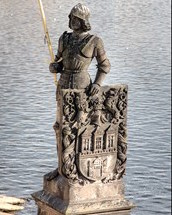
bruncvik
In the morning Bruncvík left with fifty followers on horseback with him. They rode out of Prague and headed deep into the forest. Bruncvík and his followers searched high and low but found no sign that would explain his quest. They left the forest and at its edge came across some charcoal burners. Bruncvík spoke to the charcoal burners, ‘have any of you seen aught of omens.’ Well the charcoal burners were very superstitious and were very afraid of what Bruncvík  said of omens. Some of then took up their staves and made to drive Bruncvík  and his men off. A great fight broke out and many men were killed.
Then Bruncvík headed off across the plain and he and his men were plagued with thirst. Some of his men turned back saying, ‘there are no omens, this is no quest, but madness.’ Finally Bruncvík reached the edge of the  ocean. They boarded a ship to cross the ocean but became marooned on the dreaded ‘Ember Isle’ a lonely and barren rock. Bruncvík climbed to the top of the peak in the centre of the island to try and spy a passing ship but found the peak occupied  by a gigantic bird which swooped down and snatched up one of Bruncvík’s men and swallowed the man down whole. The other men ran off in terror leaving Bruncvík alone with a single companion. They spent the night cowering inside a cave in fear of the giant bird. In the morning they came across a dead horse and realised it might be a way to escape. Bruncvík’s companion sewed him into the dead horse’s carcass. Just at that, the bird returned and snatched up the horse carcass. The great bird then flew to the mainland and dropped the horse carcass into a huge nest to feed her three young chicks. As the three chicks tear at the carcass Bruncvík wriggled free and made his escape.

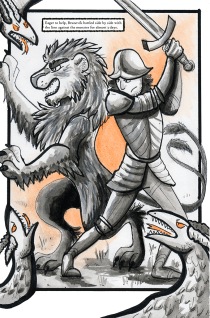
Bruncvík then thought of home and his beloved Neomenia. His quest had been fruitless and, full of sorrow that he had not been able to fulfil his vow to his father, he returned to the forest to find his path home. After walking in the forest for some time he heard a great roaring up ahead, he walked on and came to a small clearing where he saw a noble lion fighting a nine-headed beast. The lion was near exhaustion and Bruncvík was moved by its plight. Unsheathing his sword Bruncvík, stepped forward and attacked the beast. The monster showed no sign of tiring and fought Bruncvík  until he too was exhausted. Day after day the beast fought. On the third day, just as it seemed as if the beast would win, Bruncvík  and the lion make one final attack together. The lion pounced and Bruncvík raised his sword and brought it down but the beast jumped out of the way and the sword landed on the lion’s tail slicing it lengthways in two. At this the lion roared and leapt on the beast while Bruncvík chopped off its head.
b66315efef39a8f0576170-bruncvik-a83126762a8d063fe942badc35f8be14b6d104d40

The beast was vanquished but the lion lay on the ground, blood poured from its sliced tail. Bruncvík wept and prayed. Bruncvík’s prayers reached the gods and the wound on the lion’s tail healed, although the tail remained in two pieces. Bruncvík and the lion were amazed at this and although no word was spoken become devoted to each other. Bruncvík turned for home with his new found companion and they walked through the forest until night when they lay down to rest under a cursed tree. In the morning when they awoke they realised they did not know the way home. A mist has arisen and obscured their way. Suddenly a demon appeared out of the mist and challenged Bruncvík to a duel. They fought for many hours but eventually the demon tired. Just as it seems that Bruncvík would be victorious and just at the moment his sword pierced the demon’s heart, the fiend bite Bruncvík’s hand and poison from his fangs entered Bruncvík’s blood. The demon died but Bruncvík fell to the ground as if dead. His good friend the lion roared in anger and licked Bruncvík’s face to try to wake him, to no avail. For several days Bruncvík lay as if dead, while the lion watched over him. He washed him gently with his great tongue, carried water to him in his shaggy mane and keept him warm at night. Finally after seven days  Bruncvík recovered and they continued on their way home to Prague. Finally they reached the end of the forest but found themselves in a strange land ruled by strange women. When the women saw Bruncvík and his lion they declared he should marry their ruler. Bruncvík refused stating, ‘I already have a wife and I must return to my home in Prague.’ The woman locked Bruncvík up and put the lion in a cage. Bruncvík broke out and ran to the cage to free the lion but it was locked with great chains. He saw a sword hanging nearby and taking the sword down tried to break the chains but the sword flew out of his hands. He cried out in anger and desperation, ‘oh sword why won’t you break the chains around that cage.’ At which point the sword broke the chains. Bruncvík realised that the sword was magical and decided to take it with him to Prague. He and the lion left the land pursued by the women but when Bruncvík commanded the sword to attack the women and cut off their heads the women retreat.

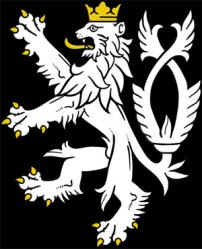
Finally Bruncvík arrived back in Prague after seven long years. As he arrived he found the whole court in all its finery and Neomenia about to get remarried. When he arrived in the great hall everyone rejoiced at his return and wondered at the lion with the two tails. Bruncvík and Neomenia renewed their vows and ruled together with great wisdom.The lion remained at court for many years and when Bruncvík finally died, the lion sat roaring on his grave for seven days before he too died of a broken heart.
bohemian-lion-stock

——-oO——-

Posted in Uncategorized | Leave a comment

The Four Great Regents – Isabella Clara Eugenia

In the late sixteenth and early seventeenth centuries the Netherlands  were ruled by a quartet of women: Margaret of Austria, Mary of Hungary, Margaret of Parma and Isabella Clara. These four women were remarkable not only because they ruled at a time when the idea of women’s rule was anathema to most but also in the effective and in most areas positive manner in which they ruled.

Isabella Eugenia, joint rule with her husband 1601 – 1621,  rule as sole regent 1621-1633

Isabella Clara Eugenia of Austria was born on the 12 August 1566 in Segovia. She was the daughter of Philip II of Spain and his third wife Elisabeth of Valois and was the granddaughter of Emperor Charles V. When Isabella was barely two years old her mother died and in 1570 her father married his niece Anna of Austria. Just after her mother’s death Philip concluded a marriage contract with Maximilian II, the Holy Roman Emperor, for Isabella to marry the Emperor’s son Rudolf II. Rudolf was also Isabella’s cousin. Around 1588 the adult Rudolf declared he did not want to marry anyone and the contract was broken.

1618-isabella-clara-eugenia-2
In 1589, Isabella’s uncle, Henry III of France, was assassinated and Philip claimed the French crown on her behalf despite French Salic Law, which forbade cognatic succession. In addition, Elisabeth of Valois had ceded any claim to the French crown when she had married Philip. However the Parlement de Paris, for religious and political reasons declared Isabella as ‘the legitimate sovereign’ of France. The Catholic nobility were concerned about the claim to the crown by the protestant Henry III of Navarre. Despite the proclamation of the Parlement, Henry pressed his claim under traditional French inheritance laws. The Parlement, and eventually, the Catholic nobility realised that to reject Henry’s claim was to reject French tradition which could undermine their own authority. A compromise was reached and Henry’s claim was accepted, he converted to Catholicism and was crowned in 1594.
Philip then turned to another possible marriage for Isabella. He decided that Archduke Albert of Austria, Rudolf’s younger brother. At the same time as arranging a marriage Philip was attempting to consolidate his power in Spain. As always in the European power politics on the early modern era the wealthy, but stubbornly different, northern provinces needed delicate handling. Philip decided to cede the Spanish Netherlands to Isabella. He was confident that she could handle the needs of his northern subjects while freeing him to concentrate on Spain.
Philip decreed that Isabella and Albert were to jointly reign over the Netherlands as duke/count and duchess/countess. In addition to his secular title as an Archduke of Austria, Albert was also the Archbishop of Toledo. In proposing the match, it was understood that Philip would bear the cost of pleading with Pope Clement VIII to release Albert from his religious commitments. The was by no means guaranteed and would cost a considerable sum of money, not only in the cost of sending emissaries to Rome but in the donation that would be required to release Albert.
While Philip was arranging matters with the Pope he became ill. Initially thought to be merely a combination of various complaints including gout, arthritis and a stomach ulcer, Philip was finally diagnosed with cancer. Isabella returned to her father’s side and nursed him for the next three years. Philip died in September 1598 having renounced all his rights to the Spanish Netherlands in favour of Isabella. On 18 April 1599, Isabella married Albert. The marriage, although arranged for political reasons, proved to be a happy one.

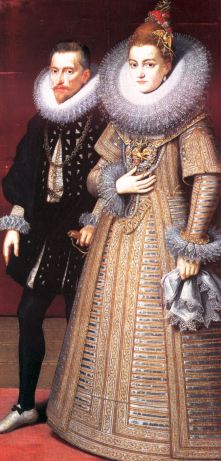
landvoogden_albrecht_en_isabella_van_oostenrijk
In 1601, Isabella and Albert assumed rule of the Spanish Netherlands. The country had endured some four decades of religious and economic war and all sides longed for peace. Isabella and Albert were both of a pragmatic mind and recognised that while no-one wanted a continuation of the previous years of conflict a reconciliation that satisfied all sides would take a long time to achieve and would be unlikely to achieve everything that everyone wanted. This recognition allowed them to operate in the fractured politics of the Spanish Netherlands. Under Isabella and Albert rule, the economy of the Spanish Netherlands was stabilised and previous anti-Spanish sentiments were reduced. However, Isabella and Albert were aware of the resentment felt by the loss of the northern provinces in 1581. Many in the Spanish Netherlands blamed the authoritarian rule from Spain for the loss of the provinces north of the rivers. Others felt that Spain had not been sufficiently ruthless in dealing with the northern rebels. Religious divisions also remained. While the majority of those in the Spanish Netherlands  were Catholics some were Protestant. Resentment over any concessions given to the  minority continued to rankle with many devout Catholics. The main bone of contention was, however, economic. The northern and southern provinces had always had different trade outlets to the north and south but a large percentage of their trade had been with each other including access to their respective foreign markets. This issue, above all others, was Isabella and Albert’s prime concern.
They addressed this by rejecting any notion of an independent country for the Spanish Netherlands and worked for the reincorporation of the Southern Provinces into the Spanish monarchy. A reincorporation that, in Isabella and Albert’s mind, would revitalise the economy of the Spanish Netherlands. They encouraged the development of artistic endeavours most notably in the Baroque,which had been popularised in the wake of the Catholic Reformation. Thus resulted in the creation of the Flemish Baroque painting.
They patronised several artists such as Pieter Brueghel the Younger, Coebergher, Peter Paul Rubens, the Van Veens and the De Nole family. Isabella and Albert used the arts to promote the Spanish Netherlands as an artistic and political centre. They encouraged artists to visit and work there and then used the lure of the art produced to bring political and philosophical thinkers. This developed a momentum such that the court at Brussels became a centre for political thought. Isabella and Albert also used their connections to invite family members and friends to court such that  Brussels became a key link in the chain of Habsburg Courts.
Between 1601 and 1621 Isabella and Albert rescued the Spanish Netherlands from the disaster that had been the independence of 1581. They revived its fortunes and created a vibrant artistic and political entity. However, that had been built on the strength of Isabella and Albert’s personalities and connections. It was not, yet, fully embedded but needed a few more years of continuity. In 1621, Albert died and the country could well have fallen into disarray. Philip III, King of Spain, recognising the danger appointed his half-sister as Governor of the Spanish Netherlands. Continuity guaranteed the country continued to flourish under Isabella’s rule but with one slight change. After Albert’s death, Isabella joined the Third Order of St Francis and continued her role as Governor of the Netherlands while keeping to the precepts of the Franciscan order. She continued to promote the arts and the production and trading of luxury items while leading an increasingly simple life within her palace in Brussels. The contrast between the luxury of her surroundings and the simplicity of her life heightened her reputation as a patron who genuinely appreciated artistic effort and enhanced the reputation of her court as somewhere politics might take place free of the taint of corruption.

isabella_clara_eugenia_as_a_nun
Isabella died in 1633, the last of the Four Great Regents. She was succeeded as Governor by Cardinal-Infante Ferdinand, the third son of her half-brother Philip.

——-oOo——-


Posted in Uncategorized | Leave a comment

The Four Great Regents – Margaret of Parma

In the late sixteenth and early seventeenth centuries the Netherlands  were ruled by a quartet of women: Margaret of Austria, Mary of Hungary, Margaret of Parma and Isabella Clara. These four women were remarkable not only because they ruled at a time when the idea of women’s rule was anathema to most but also in the effective and in most areas positive manner in which they ruled.

Margaret of Parma, period of rule 1559 – 1567, 1578 – 1582

Margaret of Parma, was born on the  28 December 1522 – 18 January 1586)
Margaret of was Parma was born on the 28 December 1522. She was the illegitimate daughter of Charles V and Johanna Maria van der Gheynst. While her father was the Holy Roman Emperor her mother was a servant of Charles de Lalaing, Seigneur de Montigny. Although illegitimate and a girl Charles placed under the care of her great-aunt, the Archduchess Margaret of Austria, and her aunt Mary of Austria. Both of whom had been governors of the Netherlands.
Margaret spent her childhood in the palace of her aunts in Mechelen. In 1526, Charles V arranged a political marriage for Margaret. Charles had ambitions in Italy and proposed a marriage between Margaret and Alessandro de’ Medici, Duke of Florence and the nephew of the Pope Clement VII (born Giulio di Giuliano de’ Medici). The de’ Medici family agreed the match and in 1527, when Margaret was five years old she was officially engaged to Alessandro. The marriage contract was signed by Charles and Pope Clement VII in 1529. Once the marriage contract was officially signed Charles publicly acknowledged Margaret as his daughter and she was given the title Margaret of Austria.
In 1533, Margaret left Mechelen for Italy and was educated in the courts of Florence, Parma and Rome. In 1538 the marriage finally took place between the fifteen year old Margaret and the twenty eight year old Alessandro. The marriage was short-lived however. In 1537, Alessandro’s  cousin Lorenzino de’ Medici, ‘Lorenzaccio’ (bad Lorenzo), assassinated him. Lorenzino had promised Alessandro sex with his sister Laudomia, a noted beauty. On arriving at the assignation point, Alessandro was stabbed by Lorenzino.
Charles, angered at the murder of Alessandro and its effects on his political machinations in Italy then proposed a wedding between Margaret and Ottavio Farnese, Duke of Parma. Margaret attempted to defy her father and stated she would not remarry so quickly or to a man whom she disliked. However, her father brought pressure to bear and she eventually married Ottavio on 4 November 1538. The marriage was a deeply unhappy one as the couple disliked each other and the political arguments over control of Parma between the Pope and the Emperor put a great deal of stress on the couple. In 1545, Margaret gave birth to twins sons, Charles and Alexander, Charles died in infancy. Having ‘done her duty’ and provided a male heir,  Margaret and Ottavio agreed to live apart, maintaining separate households. By 1555, the political situation in Parma had come to a head and the Farnese family were officially recognised as rulers of Parma by Spain in exchange for the custody of Alexander. Margaret then left Italy and travelled back to the Netherlands. Alexander was given in to the care of Margaret’s half-brother Philip II.

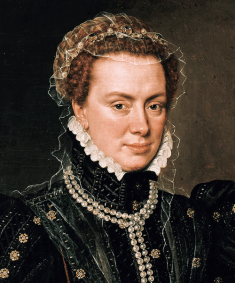
ccm1q-ixiae9b4b
After the death of Mary of Hungary in 1555, Phillip has assumed his rule over the Netherlands. However, by 1559 his main ambitions lay in Spain and he appointed Margaret as governor of the Netherlands. The country that Margaret was to govern was in turmoil. The imposition of the Inquisition and the form of rule from Spain which disregarded many of the old laws and authorities of the provinces were deeply resented. To add to Margaret’s troubles, the form of governorship which Philip had given her had little actual authority. Rule and law came from Spain and Margaret was merely in place to ensure that such rule was complied with in Philip’s absence. In addition Philip had put Cardinal Antoine Perrenot de Granvelle in position in the Netherlands as a leading minister to ensure Philip’s edicts were carried out. Granvelle was so disliked in the Netherlands that even Philip was forced to recall him to Madrid in 1564. In 1565, the continuation of Philip’s harsh rule resulted in the formation of an opposition party. Margaret met with the leaders of the party and listened to their complaints which mainly centred on religious repression. Margaret understood the reality of the situation; the opposition party was strong with widespread support and she lacked force with which to subdue them. Pragmatically she agreed to stop the religious repression.
In 1566, Iconoclastic riots took place all across the Netherlands. Margaret managed to stop them, but Philip, angered by development in the Netherlands decided to send a military force under the the Duke of Alba. Margaret warned Philip that Alva’s tactics would merely exacerbate an already tense situation and probably lead to disaster. When Alva finally arrived in 1567, Margaret discovered that his power of authority from Philip was greater than her own. Margaret resigned the governorship and retired to Italy.

margaret-of-parma-duchess
Once in Italy Margaret was appointed governor of Abruzzo, where she had inherited a domain from her late husband. In 1578, Philip appointed Margaret’s son Alexander as governor-general of the Netherlands. Philip approached Margaret and asked her to become co-governor with Alexander. It was thought that Margaret’s experience and Alexander’s enthusiasm would prove a good balance and allow the Netherlands to reach an equilibrium between its different religious communities. However, the joint arrangement proved unworkable. Alexander proved unable to accept his mother’s advice preferring the autocratic style of Philip in many of this dealings with the Dutch. He was unwilling to accommodate religious plurality seeing it as a challenge to Spanish Habsburg rule. In 1582, Margaret resigned her post as co-governor and the following year Philip gave her permission to return to Italy. She died in Ortona in 1586 and was buried in the church of S. Sisto in Piacenza.

——-oOo——-

Posted in Uncategorized | Leave a comment

The Four Great Regents – Mary of Hungary

In the late sixteenth and early seventeenth centuries the Netherlands  were ruled by a quartet of women: Margaret of Austria, Mary of Hungary, Margaret of Parma and Isabella Clara. These four women were remarkable not only because they ruled at a time when the idea of women’s rule was anathema to most but also in the effective and in most areas positive manner in which they ruled.

Mary of Hungary, period of rule, 1531-1555

Mary of Hungary, who was also known as Mary of Austria was born on 15 September 1505 to Queen Joanna and King Philip I of Castile. When she was ten years old she was married to King Louis II of Hungary and Bohemia.

During her time in Hungary, Mary became aware of the teachings of Martin Luther. Highly intelligence she read widely and discussed the issues surrounding the new teachings. This attracted the interest of Martin Luther, who dedicated four psalms to her in 1526. This interest in the new religious teaching gave rise to severe disapproval from Mary’s family, most notable her brother Ferdinand. Under pressure from Ferdinand Mary turned to her court preacher, Johann Henckel, who led here back to the core Catholic beliefs. Despite this Mary continued to hold Martin luther and his basic teachings in high esteem.

1519-mary-of-hungary-by_med

King Louis died at the battle of Mohács in 1526 and Mary’s brother Ferdinand I was proclaimed the new king.  The lands that Ferdinand had inherited were deeply troubled due to the actions of the  pretender to the throne, John Zápolya. In order to further consolidate his power Ferdinand concentrated on subduing the nobility of Bohemia and asked Mary to act as his regent in Hungary. By 1530, Ferdinand’s power was secure and Mary stepped down from her role as regent. However, her time in Hungary had demonstrated her political acumen and when her aunt, Margaret of Austria, died in 1530 Emperor Charles V, Mary’s older brother, asked her to take over the governorship of the Netherlands. Mary was reluctant to do so as, despite her success in Hungary, she disliked the role of political leader. Nevertheless she took over as governor of the Netherlands in January 1531.

The governance of the Netherlands was fraught with difficulties at that time. Mary faced the disruption felt across Europe from the Reformation. In addition, the Netherlands was frequently caught in the political rivalry between the Emperor and the King of France. Although she never enjoyed governing Mary proved to be an extremely competent ruler.  So much so that the Emperor granted her greater powers than those enjoyed be her aunt. The style of the two women was in stark contrast. Margaret had been known to rule as many female regents; she was feminine, flexible, adaptable, witty, flirtatious and charming. Mary’s rule was compared to that of a man. She was authoritarian, exercising might more than mercy. She was known to be singleminded, determined and seldom swayed by emotion. Although this allowed her to deal with the many problems that beset the Netherlands, Mary felt her lack of femininity or ‘power as a woman’ as a personal failing. In addition to her personality Mary was not a great beauty and it was felt that her lack of physical grace was the reason for her lack of feminine charm.

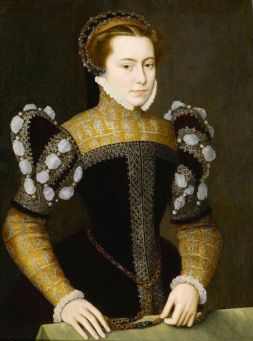
marie_de_hongrie_1520
To add to Mary’s burdens the regency of the Netherlands also meant that she assumed the guardianship of her nieces, Dorothea and Christina of Denmark, the daughters of her older sister, Queen Isabella of Denmark, who had died in 1526. This further involved her in the machinations of the Emperor as he sought to place the girls into politically advantageous marriages. In 1532, the Emperor agreed a marriage for Christina to Francesco II Sforza, the Duke of Milan. Mary felt that Christina, who was only eleven 11 years old, was too young for the marriage. Defying the Emperor Mary managed to delay the marriage until March 1533.

In religious matters Mary was personally tolerant towards Protestants but under pressure from the Emperor suppressed Protestantism across the Netherlands. She was also initially challenged by several of the leading noble families. The families received their positions through the patronage of the regent.Several of the families had started to build support in specific geographic areas and worked to ensure their sons received their positions after them. Mary recognised the danger to the Emperor’s authority should the families cement the support. Mary solved this by giving the families the coveted court position but in different regions. She faced the wrath of the families but was eventually supported by the Emperor who recognised her wisdom and loyalty in protecting his interests.
In 1555, Charles decided to abdicate as emperor in favour of his brother Ferdinand and gave the governorship of the Netherlands to his son Philip. Mary decided to resign from her post and although Charles and Philip urged her to remain in the post she formally transferred her authority to Philip in October 1555.  In 1558, Charles and Philip asked Mary to consider resuming her regency in the Netherlands but Mary declined. However, in August of the same year Charles became ill and Mary changed her mind, she would become governor once again.

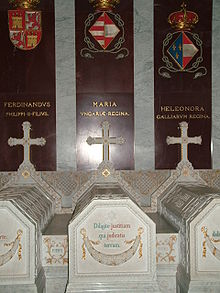
In September 1558, Charles died. Mary had two heart attacks in October and on 18 October 1558. Mary was first buried in the Monastery of Saint Benedict in Valladolid. Fifteen years after her death, Philip ordered that the remains be transferred to El Escorial.

220px-grabmaria_von_ungarn

——-oOo——-

Posted in Uncategorized | Leave a comment

The Four Great Regents: Margaret of Austria

In the late sixteenth and early seventeenth centuries the Netherlands  were ruled by a quartet of women: Margaret of Austria, Mary of Hungary, Margaret of Parma and Isabella Clara. These four women were remarkable not only because they ruled at a time when the idea of women’s rule was anathema to most but also in the effective and in most areas positive manner in which they ruled.

Margaret of Austria, period of rule 1507-1515, 1519-1530

Margaret  1


Margaret of Austria the daughter of Maximilian I, Holy Roman Emperor and Mary of Burgundy, co-sovereigns of the Low Countries, was born in 1480. She was betrothed to Charles, the son of Louis XI of France in 1482. In that same year her mother died and Margaret was transferred to the guardianship of King Louis XI of France and was educated at the French court. Despite the betrothal Charles renounced the agreement and married Margaret’s stepmother Anne, Duchess of Brittany as a more profitable political alliance. (The Duchess of Brittany had been married to Margaret’s father by proxy but their marriage was annulled). Margaret’s father arranged  marriage with John, prince of Asturias, sone of Queen Isabella I of Castile and King Ferdinand II of Aragon. Margaret and John married in 1497 but John died only six months later. After delivering a still born daughter Margaret returned to the Netherlands in 1500 where she was godmother to her brother’s new born son Charles of Austria. In 1501, Margaret married Philibert II, Duke of Savoy who died three years later. The marriage was childless.
In 1506 Margaret’s brother, Philip, died and in November she was elected ruler by the representative assembly of Franche-Comté (the title was confirmed in 1509).  Her father Emperor named her governor of the Low Countries and guardian of her young nephew Charles (the future Charles V, Holy Roman Emperor) in 1507.
Margaret was a skilful regent. Caring deeply for her subjects she frequently pressed their case with the Emperor, her father. She also negotiated with the English on behalf of Flemish cloth merchants and obtained a treaty of commerce that was extremely favourable to the interests. Margaret was also interested in politics across Europe and played a role in the formation of the League of Cambrai in 1508.
In 1515, Margaret’s nephew, Charles, gained his majority and dismissed her as regent. However, within four years Charles recognised Margaret’s  value and reappointed her as regent. Margaret continued to infleunce politics across Europe and in 1529, together with Louise of Savoy, she successfully negotiated the Treaty of Camcrai, the so-called Ladies’ Peace.
In addition to the economic and relative political stability that typified Margaret’s rule she added patronage of the arts. Margaret was musical, well read and wrote poetry.She encouraged humanists and artists to her court at Mechelen,  where she has amassed a large library with several missals, historical and ethical treatises.The library held several musical manuscripts including works by Josquin des Pres, Jacob Obrecht, Pierre de la Rue and Johannes Ockeghem. Her court was also frequented by artists such as Pieter van Conixloo and Master of the Legend of the Magdalen.

Margaret died in 1530 at Mechelen. She is buried at Bourg-en-Bresse.

67

——-oOo——-

Posted in Uncategorized | Leave a comment

Sascha Gura

Silent movie star Sascha Gura was born in Munich in 1896. Born Eugenia Theresia Gura, she was the daughter of actor and singer Hermann Gura and the granddaughter of actor and singer Eugen Gura. Growing up in an artistic home it wasn’t long before Sascha’s talent was recognised. After an early education at the local gymnasium she auditioned for a place at the Königliche Hochschule für Musik in Munich. Sascha was accepted and in 1914 started her studies at the Königlichen Musikkonservatorium under the artistic director Franz Hauser. While still at the Königlichen Musikkonservatorium she started singing professionally mainly in short operettas. At the same time she was spotted by Otto Rippert, the film director, who offered Sascha a part in his new film. Der Totentanz (Dance of Death) had been scripted by Fritz Lang and was an exploration of sex and death, love and power. Sascha played a dancer who seduced men by her dancing and then killed them under direction of a man seeking revenge on the world. The film was released in 1919 and was an instant success. This was followed by a several more films films exploring dark themes: Das Phantom des Lebens (Phantom of Life) in 1919, Wie Satan starb (How Satan Died) in 1920 and Unter der Knute des Schicksals (Under the Knout of Destiny) in 1921.

5751796795_0bea208c9b_n

http___www.filmportal.de_sites_default_files_0603E60986B54D7F8C1DAE8E3C229E0A_Gurax_Sascha_01.jpg.thumbnail
While she was filming Das Phantom des Lebens she met Hermann Karl Rudolf Friederich von Oppen. After something of a whirlwind romance the two were married in September 1920. At the same time Sascha was enjoying success at the Berlin’s Komische Oper. Her greatest success came when she was chosen for the lead role in a new film by F.W. Murnau. The great director had seen her in Der Totentanz and thought Sascha perfect for a similar film he was developing. Die Bücklige und die Tanzerin explored similar themes to Der Totentanz: a disfigured man wreaks his revenge on the world via a young dancer. Sacha was cast as the dancer Gina opposite John Gottowt. The film was yet another success and Sascah’s career continued to prosper. Unfortunately her marriage was proving to be less successful. In July 1922 Sascha and Hermann divorced although she kept the name von Oppen Gura.

ffe34c76af25e2fe6b1a743f598ab7d9
Sascaha’s film career continued to develop as she became an lead in several German and Austrian films mostly dealing in drama and horror.  She was a favourite of film going audiences and critics alike and was known by directors as a consummate professional. In 1921 she had acted in Die Liebschaften des Hektor Dalmore(The love affairs of Hektor Dalmore) Directed by Richard Oswald, the role of Hektor had been played by Conrad Veidt. This film raised Sascha’s profile with the general public. Several more film roles cam along until in 1927 Sascha starred in Bezwinger der 1000 Gefahren (Conqueror of 1000 dangers) directed by its male star, Harry Piel. This was to be Sascha’s last silent movie.
The coming of ‘the talkies’ was a new challenge for Sascha and one that she relished. The expressionist acting style of silent movies, with the need to visually portray emotion, gave way to the more natural style in films with dialogue. Unfortunately for Sascha, at the same time as the new film media was coming to the fore the Nazi part was coming to increasing prominence in Germany. And Sascha was Jewish.

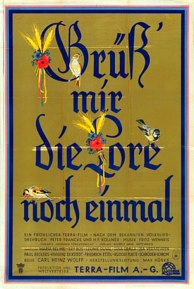
In 1932, Sascha appeared in Trenck – Der Roman einer großen Liebe (Trenck – The novel of a great love). Her part was not a leading one but she showed as ever her screen presence, capable of the new acting style and her speaking voice translated well. For some silent movie stars the arrival of talking films was a transition that proved difficult to make. Sascha’s next role was in 1934 in Grüss mir die Lore noch einmal (Greet Lore for me one more time). Her role was main supporting actress and her performance showed her growing confidence in the new medium. However, this role was to prove her last.

gruess-mir-die-lore-noch-einmal
Sascha’s last entry in the Berlin address book was in 1931 where she was listed as a singer. The continued pressure on Jewish artists from the Nazi regime caused many to flee, most notable to the United Kingdom and the USA. Sascha, however, was not one of them. Sascha disappeared some time after the release of Grüss mir die Lore noch einmal. Her fate remains unknown.

542369719

——-oOo——-

Posted in Uncategorized | Leave a comment

Dragutin Dimitrijević – ‘Apis’

Dragutin Dimitrijević was born in Belgrade on the 17 August 1876 into an ordinary middle class family. He was noted to be academically bright in his junior school and at the age of sixteen was sent to the Belgrade military academy. He excelled at the academy and when he graduated two years later he was recruited into the Serbian Army’s General Staff.
Dimitrijević served as a junior officer and reached the rank of captain during the early reign of King Aleksandar Obrenović (Alexander I). Aleksandar had ascended the throne of Serbia in 1889 when his father, King Milan, had abdicated. As a loyal member of the  army Dimitrijević had pledged allegiance to the king but dissatisfaction over the king’s reign soon started to spread through the army. In 1900 Aleksandar married Draga Mašin, a former lady-in-waiting to his mother. The marriage had taken place without his father’s permission or approval. In addition  Draga Mašin’s status was considered to render her unsuitable to marry the young king. The king’s mother also opposed the marriage and Aleksandar  sent her into exile. Due to the lack or resect shown to his father and slight to the royal house in marrying beneath him, opposition to the king grew. The Prime Minister, Dr. Vladan Đorđević, felt so strongly that the marriage was unsuitable that he resigned immediately. from his offices. This loss of a key ally in the parliament weakened Aleksandar’s position politically. He had difficulty in forming a new cabinet and this created further antagonism as politicians felt the political upheaval to be entirely the king’s fault. The differing political parties in Serbia was exercised by various issues foremost amongst those being the Serbian nationalist who were agitating for the return to a greater Serbia encompassing the ‘traditional’ heartlands of Serbia and their antagonism to the Dual Monarchy of Austria- Hungary and their treatment of the Serbs that lived within their borders. In order to address these issues Aleksandar presented the parliament with a new liberal constitution. The new constitution allowed for issues to be discussed with all opinion heard and acted to reduce political criticism of the king.

Apis 1
However, although political tension had somewhat reduced a rumour arose that the king intended to name Lieutenant Nikodije, one of Draga Mašin’s brothers as heir presumptive. Lieutenant Nikodije was personally unpopular and moreover this was seen by many as a further slight on the royal house. Tension rose in the army and in early 1903 a plot arose to assassinate the king and queen. On the 11 June 1903, Dimitrijević and several of his fellow junior officers broke into the royal palace and killed the king and queen. The killing was particularly brutal. King Aleksandar and Queen Draga were shot and their bodies mutilated and disemboweled and thrown from a second floor window of the palace onto piles of garden manure lying below.

Dimitrijević did not participate in the actual murders, having been wounded in the storming of the palace. After the deaths of King Aleksandar and Queen Draga, Petar I Karađorđević became king of Serbia. The Serbian parliament declared that Dimitrijević was ‘the saviour of the fatherland’ and immediately appointed him Professor of Tactics at the Military Academy.  Dimitrijević flourished in the role. He travelled widely across Europe studying various different military tactics and training regimes.  During this time Dimitrijević became increasingly convinced of the need for all Serbs to join together in a greater Serbia. The intransigence of Emperor Franz Josef in this matter raised tensions across the Balkans. By 1911 Dimitrijević tried to arrange for the emperor’s assassination but was unsuccessful. However, in 1912 war broke out in the Balkans and Serbia, under Dimitrijević’s direction won several decisive victories increasing the land under Serbian control and the political calls for a greater Serbia.
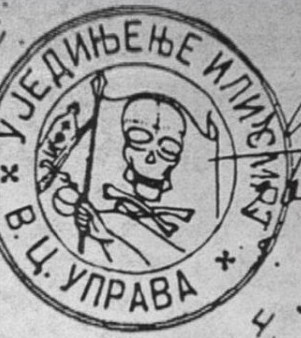
The group that had undertaken the royal assassination were members of the Ujedinjenje ili smrt  (Unification of Death) more generally called the Crna ruka (Black Hand) a group that had formed in 1901. By 1912 Dimitrijević was simultaneously the head of Serbian military intelligence and the leader of the Ujedinjenje ili smrt and was known as Apis (the Bull). Apis was increasingly worried by the action of the Archduke Franz Ferdinand and his conciliatory attitude towards the Serbs. If he succeeded the elderly emperor and his moderate political reforms were accepted then support for a greater Serbia might dissipate. Apis needed to remove the archduke and precipitate an aggressive act on the part of the Austrians to allow him in turn to retaliate. A series of incursions into Austrian territory were orchestrated by Apis alongside several political murders but Austria still refused to react. In the summer of 1914, however, the archduke announced his intention to visit Sarajevo to view military manoeuvres and Apis sensed an opportunity

Apis 2
In June 1914, Apis contacted Mlada Bosna (Young Bosnians) a group that agitated for the unification of all southern Slavs and recruited three young members; Gavrilo Princip, Nedeljko Čabrinović and Trifko Grabež. They were to assassinate the archduke. As the Bosnians were young Apis also recruited several older Serbians to help in the plot,  Veljko and Vaso Čubrilović, Muhamed Mehmedbašić, Danilo Ilić, Cvjetko Popović and Miško Jovanović. However, Major Vojislav Tankosić, another member of Ujedinjenje ili smrt, felt the plot to be badly timed and took his concerns to Nikola Pašić, the prime minister. Pašić agreed with Tankosić, feeling the assassination to be likely to plunge Serbia into a flown blown war with the Austrians for which they were ill-prepared. Pašić ordered the three Bosnians to be arrested but the order was not implemented and the three arrived in Sarajevo where they met up with the four Serbians.
On the 28 June 1914 Gavrilo Princip assassinated Franz Ferdinand Archduke of Austria. The Austrian authorities instantly rounded up several members of the Ujedinjenje ili smrt. Under interrogation the men named Dimitrijević, Milan Ciganović, and Major Voja Tankosić as the organiser of the plot. On 23 July 1914, the Austro-Hungarian government sent an ultimatum to the Serbian government with a list of ten demands and a deadline of 5 p.m on the 25 July by which to reply. The ultimatum was worded such that is was extremely unlikely that the Serbians would comply and thus allow the Austrians to declare war; the intent of the  ‘war party’ in Vienna. Pašić responded on 25 July 1914, accepted all the points of the ultimatum except the demand that Serbia allow an Austrian delegation to participate in a criminal investigation against those participants in the conspiracy that were present in Serbia. On the 28 July the Dual Monarchy of Austria-Hungarian declared war on Serbia.
The declaration of war saw, Dimitrijević expand his role as head of military intelligence and work across all aspects of the Serbian war machine. Several early successes in the war saw Dimitrijević promoted to colonel in 1916. Although this promotion was popular within the army Pašić was becoming increasingly concerned at Dimitrijević’s growing influence and power. The Ujedinjenje ili smrt had been officially banned in 1915. but had merely continued as before. In September 1916 there had been an attempted assassination of the regent Aleksandar I Karađorđević. Pašić then made his move and arrested Dimitrijević and several of the other senior members of Ujedinjenje ili smrt on suspicion of having planned the assassination.
Dimitrijević and his co-defendents were put on trial, the Salonika Trial, and on the 23 may 1917 were found guilty of treason and sentenced to death. Dimitrijević was executed on 24 June 1917, by firing squad. In 1953, Dimitrijević and his co-defendants were all posthumously retried by the Supreme Court of Serbia. They were found not guilty due to the lack of proof of their involvement in the assassination plot.


——-oOo——-

Posted in Uncategorized | Leave a comment

Joseph Roth

Joseph Roth, born Moses Joseph Roth, died in Paris on 27 May 1939. Roth was born in the small town of Brody near Lviv in East Galicia, part of the Dual Kingdom of Austria-Hungary, on 2 September 1894. His parents were parts of the large Jewish community in Brody, although Roth’s father had left the family home before Roth’s birth.

JosephRoth_Flash_0

Roth showed early promise at school and while at the local high school was encouraged by his teachers to consider attempting to gain a university place. In 1913 Roth began university in Lviv but was unable to settle down to his studies. In 1914 he transferred to the University of Vienna where he read philosophy and German literature. In 1916 Roth left the university and joined the Imperial Habsburg army. Roth was posted to the Eastern Front where he served as a war correspondent. Roth witnessed at first hand the conditions of soldiers on both sides of the conflict as well as the inter-racial discriminations suffered by the many ethnic groups within the Habsburg forces.

At the end of the war Roth returned to Vienna and started work on several left wing newspapers rather than returning to his university studies. One of the main publications he wrote for was Vorwärts (Forward) the central publication of the Social Democratic Party of Germany. Roth wrote under the pen-name of Der rote Joseph (The red Joseph). Roth’s left wing politics and the political events in Weimar Germany  drew him to Berlin in 1920 where he worked for the Neue Berliner Zeitung and by 1921 he was also writing for the Berliner Börsen-Courier.

In 1922 Roth met and married Friederike (Friedl) Reichler and the couple initially set up home in Berlin before Roth’s  took them across Europe. in 1923 Roth was employed by the Frankfurter Zeitung as their main foreign correspondent. He travelled across Europe, filing reports from all corners of the continent. At the same time Roth was working on his novels. The first, Das Spinnennetz (The Spider’s Web), was published in serial form in 1923 in Austria. This success galvanised Roth to continue his fiction writing Hotel Savoy and Die Rebellion (The Rebellion) in 1924, April. Die Geschichte einer Liebe (April: The Story of a Love Affair) and Der blinde Spiegel (The Blind Mirror) in 1925.

While Roth’s writing had continued to be successful his marriage was in trouble. Roth and Friedl had been deeply in love when they had first met but over over several years Friedl had became mentally ill. By the late 1920s Friedl was diagnosed as schizophrenic. Roth was advised that she would need constant medical care and Friedl was admitted to a private lunatic asylum. This continued care would put a strain on Roth’s finances for the rest of his life.

On January 30, 1933, Adolf Hitler became Reich chancellor; Roth left Germany and moved to Paris where he spent most of the next six years. The increasing dominance of right wing politics strongly influenced his writing both reportage and fiction. His works evoked the memory of Central Europe before 1914 and in particular the Dual Monarchy. Most notably in works such as Radetzkymarsch (Radetzky March) written in 1932 and Die Büste des Kaisers (The Bust of the Emperor) written in 1935. His reportage work highlighted the plight of outsiders; Jews, the homeless, drunks. This element of his work produced Juden auf Wanderschaft (The Wandering Jews) in 1927 and Was ich sah: Berichte aus Berlin, 1920-1933 (What I Saw: Reports from Berlin), 1920-1933).

220px-Joseph_Roth_Radetzkymarsch_1932

In 1936 Roth had an affair with the German writer Irmgard Keun. The pair worked together, traveling extensively across Europe. However, despite this Roth was becoming increasingly depressed and drinking to excess as the Nazis tightened their grip on power in Germany. By 1938 the affair had burnt itself out and Roth D Keun went their separate ways. At the same time, despite continuing to write, Roth was earning less money. Fewer people were buying books and the number of left wing newspapers was decreasing across Europe. His depression and heavy drinking continued and he lived in a series of increasingly shabby hotels across Paris.

In 1939, his novella Die Legende vom heiligen Trinker (The Legend of the Holy Drinker) was published. The story tells the tale of a homeless alcoholic and his attempt to regain his dignity. Just after its publication Roth heard that the playwright Ernst Toller had hanged himself in New York. On hearing  the news Roth drank himself into a collapse and died on May 27 1939.

Roth is interred in the Cimetière de Thiais, south of Paris.

Friedl Roth was murdered by the Nazis as part of their Gnadentod (mercy death) policy regarding the mentally ill.

Posted in Uncategorized | Leave a comment

The Life of Arnold Schönberg

Arnold Schönberg or Schoenberg is known to the world as the innovative Austrian composer who revolutionised music with the introduction of atonality. Born in Austria in 1874, Schönberg was a leading member of the Second Viennese School.


Schoenberg-Arnold-13


Schönberg was born in the Leopoldstadt district) of Vienna to Samuel and Pauline Schönberg. Samuel, who was originally from Bratislava, was a shopkeeper, and his Pauline was a native of Prague. The family were lower middle class and Schönberg was an unremarkable child although he did show some early talent at music. Despite this his father was reluctant to spend money on musical instruction and Schönberg was largely self-taught. Nevertheless by 1894 he was taking some counterpoint lessons with Alexander von Zemlinsky, the composer.

By the late 1890s anti-Semitism was on the rise in Austria and in 1898 Schönberg converted to Christianity. While this acted as something of a self-defence against the anti-Semitism it also strengthened a sense of attachment to Western European cultural traditions that had been somewhat lacking in the family home.

In October 1901, Schönberg married Mathilde von Zemlinsky, the sister of Alexander. in 1902 a daughter, Gertrud, was born and in 1906 they had a son, Georg. By this time Schönberg had rejected the family trade and had decided on a career in music. He started out orchestrating operettas, while making his first steps in composing. One of his earliest works was Verklärte Nacht (1899). His early work attracted the attention of Richard Strauss and Gustav Mahler both of whom recognised his talent and nurtured the young composer.

During the summer of 1908, Mathilde left Schönberg for several months for the young Austrian painter, Richard Gerstl who was a personal friend. The affair was brief after which Mathilde returned to the family home and Gerstl committed suicide. Schönberg embedded this personal trauma into his work increasing the radical expansion of his musical expression most notably in Das Buch der Hängenden Gärten

By 1909 Strauss had adopted a more conservative tone in is music and his association with Schönberg stopped. However, Mahler adopted him as a protégé and continued to support him, despite the growing gulf between their individual musical styles. Schönberg’s work continued and in addition to composing in 1910, he wrote Harmonielehre (Theory of Harmony,) outlining his theory of music. Early in 1912 he moved to Berlin where he composed Pierrot Lunaire his great song cycle that employs, Sprechstimme, or melodramatically spoken recitation, within the work. He was offered a teaching position at the Vienna Conservatory by the director, Wilhelm Bopp, but declined stating that he needed to get away from the influence of Vienna.

The outbreak of the Great War World War I intruded into Schönberg’s life and despite being forty-two he was drafted into the army and found little peace in which to work. However, by 1918 he returned to Vienna and founded the Verein für musikalische Privataufführungen (Society for Private Musical Performances in Vienna). The Privataufführungen would provide a musical haven in which composers and musicians could work free from the constraints of the critics and the public. This was to be the birthplace of pure music uncontaminated by modern money and opinion. By 1921, despite having produced 353 performances, financial pressures grew too great and the the Privataufführungen closed its doors.
Mathilde died in 1923, and in August of the following year Schönberg married Gertrud Kolisch, sister of the violinist Rudolf Kolisch. In 1925 Schönberg was appointed Director of a Master Class in Composition at the Prussian Academy of Arts in Berlin. He was unable to take up his post until 1926 due to ill-health.

The increasing anti-Semitism of Austria and Germany and the rise of the NAZI party weighed heavily on Schönberg and in 1933 while on holiday in France he returned to his Jewish faith. His reasons were tow fold; Schönberg wanted to actively and publicly state his opposition to Nazism. and he felt deeply that his ‘racial and religious heritage was inescapable’. This move puts him in a dangerous position and in 1934 the NAZI party identified his music as ‘Jewish degeneracy’. He initially attempted to move to London before finally deciding to go to the United States.

After his arrival in the United States he changed the spelling of his name to Schoenberg.
His gained a teaching post at the Malkin Conservatory in Boston before moving to Los Angeles, where he taught at the Universities of Southern California and California. By 1935 he was then appointed visiting professor at UCLA .

In 1941, he became a citizen of the United States. Schoenberg died on 13 July 1951 and his ashes were interred at the Zentralfriedhof in Vienna on 6 June 1974.
Arnold Schönberg innovations in musical composition are, arguably, one of the most influential features within twentieth century music. His rejection of tonality was revolutionary. The traditional hierarchical tonal order in music, the diatonic scale, was subverted by Schönberg development of the dodecaphonic technique; manipulating all twelve notes of the chromatic scale. His work cannot easily be classified. His first ‘phase’ could be thought of as Expressionist and covers work such as Verklärte Nacht, Op. 4. The second ‘phase’ saw the initial development of dissonance and atonality and includes Das Buch der Hängenden Gärten, Op. 15. His final ‘phase’ saw the full development of the dodecaphonic technique and gave rise to compositions such as Variations for Orchestra, Op. 31.
Schoenberg’s archival legacy is collected at the Arnold Schönberg Center in Vienna.
http://www.schoenberg.at/index.php?lang=en

Posted in Uncategorized | Leave a comment

Building the Ringstraße

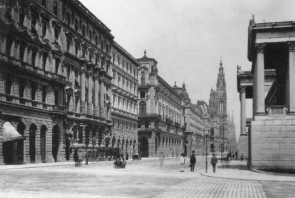
The Ringstraße in Vienna was built  after a decree by Emperor Franz Josef in 1857. The road transformed the city, creating a modern boulevard where the city’s military fortifications had previously stood. The road became a focus for much of Viennese public life. The Ringstraße employed various styles of architecture in the public buildings erected and acted as a testing for the competing architectural philosophies of the likes of Camillo Sitte and Otto Wagner.

ringstrasse-kl

The Altstadt (old town )  of Vienna had originally been surrounded by walls and a defensive glacis 500m wide. By the mid eighteenth century these fortifications had become redundant and some streets had been built within the glacis. This development was somewhat haphazard and could have further encroached on the glacis but for the revolution of 1848. The army, led by Generaladjutant Karl Grünne, troubled by the events of 1848 demanded the glacis be cleared of obstructions. The cavalry required room in which to attack any more potential revolutionaries. However, their demands were opposed by those who wanted the city to expand. In 1850 the Vorstädte (area just outside the city centre) was incorporated into the city which resulted in problems with the city walls blocking the traffic between the Altstadt and the Vorstädte. The tension between town planners and the military continued until 1857 when the emperor decreed that the walls and glacis be removed and a new road be built. Having seen the transformation of Napoleonic Paris the emperor decided on a scheme of greater scale to demonstrate the grandeur and longevity of the Habsburg Empire.

A city Expansion Committee was established to oversee the work. The military, although fanatically loyal to the emperor, retained their opposition to the scheme. Their opposition finally found some favour with the emperor and a new arsenal and two barracks were constructed near railway stations to allow the army to quickly move reinforcements into the city if necessary. Large tracts of land adjacent to the Hofburg were reserved for military purposes and the road itself was to be a broad boulevard allowing the army to move quickly in time of national emergency.

By the 1860s the liberals were in the ascendancy in the Austrian parliament and the mood was for a series of public buildings to be built along the Ringstraße promoting law and peace. The street enclosed the old city divided it from the suburbs. The design of the street was for the buildings to magnify the horizontal space of the Ringstraße. Unlike cities such as Paris the buildings were not oriented towards each other but towards the continuous movement of the street; alone or in small groups they always complemented  the Ringstraße. Political, educational and cultural ideals were expressed in an eclectic, historicist style called Ringstraßenstil (Ring Road Style) between the 1860s and 1890s. For example, the Rathaus was built in Gothic, designed by Friedrich Schmidt, the University was built in the style of the Renaissance, designed by Heinrich Fertel and the Burgtheatre built in the Baroque, designed by Karl Freiherr von Hasenauer.

One of the most imposing buildings was the Reichsrat (parliament). Designed by Theophil Hansen, the parliament building was a monument to classical Hellenic architecture. A large central hall gave way to two large equal wings housing the House of Lords and the House of Representatives. This reflected the equal parts played by both houses in the crisis years of the Austro-Prussian wars of 1866. The front of the building boasted tall Greek columns with the entrance on the second storey giving the illusion of great height. A wide ramp with classical statuary was then created in front of the Reichsrat.


65_011

However, these impressive public buildings were only part of the Ringstraße, the larger part of which was devoted to residential housing. The most common residential building was the apartment house. These buildings of four to six stories generally housed about sixteen separate apartments and were modelled on the Baroque Adelspalast; the large city houses of the aristocracy. For the Ringstraße the Adelspalast  became a Mietpalast (Rent Palace) or a Wohnpalast (Apartment Palace). The Mietpalast mimicked the Adelspalast in external form at least. Large front facing windows and intricate facades proclaimed to all that these were not houses for the working class. The Mietpalast frequently had large vestibules with ornate stairways leading to the upper floor.  Some larger and more elaborate buildings even housed inner courtyards with small formal gardens. However, all was not as it seemed. The elaborate stairways often led only to the first two floors, that is those that could be seen from the vestibule. Upper floors were reached by more modest stairways. The large front facing windows on upper floors frequently belied the interior room sizes. The Mietpalast could be owned in its entirety by a member of the aristocracy or wealthy banker class and then rented out to produce an income. Alternatively apartments were sold off individually to members of the middle class, usually widowed women, to again rent out and supplement their income. Both owners and tenants revelled in the buildings and demand for an apartment on the Ringstraße outstripped supply.


113.672.568

For all its success the Ringstraße had its critics not least among those architects that worked on many of its buildings, Camillo Sitte and Otto Wagner, to name but two. Camillo Sitte was firmly in the classicist school of architecture promoting the historical-aesthetic aspirations of the Ringstraße. Sitte despaired of the loss of that aspiration in the needs of the modern city. For Sitte the free flowing forms of the ancient city  allowed architecture to flourish in its most artistic form. The modern city, in contrast, promoted the rectilinear form constraining architecture. The Ringstraße was the prime example of this constraint. Far from allowing the historical-aesthetic architecture of the public buildings to dominate as they should, the Ringstraße subjugated the historical-aesthetic elements to the dominant linear features of the street.
In contrast to Sitte, Otto Wagner criticised the Ringstraße from the opposite side. In 1893 Wagner submitted plans to the Commission for a series of roads and associated works to run in parallel to the Ringstraße. Wagner’s vision was to sweep away the historicism of the previous thirty years of development and to move forward with rational urban development. Architecture, in Wagner’s view, should have as its prime motive modern life. When commissioned to design a Mietpalast Wagner produced a building with a stripped facade, a small vestibule and a functional stairway. Wagner stressed the primacy of utility; architecture should adapt form to purpose. He railed against the public buildings and their classical statuary of the Ringstraße.


screen_shot_2012-04-17_at_102626_pm1334715998767

The construction on the Ringstraße ended only in 1913 with the completion of the Kriegsministerium ( warministry) and by that time Ringstraßenstil was thought by many to be somewhat outdated. By the end of the twentieth century however the understanding of Ringstraßenstil had grown with a greater appreciation of the Ringstraße and its many and varied elements.

——-oOo——-

Posted in Uncategorized | Leave a comment