Kaspar Hauser

On 28 May 1828, Kaspar Hauser appeared in the centre of Nuremberg in Bavaria. He was standing in the town square holding two letters. The first was addressed to Captain von Wessing of the 4th squadron of the 6th cavalry regiment.

63110864

Von der Bäierischen Gränz, 1828. Ich habe ihn im Lesen, Schreiben und in der christlichen Religion unterwiesen, aber ich habe ihn nicht einen Schritt aus meinem Haus genommen. Der Junge möchte nun Kavallerist werden wie sein Vater. Ich lade den Kapitän ein, ihn entweder zu ihm oder zu ihm zu bringen.
(From the Bavarian border, (the place is unnamed) 1828. The boy was given into my custody as an infant on 7 October 1812. I have instructed him in reading, writing and the Christian religion, but did not let him take a single step out of my house. The boy would now like to be a cavalryman as his father was. I invite the captain either to take him in or to hang him.)

The second letter purported to be from his mother to his guardian. This letter sated that the boy was named Kaspar, that he had been born on 30 April 1812 and that his father, a cavalryman of the 6th regiment, was dead. Both letters were unsigned and had been written by the same person.

Kaspar stood motionless in the square with the hand holding the letters outstretched until a cobbler name Weickmann approached him. After glancing at the letters, Weickmann took Kaspar to Captain von Wessing’s home. When questioned Kaspar would repeatedly reply ‘I want to be a cavalryman, as my father was’ and ‘Horse! Horse!’ before starting to cry and answering ‘Don’t know.’ to any further questions. Unsure what to do with the boy von Wessing sent him to the police station where he was questioned further. He was was found to be able to write his name, Kaspar Hauser. He could read a little, could say some basic prayers although his vocabulary was somewhat limited. He could provide no account of himself and as a result was imprisoned as a vagabond.

For the next two months, Kaspar was kept in the Luginsland Tower in Nuremberg Castle, cared for by the town gaoler, Andreas Hiltel. He was fit and healthy and was estimated to be about 16 years old. He was thought to be intellectually impaired but the Mayor, Binder, claimed that the boy had an excellent memory and was learning quickly. This difference of opinion as to his mental abilities would continue throughout Kaspar’s life.

Mayor Binder interviewed Hauser who said that for as long as he could remember he had spent his life totally alone in a small darkened cell with a straw bed and two small wooden toys, a carved horse and dog. He was fed on rye bread and water that was by his straw bed every morning. Occasionally the water would taste bitter and after drinking it he would sleep heavily. When he awoke after that he would wake to find his straw changed and his hair and nails were trimmed.

1928.09.30-2-Kaspar-Hauser

One day a man came to him and taught him how to write his name and recite the words ‘I want to be a cavalryman, as my father was’, in the old Bavarian dialect. Hauser claimed he had not known what this phrase meant. The man kept his face covered at all times. The man visited several times and then finally brought Kaspar to Nuremberg and left him there. After this tale was told and retold rumours arose that he was a ‘lost prince’ possibly of the House of Baden. However, there were an equal number of people who were convinced that he was an imposter.

Paul Johann Anselm Ritter von Feuerbach, a judge, began to investigate the case. Kasper was formally adopted by the town of Nuremberg and money was donated for his upkeep and education. Kasper was sent to live with a local schoolteacher, Friedrich Daumer, who took care of him. Daumer taught Kasper to read and write. He also conducted various experiments with him involving magnets and occult writing.

Kasper stayed with Daumer for over a year and made reasonably good progress with his lessons but was found to be evasive and prone to lying.

On the morning of 17 October 1829, Kasper and Daumer had argued over the teenagers recent activity and his evasion over his lack of study. Later in the morning when Kasper was sitting in the outside toilet, he attacked and wounded by a hooded man who threatened him saying, ‘You still have to die ere you leave the city of Nuremberg.’ Kasper ran away from the man and went to his room in Daumer’s house. After a few moments he went downstairs and climbed into the cellar to hide. When he did not appear for lunch, Daumer went to look for him and found him hiding in the cellar. Daumer contacted the police and Kasper was transferred him to the care of Johann Biberbach, one of the municipal authorities.

When news of the attack became known it fuelled rumours about Kasper’s possible descent from Hungary, England or the House of Baden. After some further questioning, Kasper changed the details about the attack several times. Suspicion started to arise that perhaps the wound was self inflicted.

Kasper’s time with Biberbach soon deteriorated when he again was evasive and told lies on several occasions.

On 3 April 1830, a pistol shot went off in his room. When the Biberbachs entered the room they found Kasper bleeding from a wound on the right side of his head. He claimed that he climbed on a chair to get some books, the chair fell and while trying to hold on to something he accidentally tore down the pistol hanging on the wall, causing the shot to go off. Doubts were cast on this, especially when the wound was found to be extremely slight, Kasper again changed parts of his story and after Mrs Biberbach called him ‘full of vanity and spite’ with a personality with ‘horrendous mendacity’ and with an ‘art of dissimulation.’

In May 1830, Kasper was transferred to the care of Baron von Tucher. By the autumn that relationship had also broken down as von Tucher complained about Hauser’s lies and vanity.

A British nobleman, Lord Stanhope, took an interest in Hauser and applied for and gained custody of him in the autumn of 1831. He investigated Hauser’s origin and took him to Hungary on two occasions. Hauser had seemed to remember some Hungarian words and had once declared that the Hungarian Countess Maytheny was his mother. The trips were a complete failure and Stanhope started to doubt Hauser’s authenticity. By December 1831, Stanhope sought out a schoolmaster, Johan Georg Meyer, in Ansbach who agreed to look after Hauser. In 1832, Stanhope returned to England. He continued to pay for Hauser’s living expenses but reneged on his previous promise to take Hauser with him. In 1834, Stanhope published a book in which he presented the evidence against Hauser, taking it as his ‘duty openly to confess that I had been deceived.’

Meyer, had taken on the care of Hauser as a purely financial arrangement. His relationship with Kasper quickly became strained as he found the boy to be a liar and probable imposter. In May 1833, Anselm von Feuerbach, died. As time had gone on, he too had started to have doubts about Hauser. Papers found after his death state, ‘Caspar Hauser is a smart scheming codger, a rogue, a good-for-nothing that ought to be killed.’
On 9 December 1833, Kasper and Meyer had a serious argument. Five days later, on 14 December 1833, Kasper came home with a deep wound in his left breast. He said that he was lured to the Ansbach Court Garden and that a stranger stabbed him there while giving him a bag. A doctor was called to care for Kasper and the police searched the Garden and found a small a violet purse containing a pencilled note in “Spiegelschrift” (mirror writing). The message read:

‘Hauser will be able to tell you quite precisely how I look and from where I am. To save Hauser the effort, I want to tell you myself from where I come _ _ . I come from from _ _ _ the Bavarian border _ _ On the river _ _ _ _ _ I will even tell you the name: M. L. Ö.’

Kasper died of his wound on 17 December 1833. Yet again he had given contradictory accounts of the attack. The note contained errors, typical for Kasper, who, on his deathbed, had muttered about ‘writing with pencil’. The note was also folded in a specific manner, just as Kasper folded his letters. The doctor that attended him stated that the wound could have been self-inflicted.

Hauser is buried in the Stadtfriedhof in Ansbach. His headstone reads, in Latin, “Here lies Kaspar Hauser, riddle of his time. His birth was unknown, his death mysterious. 1833.” A monument to him was later erected in the Court Garden which reads Hic occultus occulto occisus est, (Here a mysterious one was killed in a mysterious manner.)

After his death, Hauser’s body underwent at autopsy. Dr. Heidenreich, one of the physicians present, claimed that Hauser’s brain was small cortical size indicating epilepsy. Dr. Albert, who conducted the autopsy and wrote the official report, did not find any anomalies in Hauser’s brain.

A 1928 medical analysis supported the view that Hauser had accidentally stabbed himself too deeply. In 2008, a forensic analysis stated that it was ‘unlikely’ that the wound was inflicted exclusively for self-damage, but that a suicidal stab and a homicidal act could not be definitively ruled out.

According to contemporary rumours, Kaspar was the hereditary prince of Baden who was born 29 September 1812, and who had died 16 October 1812. The rumour was that the prince was switched with a dying baby and subsequently surfaced 16 years later as Kaspar Hauser. Charles, Grand Duke of Baden and Stéphanie de Beauharnais, cousin by marriage and adopted daughter of Napoleon, would, therefore, have been Kasper’s parents. Because Charles had no surviving male progeny, his successor was his uncle Louis, who was later succeeded by his half-brother, Leopold. Leopold’s mother, the Countess of Hochberg, was the alleged culprit of the boy’s captivity. The Countess was supposed to have disguised herself as a ghost, the ‘White Lady, when kidnapping the prince to ensure the succession for her sons. As he had ‘escaped’ captivity, and his ‘true’ identity might be discovered, so he had to be murdered.

When the Grand Duchess gave birth, she was too ill to be permitted to see her dead baby. However, the baby’s father, grandmother, and aunt and attending Court physicians and nurses all saw the body and gave detailed accounts of the child’s birth, illness and death.

In November 1996, DNA analysis proved that Kaspar was not related to the House of Baden. In 2002, DNA analysis showed that the deviation observed was not large enough to exclude a relationship as the difference could be caused by a mutation. On the other hand, the relatively high similarity by no means proves the alleged relationship, as the ‘Hauser samples’ showed a pattern that is common among the German population.

Kaspar_hauser_denkmal

Statue of Kaspar, old city centre, Ansbach, Germany

—oOo—

Posted in Uncategorized | Leave a comment

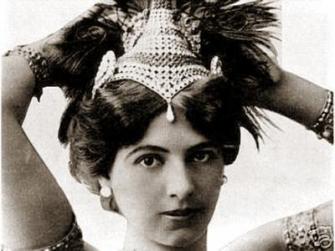
Victim or vamp: Mata Hari’s role in allied propaganda

The Great War, unlike previous conflicts, was the first total war in which whole nations were engaged not just professional armies. This required propaganda to mobilise hatred against the enemy and to convince the population of the justness of the cause. The outbreak of the Great War saw an outpouring of such propaganda from Germany justifying the actions of the Kaiser and his government. The amount and content of this propaganda initially caught the British by surprise. Its perceived level of effectiveness was such that by the beginning of September 1914, the British cabinet had agreed for the need to establish a similar unit to produce British propaganda. This propaganda unit was established under C. F. G. Masterman, the Chancellor of the Duchy of Lancaster. Entirely staffed by upper class, university trained men, except for the secretarial staff, the unit entered into the ‘game’ of propaganda with the late Victorian/Edwardian ideals of femininity firmly entrenched. Even those women, known to have stepped outside the bounds of feminine behaviour, (as designated by upper class society) the suffragettes, had, for the most part, at the outbreak of the war suspended their activities and adopted traditional female supporting roles e.g. in nursing. This then was the mindset and background of those who would subsequently use Mata Hari in their propaganda. Her gender and overt sexuality then combined with this mindset to render her an extremely useful propaganda tool whose trope of the ‘sexy, dangerous female spy’ holds true to this day.

Image 1

Wartime propaganda frequently highlighted crimes against women. Male violence against women was the mark of barbarity. Women were the victims of war and men were urged to fight to protect mothers and sweethearts. Women were seen as good and pure and passive. Most of the early Allied propaganda focused on the German invasion of Belgium with atrocities against Belgian nuns a noticeable feature. Belgium was a neutral country, passive and non-combatant, and as such could be thought of as ‘female’ as opposed to the ‘male’ combatant countries of Great Britain and Germany. Nuns, by their very nature, were truthful and good and non-sexual and so the purist examples of females. A Belgian nun was, therefore, the most innocent victim that could exist. Women’s innate goodness and passivity were seen as a counterpoint to male aggression but one that, paradoxically, was worth fighting for. To defend such a victim was noble. For the enemy, Germany, to attack such a victim put them outside the pale and thus become a legitimate target of hatred and revulsion.

When Mata Hari arrived on the scene as a ‘spy’ in 1916 she had an already established reputation as anything but a good or passive woman. A so-called naked dancer, a well known courtesan with multiple lovers, she was an overtly sexual woman that threatened and challenged the image of the female victim. Mata Hari was the ‘non victim’, the vamp. She was the polar opposite of the Belgian nun. Here was a woman who was the citizen of a neutral country, who had been living safely in the Netherlands, but had deliberately chosen to spy for the enemy. She had rejected the female norm of passivity. This was a woman who had used sex to undertaken her spying. She had rejected the purist form of female sexuality: celibacy. This was a woman who was known to be a liar. The fantasies of being a Javanese princess, or the daughter of a Hindu priestess that had been part of the fun in 1910 had by 1916 been exposed as lies. And lies mattered.
In 1928 Arthur Ponsonby, a Liberal MP and known pacifist, published Falsehood in War Time, a work that exposed the base lies of war propaganda. Ponsonby proclaimed that

‘There must have been more deliberate lying in the world from 1914 to 1918 than in any other period of the world’s history’. Moreover, Ponsonby noted that ‘Atrocity lies were the most popular of all, especially in this country … (where) (s)lander of the enemy is esteemed a patriotic duty’.

In 1916, the British had increased their use of propaganda, concentrating their attention on Russia, Italy and especially France. Work was undertaken officially at Wellington House under the control of Masterman but also by the News Department of the Foreign Office and the Neutral Press Committee and, with less control, sections of the press and community organisations that spontaneously disseminated propaganda material. By 1917, it was felt that the work could be undertaken more productively if it was controlled by one department and so the War Cabinet established a new department to be housed at the Foreign Office, the Department of Information. Strong links were forged, or in most cases, re-forged, between the Department on Information and the ‘press gang’, of Lord Beaverbrook, the editor of the Daily Express, Lord Northclifle, owner and editor of The Times, and Lord Rothermere, owner of The Daily Telegraph. All upper class men who, for the most part, had attended school or university with those in the Department of Information and who shared the same values.

With these newspapermen working alongside the Department of Information, propaganda took on a new face. Newspaper articles appeared extolling the virtues of nurses and mother who knitted socks for the ‘boys at the front’. Letters from sweethearts would be published telling of their pride in their men folks but also in their own lives sitting at home passively waiting, remaining true, staying pure. Women’s role in the ongoing conflict was reinforced as that of the good, honest, pure women; the potential victim for whom the men were fighting. This polarity of good and evil, or black and white served several purposes. The defined female role gave a certainty that comforted in war. A woman who conformed to the role was ‘doing her bit’. It reinforced why the men had gone to war. It ‘proved’ how barbaric the enemy was because they threatened that role.

By 1917, war fatigue had started to set in. The horror of the slaughter, the overwhelming numbers of casualties could no longer be denied. The old story of ‘bad’ Germans was wearing thin and needed a new impetus. And it was at that moment that Mata Hari was arrested by the French. The Allies, notably Britain, were continuing to peddle atrocity propaganda with stories of good, honest, pure women being attacked. The capture of the bad, dishonest, sexually promiscuous Mata Hari was a propaganda godsend. The Allies were presented with an opportunity to reinforce all of the social norms they were fighting for, defend their own military tactics, put pressure of the US to join the war while continuing to attack the enemy as barbaric.

Image 13

The lessons of Mata Hari’s sexuality helped reinforce the ‘passive, good woman’ motif. Good women might be victims of war but would always be defended by decent men. Bad women, such as Mata Hari, were vamps and as such would be caught and punished. Of course in that punishment Mata Hari then became a victim. But the central message held. Women who stepped out of the defined limits of female behaviour were bad and would be punished. This basic propaganda message contained multiple layers. For the men at the front it reassured them that ‘their’ women were good and pure and were waiting for them at home. It also ‘proved’ the necessity of the war; to punish the Germans for attacking good, pure women. For women the message was a warning. Bad behaviour has consequences. Stay good and pure and you will be defended. Act outwith social norms and you will be caught and punished. No overt relationships were made between Mata Hari and the Suffragettes but the links between ‘bad’ behaviour and the inevitability of male justice could not have gone unnoticed, especially by those Suffragettes who had seen the inside of prison. Even though the Suffragettes had suspended direct action at the outbreak of the war, the outrage felt by most upper class men at their activities should not be underestimated. The opportunity to use Mata Hari to deliver a warning, however covert was, therefore, eagerly grasped. But a further layer of meaning could also be discerned. If Mata Hari had helped the enemy, had she helped them violate other women? Did highly sexual women betray ‘good womankind’? If so they had to be shunned. In this way the social norms around feminine behaviour could be self imposed, with female peer pressure exerting a corrective steer on wayward women such as Suffragettes.

Secondly there is Mata Haris’ role in defending military tactics. 1916 had been a gruelling year for all of the Allies. Major battles had been lost or won at immense cost. The public were becoming war weary. Several propaganda tactics were tried but the questions continue to arise. Were the losses because our soldiers were not brave? Or were our generals incompetent? Neither scenario could be countenanced. A two pronged propaganda campaign was initiated. Firstly, failure had to be blamed on spies and saboteurs. Our ‘brave lads’ were not to blame, our general were working all hours. And secondly, propaganda that portrayed German atrocities against women were intensified. Images of the violation of women, real and symbolic, took on a heightened meaning. The propaganda used was highly sexualised with images of women hanged ‘stark naked and mutilated’, and claims that German soldiers regularly cut off the breasts of their victims. By 1917, the propaganda had created a ‘spy mania’ where anyone suspected of being a spy was in danger of mob violence, while anti-German feeling reached fever pitch.
The capture of Mata Hari was, therefore, lauded as a great triumph. This was a woman who had danced naked and had worked to help Germans to mutilate other ‘decent’ women. (In fact Mata Hari seldom performed naked and never exposed her breasts.) On the surface, the capture of Mata Hari the spy was a straightforward victory. However, her sexuality also allowed propaganda to deflect any criticism of the men involved in her case.

Image 25

‘Wicked’ Mata Hari had used her sexual wiles against decent men who were used to decent women and as such had no defence against such an unnatural sexual monster. They could not comprehend her behaviour, because it was so outwith the social norms of feminine behaviour and as a result the men who might have told her secrets were to be allowed some degree of licence.
Her abnormal behaviour further explained the time taken to capture such a woman. Decent men were unused to women such as Mata Hari and how they acted. The time between the Allies first suspicions about her, in December 1915, and her arrest, in 1917, were due to decent men’s ignorance of how such a creature acted and indeed how to trap her.

All of the blame was loaded onto Mata Hari the vamp. She was sexually voracious, the men were helpless. However, while this ‘story’ played well in the press it did not bear too close an examination. What sort of man was unable to detect she was a spy and had, albeit unwittingly, given her information? If Mata Hari was the voracious sexual predator who pursued men, did that render the men as passive victims? It is noticeable that several of the men involved with Mata Hari always stated, after her capture, that they had known from the beginning she was an enemy agent. They had only played along in order to capture her.

Finally there is the use of Mata Hari in the campaign to persuade America to join the war. The American historian, H. C. Peterson studied the effects of British propaganda on American and observed that,

‘The most important reason for the American action in 1917 … was… the attitude of mind in this country — the product of British propaganda. People under the influence of the propaganda came to look upon the struggle of 1914–1918 as a simple conflict between the forces of good and evil… it created a willingness to sacrifice American youth in an attempt to punish the hated nation.’

It is noticeable that after years of the US deliberately staying out of the European conflict, the mindset changed in 1917, the year of Mata Hari’s arrest. The war had seen several ‘crisis’ moments when the US government, sensing the mood of the people, could have entered the war, e.g. the sinking of the Lusitania in 1915. However, it must be remembered that at the outbreak of the Great War the US had large numbers of recent European immigrants. All of whom had emigrated for a better life in America, i.e. they had left a worse life in Europe. There was little genuine feeling to help the ‘mother countries’ of Europe. That changed in 1917, for a variety of reasons, one of which was the continued and increasing portrayal of the sexual violation of women by German soldiers. The arrest of Mata Hari, which very quickly made the international press, was a real sensation. The Allies very quickly realised the value of her fame and used it. The internationally known and sexually alluring woman as a spy, fascinated and repelled in equal measure. The implication that her actions had aided the violation of other women, as the story could be spun, became a step too far for church going Americans and, it could be argued, in combination with other factors, helped swing the nation’s mood towards active participation in the war. The US had already severed diplomatic relations with Germany in the February so the political landscape was ripe for a mood change. On the 6th April 1917, the USA declared war on Germany.

The desire amongst the British establishment to demonise Mata Hari as the ‘greatest spy that ever was’ may have arisen from the understandable need to explain the huge cost in human lives of the Great War. The capture of the sexually promiscuous Mata Hari presented them with the opportunity to reinforce social norms, defend their own tactics and put pressure on the US to join the war. However, while that demonisation may have been an effective propaganda tool at the time it reinforced the sterile labelling of women as either vamp or victim. Interestingly, it also took Mata Hari the vamp and made her into a victim of male upper class expectations with regards to female behaviour.

Vamp or victim she remains the epitome of the ‘sexy, dangerous female spy’ to this day.


Image 3

—oOo—


Posted in Uncategorized | Leave a comment

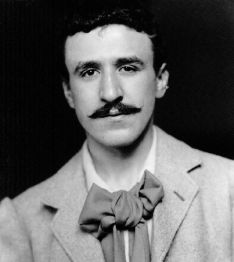
Charles Rennie Mackintosh and the Vienna Connection

Charles Rennie Mackintosh is known world wide as the designer from Glasgow who rejected the Revival and Beau Arts style of architecture and decorative arts and developed his own distinctive style. What is less well now is the influence he had on the arts and crafts movement in Vienna and the inspiration he drew from them.

_81609118_624portrai
Mackintosh started his artistic training in 1883 at the Glasgow School of Art, containing his training as a draughtsman with John Hutchison before finally moving to the firm of Honeyman and Keppie. By the age of thirty-three he had been made a partner in Honeyman and Keppie where he met Hubert James McNair and Frances and Margaret MacDonald. The group became known as the Glasgow Four.
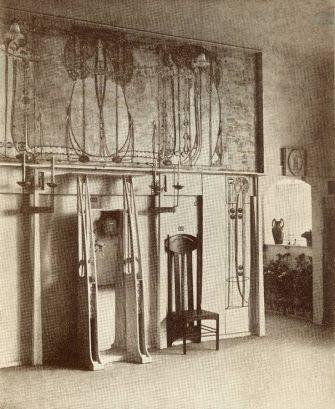
In 1900, the Glasgow Four were invited to create an interior for the Viennese Secession. The exhibit they created was a simple tearoom, with three walls painted white. (The fourth was was missing to allow the public to view the room.) Furniture was placed along the walls and the centre of the room contained a tall geometric standing vase filled with twigs and branches. The furniture in the room was dark, standing out against the white of the walls. The chairs displayed sharp geometric lines and flowing curves. Decoration was kept to a minimum including a mirror and the ‘May Queen’ a panel with green and pink bubbles of colour.

3a9abc14b49fa38e90d196673bbe8764--vienna-secession-gustav-klimt
The room was a sensation with over 20,000 visitors competing to see the work of the Glasgow artists. The Viennese called the work one of the ‘most striking achievements that modern art has created.’ The Glasgow Four were hailed as the new leaders in the arts movement and were mobbed wherever they went in the city. Commissions flooded in with Mackintosh designing rooms for Fritz Waerndorfer, a rich fabric merchant and art connoisseur. Josef Hoffmann, an Austrian contemporary of Mackintosh’s, designed a silver tea-set for Waerndorfer entirely in the Glasgow style. Hoffmann went on to establish the Wiener Werkstätte, a guild for craftsmen and artisans, and turned to Makintosh for advice. Mackintosh wrote to Hoffmann, ‘If I were in Vienna I would assist you with a great, big strong shovel.’

Josef-Hoffmann
Mackintosh made several more visits of Vienna and Hoffmann visited Glasgow on at least three occasions. The two men shared ideas and inspiration and, influence flowed in both directions. By the time Mackintosh was designing Hill house in 1902 he was incorporating artistic elements and designs originating from the Wiener Werkstätte. The curves of Mackintosh’s early work were replaced with straight lines a linear precision more common in Vienna. The house is the first instance of Mackintosh’s use of incised circles, a feature developed earlier by artists from the Wiener Werkstätte. This minimalist feature in Mackintosh’s work grew until 1914 when the Great War broke out and correspondence between Britain and Austria became impossible.

feature_3000010
In the spring of 1914 Mackintosh had moved to Walberswick on the Suffolk coast where it has been suggested that he intended to move to Vienna to continue working with the artists of the Wiener Werkstätte. In 1915, while living in Walberswick he was suspected of being a German spy, a victim of the ‘spy mania’ that swept Britain, and was arrested. His house was searched and several letters from Hoffmann and several other Austrian artists were confiscated. As their content was shown to be purely artistic in nature no further action was taken and Mackintosh lived out the rest of the war quietly. After the war few people could afford Mackintosh’s designs and his design work reduced while his main focus moved to watercolours. Hoffmann and Mackintosh never met again.

—oOo—
Posted in Uncategorized | Leave a comment

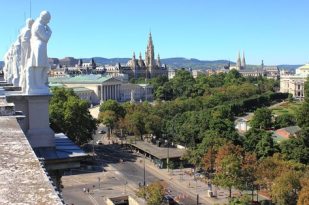
Vienna, city of dreams

The beginnings of Vienna start with the dream-like name of Vindobona. Arising from the celtic tribes that settled the area BCE, Vindobona would move through several incarnations before becoming the city it is today. After its Celtic beginnings, Vindobona was settled by the Romans in the 1st century. By the 2nd century, what started as a military camp beside the Danube soon developed into a full Roman settlement and was awarded the status of a municipium in 212. Traders came and went along the Danube and the municipium grew in size.

By the end of the 4th century the Roman Empire in the west was coming under increasing stress. At the same time the Völkerwanderung (the migration of peoples, especially of Germanic and Slavic peoples into S and W Europe) had begun and the nature of Vindobona changed again. Celts, Romans, Germans and Slavs all became part of the dream. People came and went and Vindobona grew again until a calamitous fire in the 5th century almost destroyed the dream completely. But Vindobona rose phoenix like and was soon trading across the Danube basin and the Pannonian plain. The Celts, Romans, German and Slaves were joined by Lombards and Avars as well as traders from the great Byzantium. For the next three hundred years Vindobona grew and prospered until 881, when the Salzburg Annals record a great battle between the Germans and the Magyars at the settlement of Weniam. Vindobona had changed and Wenium had arrived. The Germans and Magyars continued to fight each other sporadically over the next few centuries with the Germans finally proving triumphant and around the year 1,000 Wenium reappeared as Wein or Vienna.

Vienna, the city of dreams sat between east and west, it sat on a great trade route and it was militarist strategic. The dream became that of control of the city. Duke Henry II of the Babenberg dynasty elevated Vienna to his capital in 1155. This was followed a year later with Austria becoming a duchy in the Privilegium Minus and Vienna as the seat of the duke. The Babenberg’s dream of greatest was enhanced and entwined with that of the city.

Just before Christmas 1192, in Erdbery near Vienna, the legendary King Richard the Lionheart was captured by Duke Leopold V the Virtuous. Richard was ransomed for 50,000 Silver Marks. This fabulous sum paid for the the construction of city walls and the establishment of a mint. Vienna was a place where dreams of great wealth could be realised. By 1221, Vienna had received the rights of a city and as a staple port (Stapelrecht). This required traders passing through Vienna to offer a percentage of their goods for sale in the city. Goods from across the known world were now bought and sold in Vienna. Chinese silks, Indian spices, Cornish tinware, amber jewellery and much more. The trade flourished to such an extent that Vienna could easily rival Venice and even the great Constantinople in terms of its merchant trade.


Vienna 4

In 1278, Rudolf I took control over the Austrian lands after his victory over Ottokar II of Bohemia. And Vienna started on a new dream, a Habsburg dream that would last for over 600 years. With trade established, the Habsburgs turned to other civiv improvements. Duke Albert II had the gothic choir of the Stephansdom built. Frederick the Handsome published his edict allowing the city to maintain an Eisenbuch (iron book) listing its privileges. Rudolf IV founded the University and began the construction of the gothic nave in the Stephansdom. In 1438, Duke Albert V was elected King Albert II and Vienna became the capital of the Holy Roman Empire. By 1469, Vienna had its own bishop, and the Stephansdom became a cathedral and in 1556, it became the seat of the Emperor.

Vienna 3

In 1529, however the dream started to become a nightmare. Vienna was besieged by the Ottoman Turks. The city, protected by its walls, survived. In 1683, the Turks returned n but were defeated by the army. The dream returned and the next centuries were characterised by building activities. Vienna became a dream baroque city; lavish gardens and sumptuous palaces arose.
By the 19th century however, the dream was under threat again. Napoleon took the city twice, in 1805 and 1809. By 1810 the skies had cleared again. After Napoleon’s final defeat, the Congress of Vienna took place between September 1814 to June 1815, in which the political map of Europe was redrawn. Vienna was the capital of a new Austria, one that embarked on a period of intensive industrialisation. But with industrialisation came unrest and the European Revolutions of 1848 infected Vienna. A saviour arose in the person of Emperor Franz Josef I and the city of dreams flourished once more.
Arts, architecture, culture; the city of dreams was in full bloom, it was the Golden Era. The elegant Ringstraße boulevard was built. The city dreamed and the world joined in. In 1873 Vienna held the World Exhibition and the world came and saw and stood in awe. By 1900, the city dreamed about the arts and that dream became a reality with the Jugendstil (Art Nouveau), the Vienna Secession. At the same time Sigmund Freud the scientific dreamer of dreams was walking the Ringstraße. The city expanded again under the mayor, Karl Lueger who introduced the social policy known as the Wiener Hochquellwasserleitung, bringing fresh water from the mountains to Vienna and the creation of a belt of meadows and forests around the city. However, the dark shadows of anti-Semitism, were gathering, threatening the dream. The Great War of 1914–1918 saw Vienna threatened by food shortages. The Viennese survived by dreaming of times past while brewing coffee with acorns. The end of the war was also the end of Austria-Hungary and in November, 1918, the Republic of Deutsch-Österreich, was proclaimed in front of the parliament. After 1918 the city was plunged into revolution and by 1921, Vienna had separated from the surrounding Lower Austria and become a state in its own right. The political turmoil continued over the 1920s as both right and left dreamed of power. By 1934, the city of dreams had descended into civil war.

Vienna 5
Four years later, in 1938, the nightmare that had been brewing since Leuger had been in power came to a head when Nazi Germany annexed Austria in the Anschluss. During the Reichskristallnacht on November 9, 1938, the synagogues, shops and homes of Vienna’s Jews were destroyed. However, despite many instances of anti-Semitism, Vienna was less supportive of the Nazis than the rest of Austria. The city was bombed throughout the war and was then invaded by Soviet troops in 1945. The city of dreams became the city of destruction. After the end of the war the dream was shattered into five occupation zones between the Soviet Union, the United States, the UK, France, and with the first district being patrolled by all four. But although damaged the dream did not die and slowly it rose again.


Climbing vines and flower pattern surrounding windows on art nouveau Majolica Building, Otto Wagner, 1898-99, Vienna, Austria
In 1955, the four-power control of Vienna ended and the Austrian State Treaty was signed. The treaty included a law of neutrality that ensured modern Austria would not align itself with NATO or the Soviet bloc. Vienna turned its back on world politics yet its position between east and west Europe made it the perfect setting for espionage during the Cold War. Vienna had created yet another dream: the film the Third Man could not have been set anywhere else.
And in the 21st century? Well, history, art, architecture, music, psychoanalysis, espionage: whatever your dream, you will find it it Vienna.


—oOo—
Posted in Uncategorized | Leave a comment

The Beilis Affair

Menahem Mendel Beilis was born into a hassidic family in Kiev in 1874. He married his wife Esther relatively young and they had five children. He served in the army and by 1911 was working as a superintendent at the Zaitsev brick factory in Kiev.

On March 12, 1911 (old Russian calendar), in Kiev, a thirteen year old boy, Andrei Yushchinsky went missing while walking to school. The local police and community hunted for the boy and his body was discovered eight days later in a cave near the brick factory. He had been murdered and the body mutilated. A local lamplighter stated that he had seen Andrei being taken away by a Jew. The local police interviewed the lamplighter and suspicion fell on Beilis. This was reported to the local judiciary who reported to the Tsar that Beilis was the murderer and he was arrested. When questioned he denied any involvement in the murder.


beylis2

For the next year Beilis sat in prison waiting trial. Many antisemitic stories circulated in the press regarding ritual murders. These were countered by arguments from several prominent writers such as Maxim Gorky, Vladimir Korolenko and Alexander Blok. After he had been in prison for a year, a delegation led by a military officer officer informed Beilis that he would soon be freed due to a manifesto pardoning all katorzhniks (convicts at hard labor) on the tercentenary jubilee of the reign of the Romanov dynasty. Beilis refused this possible pardon as he was innocent and asked for his day in court.

While Beilis was in prison the murder was investigated by Nikolay Krasovsky, of the Kiev Police Department. Krasovsky came under increasing pressure from senior officers to complete his investigation showing Beilis’ guilt and present his report to the courts. Eventually this pressure became so intense that Krasovsky was fired. Convinced of Beilis’ innocence, Krasovsky continued his investigation privately, assisted by some of his former police colleagues. Krasovsky determined that the real murderers were a group of professional criminals: Rudzinsky, Singayevsky, Latyshev, and Vera Cheberyak. Just after this, Krasovsky was arrested on charges of official misconduct. He was later acquitted of all charges.

Beilis remained in prison for a further year before he was finally brought to trial in September 25 1913. Professor Sikorsky of Kiev State University, a medical psychologist, was brought forward by the prosecution team to testify that it was a case of ritual murder. He stipulated that the body had thirteen wounds on it. Justinas Pranaitis, a virulently antisemitic Catholic priest, stated that the number thirteen was important in “Jewish rituals”. The defence showed that there were actually fourteen wounds.

Beilis’ defence team comprised Vasily Maklakov, Oscar Gruzenberg, N. Karabchevsky, A. Zarudny, and D. Grigorovitch-Barsky. The defence introduced testimony from two prominent Russian professors, Troitsky and Kokovtzov, who exposed the lie of the Jewish ritual element of the murder. Aleksandr Glagolev, philosopher and professor of the Kiev Theological Seminary of the Orthodox Christian, and, Rabbi Mazeh, the rabbi of Moscow quoted passages from the Torah, the Talmud and many other books to conclusively destroy the blood ritual murder theory of the prosecution.

The defence team introduced Beilis’ alibi, that he had been at work on the day of the boy’s disappearance. Several of Beilis co-workers confirmed his presence at the brick factory. The prosecution argued that Beilis could have left the factory abducted the buy and then returned to his work.

Finally, the defence team cross examined the lamplighter, who’s initial testimony had started the investigation into Beilis. He admitted that he had been put under pressure by the secret police.

As the evidence mounted showing Beilis’ innocence, the chief prosecutor A.I. Vipper made a last ditch attempt to sway the jury. In his closing address he reiterated the blood libel and supposedly guilt of all Jews. He relied on the presumed prejudices of the jurors. These antisemitic statements were not challenged by the judge. After several hours, the entirely Christian jury returned a unanimous verdict of not guilty.

The Beilis trial was followed worldwide and the antisemitic policies of the Russian Empire were exposed and severely criticised. After his acquittal, Beilis gained a great degree of publicity. However, he preferred to remain living a quiet life with his family. He decided to move to Palestine and he and his family moved to a farm purchased for them by Baron Rothschild who had read about the trial and made the offer to help the family.

bsYk7714815

Although happy in Palestine, Beilis had difficulty making ends meet in on the farm and in 1921 the family moved to New York, in the United States. In 1925 Beilis wrote an account of his experiences titled The Story of My Sufferings.

Beilis died on July 7, 1934 and was buried two days later at the Mount Carmel Cemetery, Glendale, Queens. His funeral was attended by over 4,000 people.


—oOo—

Posted in Uncategorized | Leave a comment

A Tangled Web

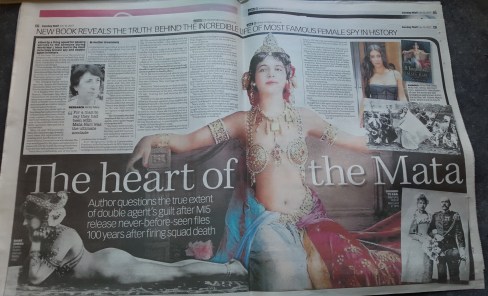
Well I’ve not posted here for a couple of months because my biography of Mata Hari, ‘A Tangled Web’ has just been published.  I have been busy with a few final details working with the great team at The History Press and preparing for my ‘meet the author’ launch event at the Imperial War Museum London on Saturday the 29th July between 11am and 1pm and between 2pm and 4pm.

http://www.iwm.org.uk/events/iwm-london/meet-the-author-mary-craig

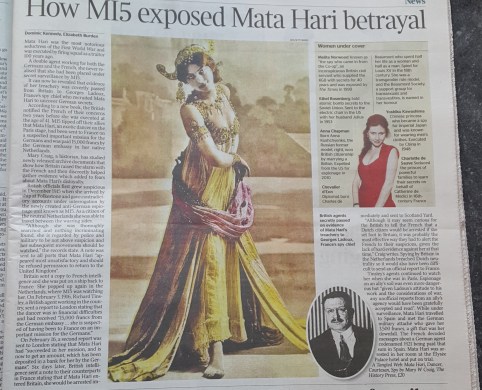
Mata Hari has been a fascinating character to research and write about. A dancer, a courtesan and a spy, she was beguiling and oozed sex appeal. But she was also spoilt and maddening and  working through archives from Paris and London was no easy task.  She was an untrained dancer who won the ‘war of the tights’ beating others such as Isadora Duncan.  She had lovers galore and was counted among the best of La Grande Horizontale. Then of course she met and fell in love with a young Russian officer and declared she would give up all her other lovers just for him.  But for all the fun and the lovers the Great War had broken out and her world was never the same. Embroiled in espionage, she became entaged in a web of lies and fantasies from which there was no escape and for which she paid the ultimate price.

Mata Hari Cover

Sunday Mail, 16/07/17

20170716_090123

The Times, 17/07/17

20170717_093305

—oOo—

Posted in Uncategorized | Leave a comment

My historical dozen

Musing over who I would like to sit down and talk to from history and so …

Catherine the Great: ruled as Queen of Russia from 1762 until her death. Under her leadership, Russia was revitalised as a major European power and Russian society was reformed.

Profile_portrait_of_Catherine_II_by_Fedor_Rokotov_(1763,_Tretyakov_gallery)


John Locke: argued that a government’s right to rule must be based on the consent of its people, promoted the idea of a ‘social contract’ – power sanctioned by the people, emphasised that all men were equal.

locke3


Eleanor of Aquitaine: founded the cult of courtly love, the highest expression of chivalry, her court produced a stream of troubadours, minnesingers and poets who idealised romantic love.

00eleanorA6


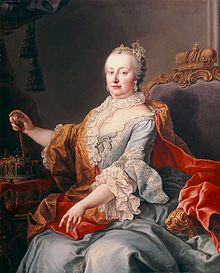
Maria Theresa Walburga Amalia Christina: the only female ruler of the Habsburg dominions and the last of the House of Habsburg, after her death, she left a revitalised empire that influenced the rest of Europe throughout the 19th century.

220px-Kaiserin_Maria_Theresia_(HRR)


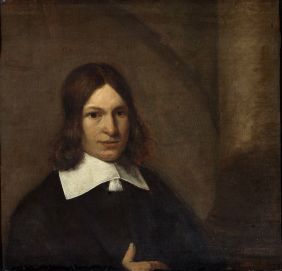
Pieter de Hooch: a Dutch Golden Age painter famous for his works of quiet domestic scenes, daily life and brick built courtyards.
Angebliche_zelfportret_van_de_schilder_Pieter_de_Hooch,_Rijksmuseum_SK-A-181


Erik Satie: French composer that was a precursor of and influential on artistic movements such as minimalism, Surrealism, repetitive music, created small melancholic piano pieces.

Ericsatie


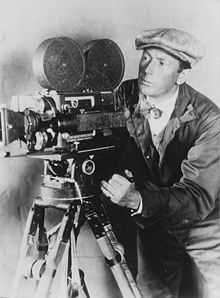
Friedrich Wilhelm ‘F. W.’ Murnau: influenced by Schopenhauer, Nietzsche, Shakespeare and Ibsen, he became one of the most an influential lExpressionist film directors.

220px-F_W_Murnau_01


Hildegard of Bingen: German Benedictine abbess, writer, composer, philosopher, Christian mystic, visionary, and polymath, founded scientific natural history in Germany.

st__hildegard_von_bingen_icon_by_theophilia-d83xlwg


Dragutin Dimitrijević known as Apis:  Serbian colonel, leading member of a military group that organised the overthrow of the Serbian government in 1903, leader of the Black Hand group responsible for the assassination of Franz Ferdinand, Archduke of Austria in June 1914.

s200_dragutin.dimitrijevi_apis


Rudolf II, Holy Roman Emperor and King of Bohemia: an intellectual devotee of occult arts and learning which helped seed what would be called the scientific revolution.

a9aeca1c7d10ea8046b92734c7779de29dec3f35


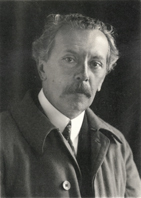
Count Miklós Bánffy de Losoncz: Hungarian nobleman, liberal politician and historical novelist, an  elected Member of Parliament, a Director of the Hungarian State Theatres, a traditionalist and a member of the avant-garde, he overcoming fierce opposition to mount plays from figures such as Béla Bartók.

banffy


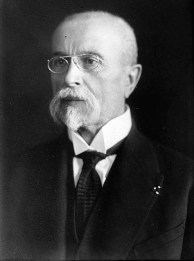
Tomáš Garrigue Masaryk: politician, sociologist and philosopher, founder and first President of Czechoslovakia.

Tomáš_Garrigue_Masaryk,_Bain_News_Service_(Library_of_Congress,_Bain_Collection)_crop


—oOo—

Posted in Uncategorized | Leave a comment

The Battles of Custoza and Novara and the Radetzky March

The First Battle of Custoza was fought on July 24 and 25, 1848 during the First Italian War of Independence between the armies of the Austrian Empire, commanded by Field Marshal Radetzky, and the Kingdom of Sardinia, led by King Charles Albert of Sardinia-Piedmont.

1848 was the year of revolutions as several cities and regions in Europe rose up in rebellion against their autocratic rulers. Revolts arose in many of the states of the Italian peninsula and Sicily, led by intellectuals and agitators who desired a liberal government. At that time, the Kingdom of Lombardy-Venetia was controlled by the Austrian crown. Charles Albert, King of Sardinia and Duke of Savoy, decided to exploit the uprisings and invade Austria. Charles Albert had previously agreed to constitutional reforms which had limited his power; as compensation for that he sought to expand his territories by attacking Austria.

In March 1848, the city of Milan had launched an uprising against the Austrian occupation of the city. At the same time, Venice proclaimed its independence from Austria and Charles Albert declared war on Austria. Field Marshal Johann Josef Wenzel Anton Franz Karl, Graf Radetzky von Radetz, who was by this time 82 years old, recognised the seriousness of the situation and withdrew his forces from Milan to the defensive positions based on the four fortresses known as the Quadrilateral: Verona, Mantua, Peschiera, and Legnago. Radetzky was an excellent tactician but had few forces at his disposal and realised that until reinforcement arrived, to stay in the city would have led to a short siege and probable surrender. By withdrawing to the Quadrilateral, Radetzky was able to fight his opponents one by one.


Sommacampagna_1848

His opponents were faced with an elderly commander with few troops but were widely dispersed from the Rivoli plateau to Governolo.  Radetzky attacked the Piedmontese II Corps, and forced it to retire, first before Peschiera and then, after another successful attack, behind the river Mincio. These two attacks on successive days resulted in the Piedmontese Army being divided in two. The Piedmontese High Command reacted slowly to events on the battlefield but finally decided to attack the Austrian army in the rear. This attack was initially successful and the single brigade that was covering the Austrian rear was forced to retreat. However, Radetzki then stopped the advance of his forward troops and, turning his forces around, marched on the Piedmontese.

The following day, the Piedmontese were ordered to attack the enemy, however General De Sonnaz refused to obey the order, claiming that his troops were too tired. This lack of conviction amongst the Piedmontese commanders led to lacklustre fighting on the part of the troops. Realising that the enemy’s morale was low the Austrians attacked and forced the line back.

Despite high losses by the Austrians, King Charles Albert and his generals were demoralised. An armistice was signed and the Piedmontese Army retreated within the borders of the Kingdom of Sardinia.

The truce held until 12 March 1849, when  Charles Albert,  denounced it. The Austrians reacted immediately and the army, under the command of Radetzky, seized the fortress town of Mortara in Lombardy.

On the 22 March the Austrian and Piedmontese troops met at Novara, west of Milan. The Austrian troops outnumbered the Piedmontese and showed greater discipline. The Piedmontese had little support from the smaller Italian states and one of their generals,  Girolamo Ramorino, was accused of disobeying orders before the battle, badly damaging morale. The Austrian forces, led again by Radetzky, drove the Piedmontese back to the foot of the Alps. The Austrian forces occupied Novara, Vercelli and Trino, and were poised to take the Piedmontese capital of Turin. Charles Albert abdicated in favour of his son, Victor Emmanuel, and exiled himself to Oporto, Portugal, and died shortly thereafter. A peace treaty was signed on 9 August. Piedmont was forced to pay an indemnity of 65 million francs to Austria. Field Marshal Johann Josef Wenzel Anton Franz Karl, Graf Radetzky von Radetz, returned to Austria a hero.


Radetzky-von-radetz

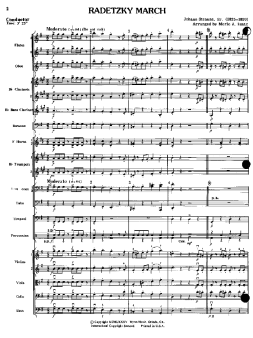
The Radetzky March, Op. 228, was  composed by Johann Strauss Sr. and dedicated to Field Marshal Johann Josef Wenzel Anton Franz Karl, Graf Radetzky von Radetz. Strauss had already used the theme in the Radetzky March in his Jubel-Quadrille, Op. 130. For the trio section of the March, Strauss incorporated an older folk melody called Alter Tanz aus Wien or Tinerl-Lied, which was popular with soldiers.


2158871

The Radetzky March was first performed 31 August 1848 in Vienna, after the victory at the battle of Custoza and soon became popular among regimented marching soldiers. When it was first played in front of Austrian officers, they spontaneously clapped and stamped their feet. This audience participation quickly developed into a tradition amongst Austrian soldiers and then spread to members of the general public.


—oOo—

Posted in Uncategorized | Leave a comment

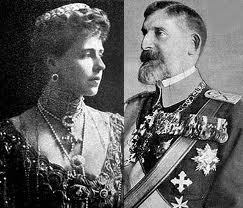
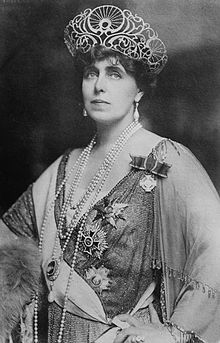
Marie of Edinburgh, Queen of Romania

Princess Marie Alexandra Victoria of Edinburgh was born in Kent on the 29 October 1875. At her birth, few would have predicted that a British royal princess and granddaughter of Queen Victoria would work tirelessly as a nurse during the Great War. Still fewer that she would end her days despised by a communist regime.

Marie, or Missy as she was known, was born the daughter of Prince Alfred, Duke of Edinburgh and Grand Duchess Maria Alexandrovna of Russia. Missy grew up in a happy household with her brother, Prince Alfred, and her sisters, Princesses Victoria Melita, Alexandra  and Beatrice. The family spent much of their early life at Eastwell Park,  as their mother preferred this to Clarence House, their official residence. Marie’s father, the Duke of Edinburgh was a member of the British Royal Navy and was frequently away from the family home on duty.

In 1886, when Marie was eleven years old, the Duke of Edinburgh was named commander-in-chief of the Mediterranean Fleet and the family took up residence at San Antonio Palace in Malta. Marie enjoyed the time in Malta, however, this was not to last. The Prince of Wales’s renounced his rights to the duchy of Saxe-Coburg and Gotha. The Duke of Edinburgh became heir presumptive to Ernest II, Duke of Saxe-Coburg and Gotha and  the family relocated to Coburg in 1889.

By 1892, Marie was being courted by several royal princes. At the end of the year King Carol of Romania visited London in order to meet the Duke of Edinburgh and Queen Victoria, to ask approval of a marriage between Marie and his son Prince Ferdinand. On 10 January 1893, Marie and Ferdinand were married at Sigmaringen Castle in Germany.
After the ceremony Marie and Ferdinand spent a few days travelling from Germany to Romania where  Marie was warmly welcomed by the Romanian people.

images

Marie gave birth to her first child, Prince Carol, on 15 October 1893. He was followed by Princess Elisabeth in 1894, Princess Maria in 1900, Prince Nicholas in 1903, Princess Ileana in 1909 and finally Prince Mircea in 1913.

Around 1897, Marie met Lieutenant Gheorghe Cantacuzène, a member, albeit through an illegitimate branch, of an ancient Romanian princely family and a descendant of Prince Șerban Cantacuzino. The two soon became romantically involved, but stopped the affair when it became publicly known. There was some speculation that Marie’s second daughter, Maria, was Cantacuzène’s daughter, and not Ferdinand’s. Over the following years, Marie was also rumoured to have been romantically linked to Grand Duke Boris Vladimirovich of Russia, Waldorf Astor, Prince Barbu Știrbey and Joe Boyle.

On 29 June 1913, the Tsardom of Bulgaria declared war on Greece, thus starting the Second Balkan War. Romania entered the war, allying itself with Greece. The war, which lasted a little over a month, was worsened by a cholera epidemic. Realising the seriousness of the situation, Marie travelled between Romania and Bulgaria, working in several hospitals tending to the sick. Soon after the war ended, King Carol became ill.

On 28 June 1914, Archduke Franz Ferdinand, was assassinated, on 28 July, Austria-Hungary declared war on Serbia and on 3 August, King Carol held a Crown Council at Sinaia, in order to decide whether Romania should enter the war. Although Carol was in favour of supporting Germany and the Central Powers, the council decided against it. Not long after the council, Carol’s illness worsened. He died on 10 October 1914 and Ferdinand succeeded as king.

At the time of Ferdinand’s ascension to the throne, the government was led by the liberal prime minister Ion I. C. Brătianu. With Brătianu’s help, Marie began pressuring Ferdinand into entering the war on the side of the Triple Entente.

On 2 November 1916, Marie’s youngest son, Prince Mircea, died of typhoid fever. In December 1916, Bucharest fell to Austrian troops, and the royal court moved to was Iași,  in Moldavia. Marie continued to work as a nurse in the military hospitals.

At the end of the war, Romania, as one of the winning countries, attended the Paris Peace Conference. The official delegation was led by Brătianu, whose attitude, combined with Georges Clemenceau’s reluctance to overlook Ferdinand’s attitude at the end of the Second Balkan War led to open conflict and the Romanian delegation left Paris. In order to resolve the situation, it was decided that Marie should attend the conference, instead of Brătianu.

Marie arrived in Paris on 6 March 1919. She was popular with the French people, due to her boldness during the War. Marie shocked many officials by leading negotiations herself. She left Paris with numerous supplies for Romania’s relief and later that year, the conference resulted in the international recognition of Greater Romania, thus doubling Ferdinand and Marie’s kingdom to 295,000 square kilometres and increasing the population by ten million.

In 1924, Ferdinand and Marie undertook a diplomatic tour of France, Switzerland, Belgium and the United Kingdom. In England, she was warmly welcomed by George V. These state visits were a symbolic recognition of the prestige Romania had gained after World War I. Whilst visiting Geneva, Marie and Ferdinand became the first royals to enter the newly established headquarters of the League of Nations.

Prince Carol’s relationship with Marie was strained when he left Romania to live abroad with his mistress. In January 1926, he sparked a dynastic crisis when he officially renounced his rights to succeed Ferdinand, simultaneously waiving all parental rights over Prince Michael, (Marie’s grandson) who had been proclaimed heir. A Provisional Regency Bill was passed, which created a regency council to support Prince Michael, if necessary. Marie and Ferdinand were concerned that a regency might create political disturbances which in turn might lead to civil unrest. This concern was, in part, due to Ferdinand’s ill health. Ferdinand was suffering from intestinal cancer, and died on 20 July.

Michael automatically succeeded as king upon Ferdinand’s death and the regency council took charge of his role as monarch. In May 1928, Carol, who had been living in England with his mistress, attempted to return to Romania. He was prevented from doing so by English authorities, who then expelled him from England.

Marie’s popularity was dented during Michael’s reign, after refusing to be part of the regency council, and in 1929 she was accused by the press of plotting a coup. On 6 June 1930, Carol arrived in Bucharest and made his way into Parliament, where the Act of Succession 1927 was duly declared null and he was acclaimed as King Carol II. The relationship between Carol and Marie remained strained however, as Carol sidelined Marie’s counsel during his reign.

During the summer of 1937, Marie fell ill. Her personal physician, Dr. Castellani, determined she had pancreatic cancer, although her official diagnosis was cirrhosis of the liver. In February 1938, she was sent to a sanatorium in Italy. Growing weaker, she requested that she be taken back to Romania, in order to die there..

Marie died on 18 July 1938. She was interred at the Curtea de Argeș Monastery, and her heart was placed in a small golden casket and interred in her Stella Maris chapel in Balchik. In 1940, after Southern Dobrudja was ceded to Bulgaria during World War II, her heart was transferred to Bran Castle.

During the forty-two year of communist rule in Romania, Marie was frequently portrayed as an ‘agent of English capitalism’ and as extremely as promiscuous.

queen_mary_of_romania_2

In Romania, Marie is known by the nickname ‘Mama Răniților’ (Mother of the Wounded), or simply as ‘Regina Maria’. Marie is also nicknamed ‘the mother-in-law of the Balkans’, due to her children’s marriages among ruling houses in the Balkans.

——-oOo——-

Posted in Uncategorized | Leave a comment

Karl I – the last king of Bohemia

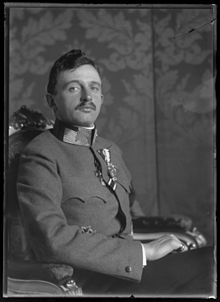
Karl Franz Joseph Ludwig Hubert Georg Otto Marie was born on 17 August 1887. The last ruler of the Dual Monarchy of Austria and Hungary, the last Emperor of Austria, the last King of Hungary (as Charles IV), the last monarch belonging to the House of Habsburg-Lorraine and the last king of Bohemia.

carlosideaustriahungriab5103637t5103641

Karl was born in the Castle of Persenbeug in Lower Austria. His father was Archduke Otto Franz of Austria and his mother, Princess Maria Josepha of Saxony. His granduncle was Franz Joseph, Emperor of Austria and King of Hungary, and his uncle Franz Ferdinand became the heir presumptive of the House of Habsburg Lorraine in 1889.

Karl spent his early years travelling, as the family followed his father’s regimental postings. As a young man he joined the army, spending the years from 1906 to 1908 as an officer chiefly in Prague, where he studied law and political science concurrently with his military duties.

Otto Franz died on 1 November 1906 and in 1907, Karl was declared of age. Despite being a member of the imperial family. Karl’s relations with his granduncle Franz Joseph and uncle Franz Ferdinand were not cordial. As a young man he was divorced from the politics of the Dual monarchy.

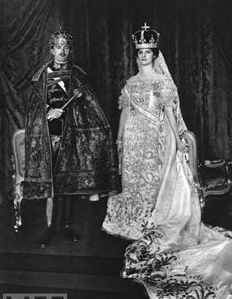
In 1911, Karl married Princess Zita of Bourbon-Parma. Due to the morganatic nature of Franz Ferdinand’s marriage, his children were excluded from the succession. Princess Zita, however, was of royal lineage and as a result, the Emperor promoted the marriage to ensure the continuation of the house of Habsburg Lorraine.

48294c2618f8affe7b8e28e0c42f0e36

After the assassination of Archduke Franz Ferdinand in Sarajevo in 1914, Karl became the heir presumptive. Emperor Franz Joseph, then initiated the heir-presumptive in affairs of state, urgently required by the outbreak of the Great War. Karl became a Generalfeldmarschall in the Austro-Hungarian Army. In the spring of 1916, in connection with the offensive against Italy, he was entrusted with the command of the XX. Corps and also served on the eastern front as commander of an army operating against the Russians and Romanians.

In November 1916, Emperor Franz Joseph died and Karl succeeded to the various thrones of the Habsburgs. On the 2 December 1916, Karl assumed the title of Supreme Commander of the whole army. His coronation as King of Hungary occurred on 30 December.

Having been a serving army officer Karl had been sickened by the bloodshed he had seen. In 1917, he secretly entered into peace negotiations with France. He employed his brother-in-law, Prince Sixtus of Bourbon-Parma, an officer in the Belgian Army, as intermediary. news of Karl’s negotiations soon leaked out. Karl initially denied the reports but the French Prime Minister Georges Clemenceau published letters signed by him. This undermined Austria-Hungary’s authority forcing them into an even more dependent position with respect to Germany.

In the final years of the great War the Dual Monarchy of Austria and Hungary was riven with tension between its various ethnic groups. As one of the conditions of his Fourteen Points, U.S. President Woodrow Wilson demanded that the Empire allow for the autonomy and self-determination of its peoples. Karl reconvened the Imperial Parliament and proposed the creation of a confederation with each national group exercising self-governance. However, most of the ethnic groups demanded full autonomy as separate nations, completely independent from Vienna.

Foreign minister Baron Istvan Burián requested an armistice in October based on the Fourteen Points, and two days later Karl issued a proclamation, radically changing the nature of the Austrian state. The Poles were granted full independence. The rest of the Austrian lands were transformed into a federal union composed of four parts: German, Czech, South Slav, and Ukrainian. Each of the four parts was to be governed by a federal council, with Trieste acquiring special status. However, the U.S. Secretary of State, Robert Lansing, then stated that the Allies were now committed to the causes of the Czechs, Slovaks and South Slavs. Autonomy for the nationalities was no longer enough and full independence had to be granted. A provisional Czechoslovakian government had joined the Allies 14 October, and the South Slav national council had declared an independent South Slav state 29 October 1918.

Previously, Karl had been in favour of a third Croatian political entity, and in his Croatian Coronation oath in 1916 he had recognised the union of the Triune Kingdom of Croatia, Dalmatia and Slavonia with Rijeka. However, this support had been vetoed by the Hungarians, for domestic political reasons, as they were against increasing power to any of the Dual Monarchy’s Slavic peoples. On 14 October 1918,  Karl proposed his manifesto for the new Croatian state which was rejected by the declaration of the National Council in Zagreb. On the 21 October after a personal visit from President of the Croatian pro-monarchy political party Pure Party of Rights, Dr. Aleksandar Horvat, Karl agreed and signed the trialist manifest. The delegation then travelled to Budapest where it presented the manifest to the Hungarian parliament who signed the manifest and releasing Karl from his oath, created a third Croatian political entity. On 29 October 1918, the Croatian Sabor (parliament) ended the union and all ties with Hungary and Austria, proclaimed the unification of all Croatian lands and entered the State of Slovenes, Croats and Serbs.

Under pressure from domestic and international politics, on 11 November 1918, Karl issued the proclamation in which he recognised the Austrian people’s right to determine the form of the state and ‘relinquish(ed) every participation in the administration of the State.’. On the 13 November, following a visit of Hungarian magnates, Karl issued a similar proclamation for Hungary. Karl did not formally abdicate, hoping that the common people of either Austria or Hungary would recall him.

On the 12 November, the independent Republic of German-Austria was proclaimed, followed by the proclamation of the Hungarian Democratic Republic on 16 November. On 24 March 1919, Karl left for Switzerland. His final proclamation stated ‘whatever the national assembly of German Austria has resolved with respect to these matters since 11 November is null and void for me and my House.’ In reply to what they considered Karl’s continuing assertion of his right to rule, the Austrian Government passed the Habsburg Law on 3 April 1919, which permanently barred Charles and Zita from returning to Austria; barred all other Habsburgs from Austrian territory unless they renounced all intentions of reclaiming the throne and accepted the status of ordinary citizens and abolished all nobility in Austria.

5befa887a4c582cf0e11698b6812552c

Early in 1921, encouraged by Hungarian royalists, known as ‘legitimists’ Karl sought to reclaim the throne of Hungary. The attempt failed, largely because Hungary’s regent, Miklós Horthy, refused to support him. Due partly to the threats from neighbouring countries to invade Hungary if Karl regained the throne. In the Autumn of 1921, Karl made a second abortive attempt at the throne. Karl and Zita were quarantined at Tihany Abbey and on 1 November 1921 were taken to the Hungarian Danube harbour city of Baja, where they set sail for the Black Sea and finally exile in Madeira. In late 1921, the Hungarian parliament formally nullified the Pragmatic Sanction, an act that effectively dethroned the Habsburgs.

On 9 March 1922 Karl developed severe pneumonia. Having previously suffered two heart attacks, he died of respiratory failure on April 1 aged only 34.

220px-tomb_of_blessed_carl


——-oOo——-

Posted in Uncategorized | Leave a comment